

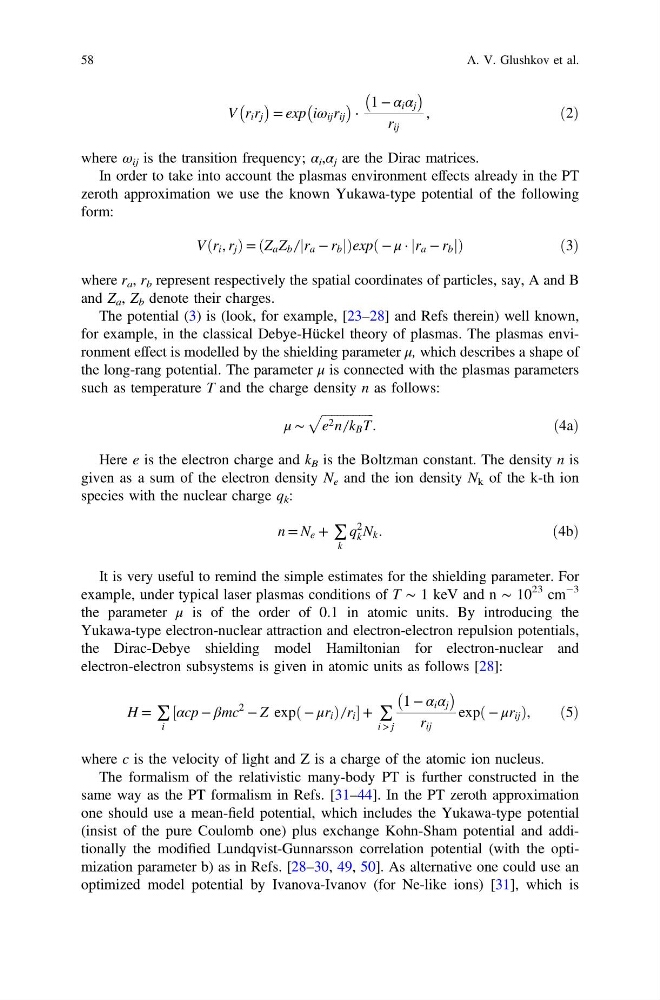
V r i r j
À Á
= exp iω ij r ij
À
Á ⋅
1 − α i α j
À
Á
r ij
,
ð2Þ
where ω ij is the transition frequency; α i ,α j are the Dirac matrices.
In order to take into account the plasmas environment effects already in the PT
zeroth approximation we use the known Yukawa-type potential of the following
form:
Vðr i , r j Þ = ðZ a Z b ̸ jr a − r b jÞexpð − μ ⋅ jr a − r b jÞ
ð3Þ
where r a , r b represent respectively the spatial coordinates of particles, say, A and B
and Z a , Z b denote their charges.
The potential (3) is (look, for example, [23–28] and Refs therein) well known,
for example, in the classical Debye-Hückel theory of plasmas. The plasmas environment effect is modelled by the shielding parameter μ, which describes a shape of
the long-rang potential. The parameter μ is connected with the plasmas parameters
such as temperature T and the charge density n as follows:
μ ∼
ffiffiffiffiffiffiffiffiffiffiffiffiffiffiffiffi ffi
e 2 n ̸ k B T
p
.
ð4aÞ
Here e is the electron charge and k B is the Boltzman constant. The density n is
given as a sum of the electron density N e and the ion density N k of the k-th ion
species with the nuclear charge q k :
n = N e + ∑
k
q
2
k N k .
ð4bÞ
It is very useful to remind the simple estimates for the shielding parameter. For
example, under typical laser plasmas conditions of T ∼ 1 keV and n ∼ 10
23 cm
−3
the parameter μ is of the order of 0.1 in atomic units. By introducing the
Yukawa-type electron-nuclear attraction and electron-electron repulsion potentials,
the Dirac-Debye shielding model Hamiltonian for electron-nuclear and
electron-electron subsystems is given in atomic units as follows [28]:
H = ∑
i
½αcp − βmc
2
− Z expð − μr i Þ ̸ r i + ∑
i > j
1 − α i α j
À
Á
r ij
expð − μr ij Þ,
ð5Þ
where c is the velocity of light and Z is a charge of the atomic ion nucleus.
The formalism of the relativistic many-body PT is further constructed in the
same way as the PT formalism in Refs. [31–44]. In the PT zeroth approximation
one should use a mean-field potential, which includes the Yukawa-type potential
(insist of the pure Coulomb one) plus exchange Kohn-Sham potential and additionally the modified Lundqvist-Gunnarsson correlation potential (with the optimization parameter b) as in Refs. [28–30, 49, 50]. As alternative one could use an
optimized model potential by Ivanova-Ivanov (for Ne-like ions) [31], which is
58
A. V. Glushkov et al.
À Á
= exp iω ij r ij
À
Á ⋅
1 − α i α j
À
Á
r ij
,
ð2Þ
where ω ij is the transition frequency; α i ,α j are the Dirac matrices.
In order to take into account the plasmas environment effects already in the PT
zeroth approximation we use the known Yukawa-type potential of the following
form:
Vðr i , r j Þ = ðZ a Z b ̸ jr a − r b jÞexpð − μ ⋅ jr a − r b jÞ
ð3Þ
where r a , r b represent respectively the spatial coordinates of particles, say, A and B
and Z a , Z b denote their charges.
The potential (3) is (look, for example, [23–28] and Refs therein) well known,
for example, in the classical Debye-Hückel theory of plasmas. The plasmas environment effect is modelled by the shielding parameter μ, which describes a shape of
the long-rang potential. The parameter μ is connected with the plasmas parameters
such as temperature T and the charge density n as follows:
μ ∼
ffiffiffiffiffiffiffiffiffiffiffiffiffiffiffiffi ffi
e 2 n ̸ k B T
p
.
ð4aÞ
Here e is the electron charge and k B is the Boltzman constant. The density n is
given as a sum of the electron density N e and the ion density N k of the k-th ion
species with the nuclear charge q k :
n = N e + ∑
k
q
2
k N k .
ð4bÞ
It is very useful to remind the simple estimates for the shielding parameter. For
example, under typical laser plasmas conditions of T ∼ 1 keV and n ∼ 10
23 cm
−3
the parameter μ is of the order of 0.1 in atomic units. By introducing the
Yukawa-type electron-nuclear attraction and electron-electron repulsion potentials,
the Dirac-Debye shielding model Hamiltonian for electron-nuclear and
electron-electron subsystems is given in atomic units as follows [28]:
H = ∑
i
½αcp − βmc
2
− Z expð − μr i Þ ̸ r i + ∑
i > j
1 − α i α j
À
Á
r ij
expð − μr ij Þ,
ð5Þ
where c is the velocity of light and Z is a charge of the atomic ion nucleus.
The formalism of the relativistic many-body PT is further constructed in the
same way as the PT formalism in Refs. [31–44]. In the PT zeroth approximation
one should use a mean-field potential, which includes the Yukawa-type potential
(insist of the pure Coulomb one) plus exchange Kohn-Sham potential and additionally the modified Lundqvist-Gunnarsson correlation potential (with the optimization parameter b) as in Refs. [28–30, 49, 50]. As alternative one could use an
optimized model potential by Ivanova-Ivanov (for Ne-like ions) [31], which is
58
A. V. Glushkov et al.