

relativistic energy approach is used [37, 45–54]. It is important to remind that a
model relativistic energy approach in a case of a multielectron atom has been
developed by Ivanov-Ivanova et al. [33–36]. A generalized gauge-invariant version
of relativistic energy approach in a case of the multielectron atomic systems has
been developed by Glushkov-Ivanov-Ivanova (see Refs. [37–39]). Earlier we have
presented the fundamentals of an advanced generalized energy approach and its
application to many actual problems of modern atomic, nuclear and even molecular
optics and spectroscopy, including, spectroscopy of atoms in a photon vacuum
and an external electromagnetic (laser) field, optics of the cooperative
electron-gamma-nuclear “shake-up” processes (including processes of the NEET
and NEEC: “Nuclear Excitation—Electron Transition”, “Nuclear Excitation—
Electron Capture”), electron-muon-beta-gamma-nuclear spectroscopy, etc. (see
[55–88] and Refs. therein). Below we present and analyze the computation results
on the oscillator strengths and energy shifts due to the plasmas environment effect,
the electron-collision strengths, collisional excitation and de-excitation rates for a
number of the Be- and Ne-like ions of argon, nickel and krypton embedded to
different types of plasmas environment with the temperature 0.02–2 keV and the
electron density 10
16
–10
24 cm
−3 .
2 Relativistic Many-Body Perturbation Theory
and Relativistic Energy Approach in Scattering Theory
2.1 Formalism of the Relativistic Perturbation Theory
with Dirac-Debye Shielding Model Zeroth
Approximation
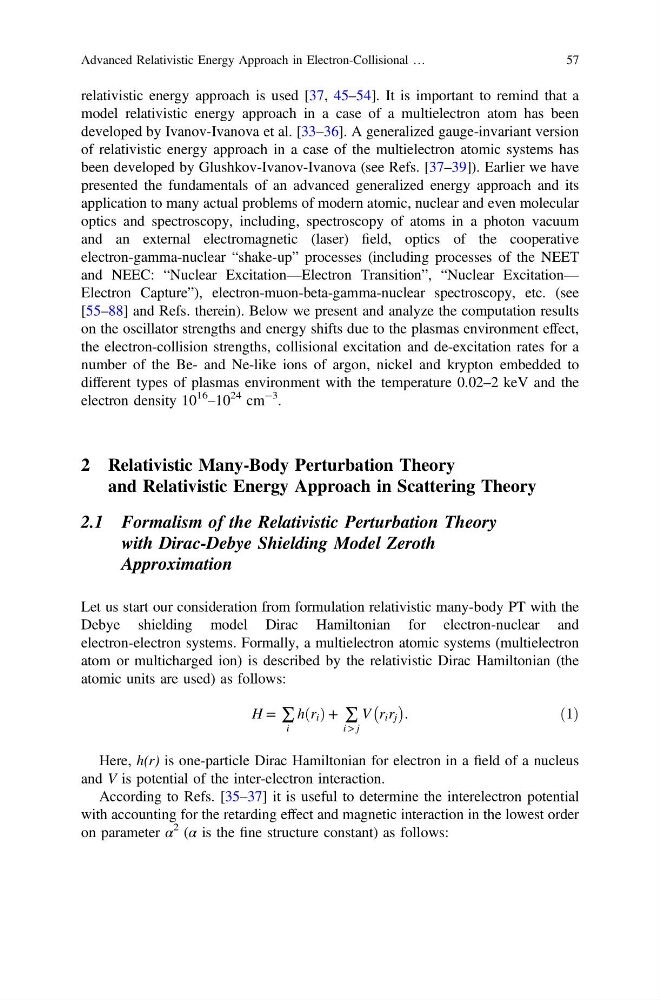
Let us start our consideration from formulation relativistic many-body PT with the
Debye shielding model Dirac Hamiltonian for electron-nuclear and
electron-electron systems. Formally, a multielectron atomic systems (multielectron
atom or multicharged ion) is described by the relativistic Dirac Hamiltonian (the
atomic units are used) as follows:
H = ∑
i
hðr i Þ + ∑
i > j
V r i r j
À Á
.
ð1Þ
Here, h(r) is one-particle Dirac Hamiltonian for electron in a field of a nucleus
and V is potential of the inter-electron interaction.
According to Refs. [35–37] it is useful to determine the interelectron potential
with accounting for the retarding effect and magnetic interaction in the lowest order
on parameter α
2 (α is the fine structure constant) as follows:
Advanced Relativistic Energy Approach in Electron-Collisional …
57
model relativistic energy approach in a case of a multielectron atom has been
developed by Ivanov-Ivanova et al. [33–36]. A generalized gauge-invariant version
of relativistic energy approach in a case of the multielectron atomic systems has
been developed by Glushkov-Ivanov-Ivanova (see Refs. [37–39]). Earlier we have
presented the fundamentals of an advanced generalized energy approach and its
application to many actual problems of modern atomic, nuclear and even molecular
optics and spectroscopy, including, spectroscopy of atoms in a photon vacuum
and an external electromagnetic (laser) field, optics of the cooperative
electron-gamma-nuclear “shake-up” processes (including processes of the NEET
and NEEC: “Nuclear Excitation—Electron Transition”, “Nuclear Excitation—
Electron Capture”), electron-muon-beta-gamma-nuclear spectroscopy, etc. (see
[55–88] and Refs. therein). Below we present and analyze the computation results
on the oscillator strengths and energy shifts due to the plasmas environment effect,
the electron-collision strengths, collisional excitation and de-excitation rates for a
number of the Be- and Ne-like ions of argon, nickel and krypton embedded to
different types of plasmas environment with the temperature 0.02–2 keV and the
electron density 10
16
–10
24 cm
−3 .
2 Relativistic Many-Body Perturbation Theory
and Relativistic Energy Approach in Scattering Theory
2.1 Formalism of the Relativistic Perturbation Theory
with Dirac-Debye Shielding Model Zeroth
Approximation
Let us start our consideration from formulation relativistic many-body PT with the
Debye shielding model Dirac Hamiltonian for electron-nuclear and
electron-electron systems. Formally, a multielectron atomic systems (multielectron
atom or multicharged ion) is described by the relativistic Dirac Hamiltonian (the
atomic units are used) as follows:
H = ∑
i
hðr i Þ + ∑
i > j
V r i r j
À Á
.
ð1Þ
Here, h(r) is one-particle Dirac Hamiltonian for electron in a field of a nucleus
and V is potential of the inter-electron interaction.
According to Refs. [35–37] it is useful to determine the interelectron potential
with accounting for the retarding effect and magnetic interaction in the lowest order
on parameter α
2 (α is the fine structure constant) as follows:
Advanced Relativistic Energy Approach in Electron-Collisional …
57