

1 Introduction
Bond dissociation energy (BDE) is important to the understanding of the mechanisms of chemical reactions and crucial to the design, synthesis, and performance
studies of new functional materials. In the field of high-energy density explosives,
the pyrolysis of explosive molecules is considered to be the critical step in the
explosion process. Especially, the BDE of the weakest (trigger) bond plays a significant role in the initial reaction of explosion. Hence, identification of the trigger
bond becomes mandatory in the studies of the safety and reliability of explosives.
For a homolytic bond breaking process [1–8],
A − B !
bond breaking
A
∙ + B
∙ ,
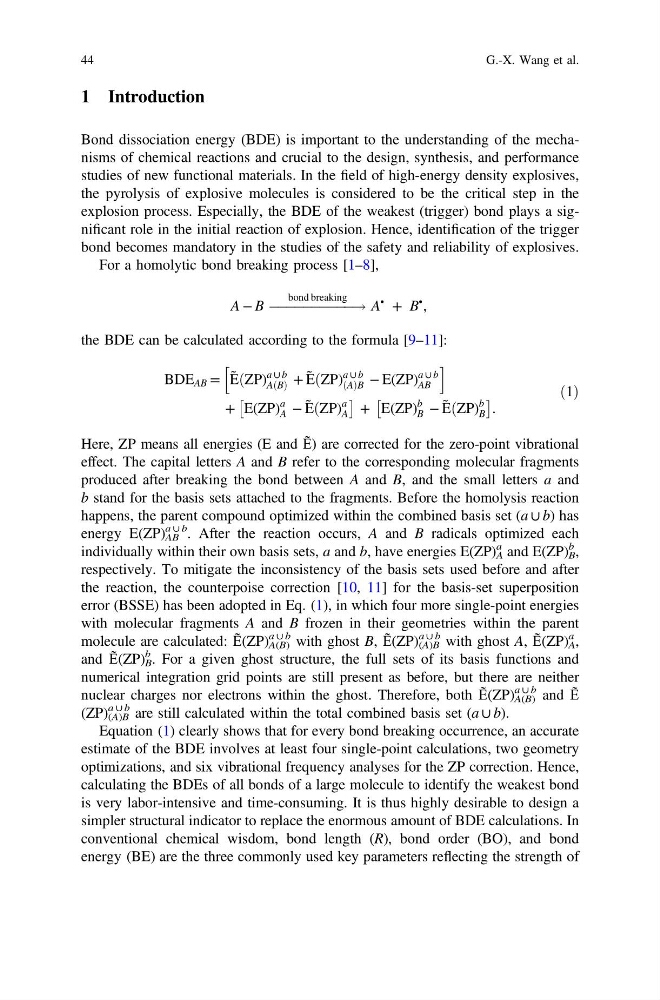
the BDE can be calculated according to the formula [9–11]:
BDE AB = E ̃ ðZP)
a ∪ b
AðBÞ + E ̃ ðZP)
a ∪ b
ðAÞB − E(ZP)
a ∪ b
AB
h
i
+ E(ZP)
a
A − E ̃ ðZP)
a
A
Â
Ã
+ E(ZP)
b
B − E ̃ ðZP)
b
B
Â
Ã
.
ð1Þ
Here, ZP means all energies (E and Ẽ) are corrected for the zero-point vibrational
effect. The capital letters A and B refer to the corresponding molecular fragments
produced after breaking the bond between A and B, and the small letters a and
b stand for the basis sets attached to the fragments. Before the homolysis reaction
happens, the parent compound optimized within the combined basis set (a ∪ b) has
energy E(ZP) AB
a ∪ b . After the reaction occurs, A and B radicals optimized each
individually within their own basis sets, a and b, have energies E(ZP) A
a and E(ZP) B
b ,
respectively. To mitigate the inconsistency of the basis sets used before and after
the reaction, the counterpoise correction [10, 11] for the basis-set superposition
error (BSSE) has been adopted in Eq. (1), in which four more single-point energies
with molecular fragments A and B frozen in their geometries within the parent
molecule are calculated: Ẽ(ZP) A(B)
a ∪ b with ghost B, Ẽ(ZP) (A)B
a ∪ b with ghost A, Ẽ(ZP) A
a ,
and Ẽ(ZP) B
b . For a given ghost structure, the full sets of its basis functions and
numerical integration grid points are still present as before, but there are neither
nuclear charges nor electrons within the ghost. Therefore, both Ẽ(ZP) A(B)
a ∪ b and Ẽ
(ZP) (A)B
a ∪ b are still calculated within the total combined basis set (a ∪ b).
Equation (1) clearly shows that for every bond breaking occurrence, an accurate
estimate of the BDE involves at least four single-point calculations, two geometry
optimizations, and six vibrational frequency analyses for the ZP correction. Hence,
calculating the BDEs of all bonds of a large molecule to identify the weakest bond
is very labor-intensive and time-consuming. It is thus highly desirable to design a
simpler structural indicator to replace the enormous amount of BDE calculations. In
conventional chemical wisdom, bond length (R), bond order (BO), and bond
energy (BE) are the three commonly used key parameters reflecting the strength of
44
G.-X. Wang et al.
Bond dissociation energy (BDE) is important to the understanding of the mechanisms of chemical reactions and crucial to the design, synthesis, and performance
studies of new functional materials. In the field of high-energy density explosives,
the pyrolysis of explosive molecules is considered to be the critical step in the
explosion process. Especially, the BDE of the weakest (trigger) bond plays a significant role in the initial reaction of explosion. Hence, identification of the trigger
bond becomes mandatory in the studies of the safety and reliability of explosives.
For a homolytic bond breaking process [1–8],
A − B !
bond breaking
A
∙ + B
∙ ,
the BDE can be calculated according to the formula [9–11]:
BDE AB = E ̃ ðZP)
a ∪ b
AðBÞ + E ̃ ðZP)
a ∪ b
ðAÞB − E(ZP)
a ∪ b
AB
h
i
+ E(ZP)
a
A − E ̃ ðZP)
a
A
Â
Ã
+ E(ZP)
b
B − E ̃ ðZP)
b
B
Â
Ã
.
ð1Þ
Here, ZP means all energies (E and Ẽ) are corrected for the zero-point vibrational
effect. The capital letters A and B refer to the corresponding molecular fragments
produced after breaking the bond between A and B, and the small letters a and
b stand for the basis sets attached to the fragments. Before the homolysis reaction
happens, the parent compound optimized within the combined basis set (a ∪ b) has
energy E(ZP) AB
a ∪ b . After the reaction occurs, A and B radicals optimized each
individually within their own basis sets, a and b, have energies E(ZP) A
a and E(ZP) B
b ,
respectively. To mitigate the inconsistency of the basis sets used before and after
the reaction, the counterpoise correction [10, 11] for the basis-set superposition
error (BSSE) has been adopted in Eq. (1), in which four more single-point energies
with molecular fragments A and B frozen in their geometries within the parent
molecule are calculated: Ẽ(ZP) A(B)
a ∪ b with ghost B, Ẽ(ZP) (A)B
a ∪ b with ghost A, Ẽ(ZP) A
a ,
and Ẽ(ZP) B
b . For a given ghost structure, the full sets of its basis functions and
numerical integration grid points are still present as before, but there are neither
nuclear charges nor electrons within the ghost. Therefore, both Ẽ(ZP) A(B)
a ∪ b and Ẽ
(ZP) (A)B
a ∪ b are still calculated within the total combined basis set (a ∪ b).
Equation (1) clearly shows that for every bond breaking occurrence, an accurate
estimate of the BDE involves at least four single-point calculations, two geometry
optimizations, and six vibrational frequency analyses for the ZP correction. Hence,
calculating the BDEs of all bonds of a large molecule to identify the weakest bond
is very labor-intensive and time-consuming. It is thus highly desirable to design a
simpler structural indicator to replace the enormous amount of BDE calculations. In
conventional chemical wisdom, bond length (R), bond order (BO), and bond
energy (BE) are the three commonly used key parameters reflecting the strength of
44
G.-X. Wang et al.