

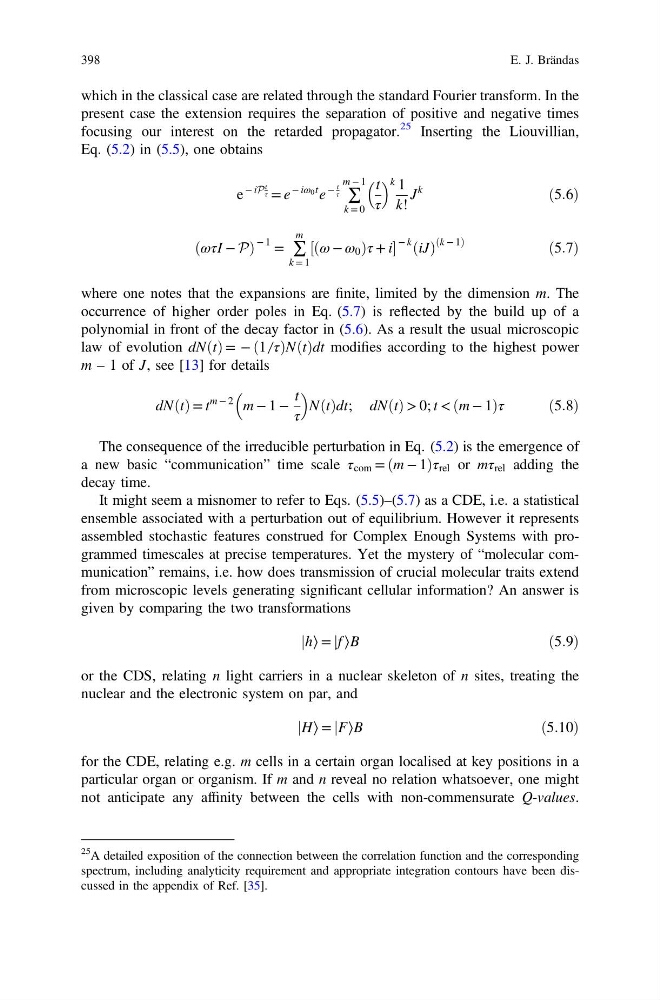
which in the classical case are related through the standard Fourier transform. In the
present case the extension requires the separation of positive and negative times
focusing our interest on the retarded propagator.
25 Inserting the Liouvillian,
Eq. (5.2) in (5.5), one obtains
e
− iP
t
τ = e
− iω 0 t e
−
t
τ ∑
m − 1
k = 0
t
τ
k 1
k!
J
k
ð5:6Þ
ωτI − P
ð
Þ
− 1 = ∑
m
k = 1
ω − ω 0
ð
Þτ + i
½
− k ðiJÞ
ðk − 1Þ
ð5:7Þ
where one notes that the expansions are finite, limited by the dimension m. The
occurrence of higher order poles in Eq. (5.7) is reflected by the build up of a
polynomial in front of the decay factor in (5.6). As a result the usual microscopic
law of evolution dN t
ð Þ = − ð1 ̸ τÞN t
ð Þdt modifies according to the highest power
m – 1 of J, see [13] for details
dN t
ð Þ = t
m − 2 m − 1 −
t
τ
N t
ð Þdt; dN t
ð Þ > 0; t < m − 1
ð
Þτ
ð5:8Þ
The consequence of the irreducible perturbation in Eq. (5.2) is the emergence of
a new basic “communication” time scale τ com = m − 1
ð
Þτ rel or mτ rel adding the
decay time.
It might seem a misnomer to refer to Eqs. (5.5)–(5.7) as a CDE, i.e. a statistical
ensemble associated with a perturbation out of equilibrium. However it represents
assembled stochastic features construed for Complex Enough Systems with programmed timescales at precise temperatures. Yet the mystery of “molecular communication” remains, i.e. how does transmission of crucial molecular traits extend
from microscopic levels generating significant cellular information? An answer is
given by comparing the two transformations
h
j ⟩ = f
j ⟩B
ð5:9Þ
or the CDS, relating n light carriers in a nuclear skeleton of n sites, treating the
nuclear and the electronic system on par, and
H
j ⟩ = F
j ⟩B
ð5:10Þ
for the CDE, relating e.g. m cells in a certain organ localised at key positions in a
particular organ or organism. If m and n reveal no relation whatsoever, one might
not anticipate any affinity between the cells with non-commensurate Q-values.
25
A detailed exposition of the connection between the correlation function and the corresponding
spectrum, including analyticity requirement and appropriate integration contours have been discussed in the appendix of Ref. [35].
398
E. J. Brändas
present case the extension requires the separation of positive and negative times
focusing our interest on the retarded propagator.
25 Inserting the Liouvillian,
Eq. (5.2) in (5.5), one obtains
e
− iP
t
τ = e
− iω 0 t e
−
t
τ ∑
m − 1
k = 0
t
τ
k 1
k!
J
k
ð5:6Þ
ωτI − P
ð
Þ
− 1 = ∑
m
k = 1
ω − ω 0
ð
Þτ + i
½
− k ðiJÞ
ðk − 1Þ
ð5:7Þ
where one notes that the expansions are finite, limited by the dimension m. The
occurrence of higher order poles in Eq. (5.7) is reflected by the build up of a
polynomial in front of the decay factor in (5.6). As a result the usual microscopic
law of evolution dN t
ð Þ = − ð1 ̸ τÞN t
ð Þdt modifies according to the highest power
m – 1 of J, see [13] for details
dN t
ð Þ = t
m − 2 m − 1 −
t
τ
N t
ð Þdt; dN t
ð Þ > 0; t < m − 1
ð
Þτ
ð5:8Þ
The consequence of the irreducible perturbation in Eq. (5.2) is the emergence of
a new basic “communication” time scale τ com = m − 1
ð
Þτ rel or mτ rel adding the
decay time.
It might seem a misnomer to refer to Eqs. (5.5)–(5.7) as a CDE, i.e. a statistical
ensemble associated with a perturbation out of equilibrium. However it represents
assembled stochastic features construed for Complex Enough Systems with programmed timescales at precise temperatures. Yet the mystery of “molecular communication” remains, i.e. how does transmission of crucial molecular traits extend
from microscopic levels generating significant cellular information? An answer is
given by comparing the two transformations
h
j ⟩ = f
j ⟩B
ð5:9Þ
or the CDS, relating n light carriers in a nuclear skeleton of n sites, treating the
nuclear and the electronic system on par, and
H
j ⟩ = F
j ⟩B
ð5:10Þ
for the CDE, relating e.g. m cells in a certain organ localised at key positions in a
particular organ or organism. If m and n reveal no relation whatsoever, one might
not anticipate any affinity between the cells with non-commensurate Q-values.
25
A detailed exposition of the connection between the correlation function and the corresponding
spectrum, including analyticity requirement and appropriate integration contours have been discussed in the appendix of Ref. [35].
398
E. J. Brändas