

Functional Derivatives and Differentiability in Density-Functional Theory
339
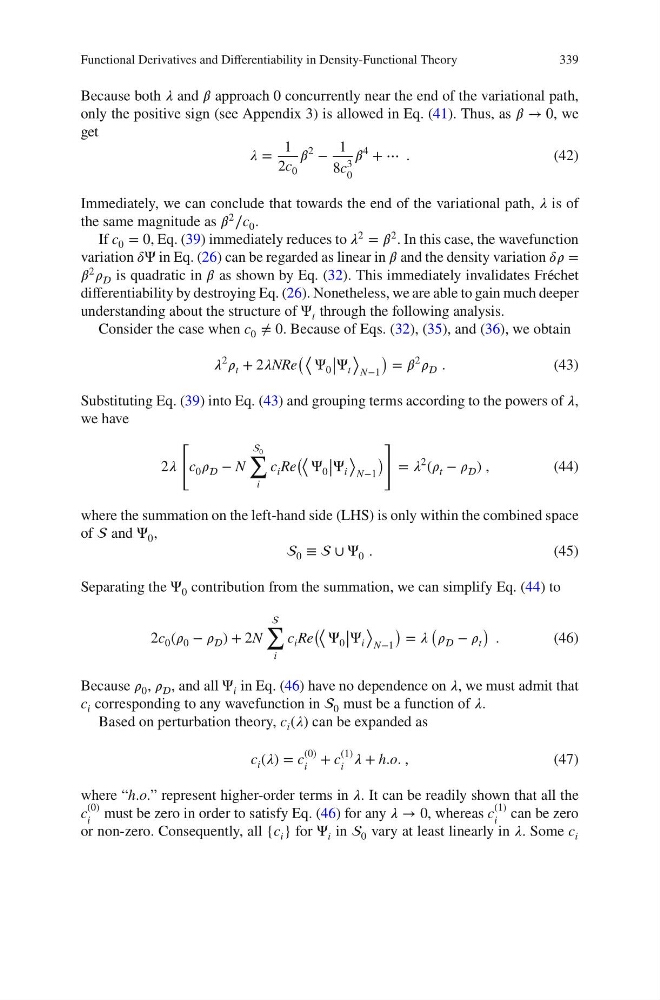
Because both í µí¼ and í µí»½ approach 0 concurrently near the end of the variational path,
only the positive sign (see Appendix 3) is allowed in Eq. (41). Thus, as í µí»½ → 0, we
get
í µí¼ =
1
2c 0
í µí»½
2
−
1
8c
3
0
í µí»½
4
+ ⋯ .
(42)
Immediately, we can conclude that towards the end of the variational path, í µí¼ is of
the same magnitude as í µí»½
2
∕c 0 .
If c 0 = 0, Eq. (39) immediately reduces to í µí¼
2
= í µí»½
2 . In this case, the wavefunction
variation í µí»¿Ψ in Eq. (26) can be regarded as linear in í µí»½ and the density variation í µí»¿í µí¼ =
í µí»½
2
í µí¼ is quadratic in í µí»½ as shown by Eq. (32). This immediately invalidates Fréchet
differentiability by destroying Eq. (26). Nonetheless, we are able to gain much deeper
understanding about the structure of Ψ t through the following analysis.
Consider the case when c 0 ≠ 0. Because of Eqs. (32), (35), and (36), we obtain
í µí¼
2
í µí¼ t + 2í µí¼NRe
(⟨ Ψ 0 |
| Ψ t
⟩
N−1
) = í µí»½
2
í µí¼ .
(43)
Substituting Eq. (39) into Eq. (43) and grouping terms according to the powers of í µí¼,
we have
2í µí¼
[
c 0 í µí¼ − N
0
∑
i
c i Re
(⟨ Ψ 0
|
| Ψ i
⟩
N−1
)
]
= í µí¼
2
(í µí¼ t − í µí¼ ) ,
(44)
where the summation on the left-hand side (LHS) is only within the combined space
of and Ψ 0 ,
0 ≡ ∪ Ψ 0 .
(45)
Separating the Ψ 0 contribution from the summation, we can simplify Eq. (44) to
2c 0 (í µí¼ 0 − í µí¼ ) + 2N
∑
i
c i Re
(⟨ Ψ 0 |
| Ψ i
⟩
N−1
) = í µí¼
( í µí¼ − í µí¼ t
) .
(46)
Because í µí¼ 0 , í µí¼ , and all Ψ i in Eq. (46) have no dependence on í µí¼, we must admit that
c i corresponding to any wavefunction in 0 must be a function of í µí¼.
Based on perturbation theory, c i (í µí¼) can be expanded as
c i (í µí¼) = c
(0)
i
+ c
(1)
i
í µí¼ + h.o. ,
(47)
where “h.o.” represent higher-order terms in í µí¼. It can be readily shown that all the
c
(0)
i
must be zero in order to satisfy Eq. (46) for any í µí¼ → 0, whereas c
(1)
i
can be zero
or non-zero. Consequently, all {c i } for Ψ i in 0 vary at least linearly in í µí¼. Some c i
339
Because both í µí¼ and í µí»½ approach 0 concurrently near the end of the variational path,
only the positive sign (see Appendix 3) is allowed in Eq. (41). Thus, as í µí»½ → 0, we
get
í µí¼ =
1
2c 0
í µí»½
2
−
1
8c
3
0
í µí»½
4
+ ⋯ .
(42)
Immediately, we can conclude that towards the end of the variational path, í µí¼ is of
the same magnitude as í µí»½
2
∕c 0 .
If c 0 = 0, Eq. (39) immediately reduces to í µí¼
2
= í µí»½
2 . In this case, the wavefunction
variation í µí»¿Ψ in Eq. (26) can be regarded as linear in í µí»½ and the density variation í µí»¿í µí¼ =
í µí»½
2
í µí¼ is quadratic in í µí»½ as shown by Eq. (32). This immediately invalidates Fréchet
differentiability by destroying Eq. (26). Nonetheless, we are able to gain much deeper
understanding about the structure of Ψ t through the following analysis.
Consider the case when c 0 ≠ 0. Because of Eqs. (32), (35), and (36), we obtain
í µí¼
2
í µí¼ t + 2í µí¼NRe
(⟨ Ψ 0 |
| Ψ t
⟩
N−1
) = í µí»½
2
í µí¼ .
(43)
Substituting Eq. (39) into Eq. (43) and grouping terms according to the powers of í µí¼,
we have
2í µí¼
[
c 0 í µí¼ − N
0
∑
i
c i Re
(⟨ Ψ 0
|
| Ψ i
⟩
N−1
)
]
= í µí¼
2
(í µí¼ t − í µí¼ ) ,
(44)
where the summation on the left-hand side (LHS) is only within the combined space
of and Ψ 0 ,
0 ≡ ∪ Ψ 0 .
(45)
Separating the Ψ 0 contribution from the summation, we can simplify Eq. (44) to
2c 0 (í µí¼ 0 − í µí¼ ) + 2N
∑
i
c i Re
(⟨ Ψ 0 |
| Ψ i
⟩
N−1
) = í µí¼
( í µí¼ − í µí¼ t
) .
(46)
Because í µí¼ 0 , í µí¼ , and all Ψ i in Eq. (46) have no dependence on í µí¼, we must admit that
c i corresponding to any wavefunction in 0 must be a function of í µí¼.
Based on perturbation theory, c i (í µí¼) can be expanded as
c i (í µí¼) = c
(0)
i
+ c
(1)
i
í µí¼ + h.o. ,
(47)
where “h.o.” represent higher-order terms in í µí¼. It can be readily shown that all the
c
(0)
i
must be zero in order to satisfy Eq. (46) for any í µí¼ → 0, whereas c
(1)
i
can be zero
or non-zero. Consequently, all {c i } for Ψ i in 0 vary at least linearly in í µí¼. Some c i