

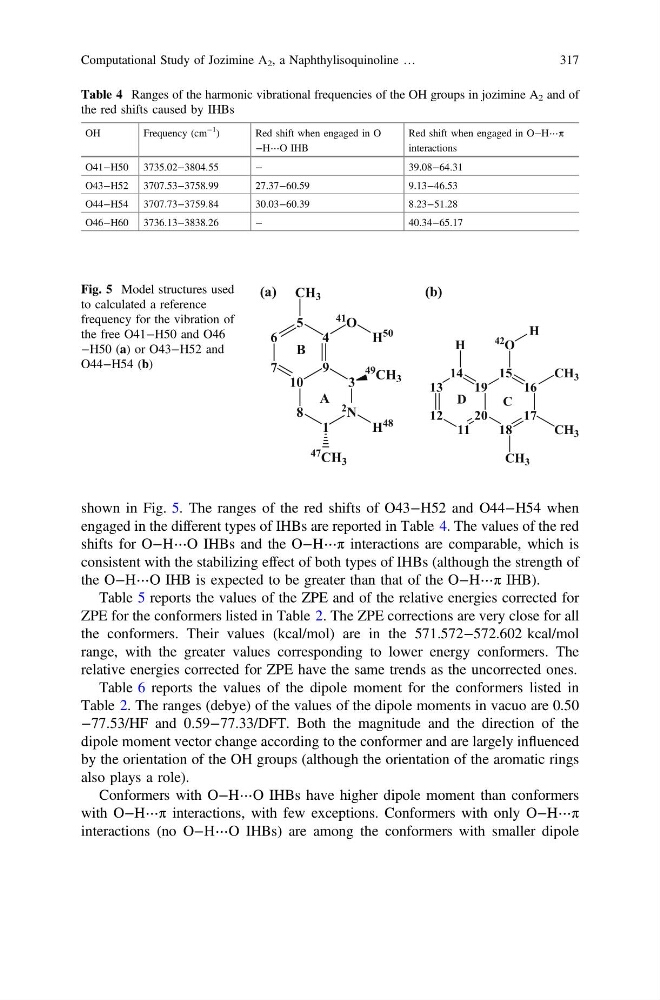
shown in Fig. 5. The ranges of the red shifts of O43−H52 and O44−H54 when
engaged in the different types of IHBs are reported in Table 4. The values of the red
shifts for O−H⋯O IHBs and the O−H⋯π interactions are comparable, which is
consistent with the stabilizing effect of both types of IHBs (although the strength of
the O−H⋯O IHB is expected to be greater than that of the O−H⋯π IHB).
Table 5 reports the values of the ZPE and of the relative energies corrected for
ZPE for the conformers listed in Table 2. The ZPE corrections are very close for all
the conformers. Their values (kcal/mol) are in the 571.572−572.602 kcal/mol
range, with the greater values corresponding to lower energy conformers. The
relative energies corrected for ZPE have the same trends as the uncorrected ones.
Table 6 reports the values of the dipole moment for the conformers listed in
Table 2. The ranges (debye) of the values of the dipole moments in vacuo are 0.50
−77.53/HF and 0.59−77.33/DFT. Both the magnitude and the direction of the
dipole moment vector change according to the conformer and are largely influenced
by the orientation of the OH groups (although the orientation of the aromatic rings
also plays a role).
Conformers with O−H⋯O IHBs have higher dipole moment than conformers
with O−H⋯π interactions, with few exceptions. Conformers with only O−H⋯π
interactions (no O−H⋯O IHBs) are among the conformers with smaller dipole
Table 4 Ranges of the harmonic vibrational frequencies of the OH groups in jozimine A 2 and of
the red shifts caused by IHBs
OH
Frequency (cm
−1
)
Red shift when engaged in O
−H⋯O IHB
Red shift when engaged in O−H⋯π
interactions
O41−H50 3735.02−3804.55
−
39.08−64.31
O43−H52 3707.53−3758.99
27.37−60.59
9.13−46.53
O44−H54 3707.73−3759.84
30.03−60.39
8.23−51.28
O46−H60 3736.13−3838.26
−
40.34−65.17
5
6
7
10
9
4
8
1
2
N
3
H
48
41
O
49 CH 3
47
CH 3
H
50
A
B
CH 3
13
12
11
20
19
14
18
17
16
15
H
42
O
H
CH 3
CH 3
CH 3
C
D
(a)
(b)
Fig. 5 Model structures used
to calculated a reference
frequency for the vibration of
the free O41−H50 and O46
−H50 (a) or O43−H52 and
O44−H54 (b)
Computational Study of Jozimine A 2 , a Naphthylisoquinoline …
317
engaged in the different types of IHBs are reported in Table 4. The values of the red
shifts for O−H⋯O IHBs and the O−H⋯π interactions are comparable, which is
consistent with the stabilizing effect of both types of IHBs (although the strength of
the O−H⋯O IHB is expected to be greater than that of the O−H⋯π IHB).
Table 5 reports the values of the ZPE and of the relative energies corrected for
ZPE for the conformers listed in Table 2. The ZPE corrections are very close for all
the conformers. Their values (kcal/mol) are in the 571.572−572.602 kcal/mol
range, with the greater values corresponding to lower energy conformers. The
relative energies corrected for ZPE have the same trends as the uncorrected ones.
Table 6 reports the values of the dipole moment for the conformers listed in
Table 2. The ranges (debye) of the values of the dipole moments in vacuo are 0.50
−77.53/HF and 0.59−77.33/DFT. Both the magnitude and the direction of the
dipole moment vector change according to the conformer and are largely influenced
by the orientation of the OH groups (although the orientation of the aromatic rings
also plays a role).
Conformers with O−H⋯O IHBs have higher dipole moment than conformers
with O−H⋯π interactions, with few exceptions. Conformers with only O−H⋯π
interactions (no O−H⋯O IHBs) are among the conformers with smaller dipole
Table 4 Ranges of the harmonic vibrational frequencies of the OH groups in jozimine A 2 and of
the red shifts caused by IHBs
OH
Frequency (cm
−1
)
Red shift when engaged in O
−H⋯O IHB
Red shift when engaged in O−H⋯π
interactions
O41−H50 3735.02−3804.55
−
39.08−64.31
O43−H52 3707.53−3758.99
27.37−60.59
9.13−46.53
O44−H54 3707.73−3759.84
30.03−60.39
8.23−51.28
O46−H60 3736.13−3838.26
−
40.34−65.17
5
6
7
10
9
4
8
1
2
N
3
H
48
41
O
49 CH 3
47
CH 3
H
50
A
B
CH 3
13
12
11
20
19
14
18
17
16
15
H
42
O
H
CH 3
CH 3
CH 3
C
D
(a)
(b)
Fig. 5 Model structures used
to calculated a reference
frequency for the vibration of
the free O41−H50 and O46
−H50 (a) or O43−H52 and
O44−H54 (b)
Computational Study of Jozimine A 2 , a Naphthylisoquinoline …
317