

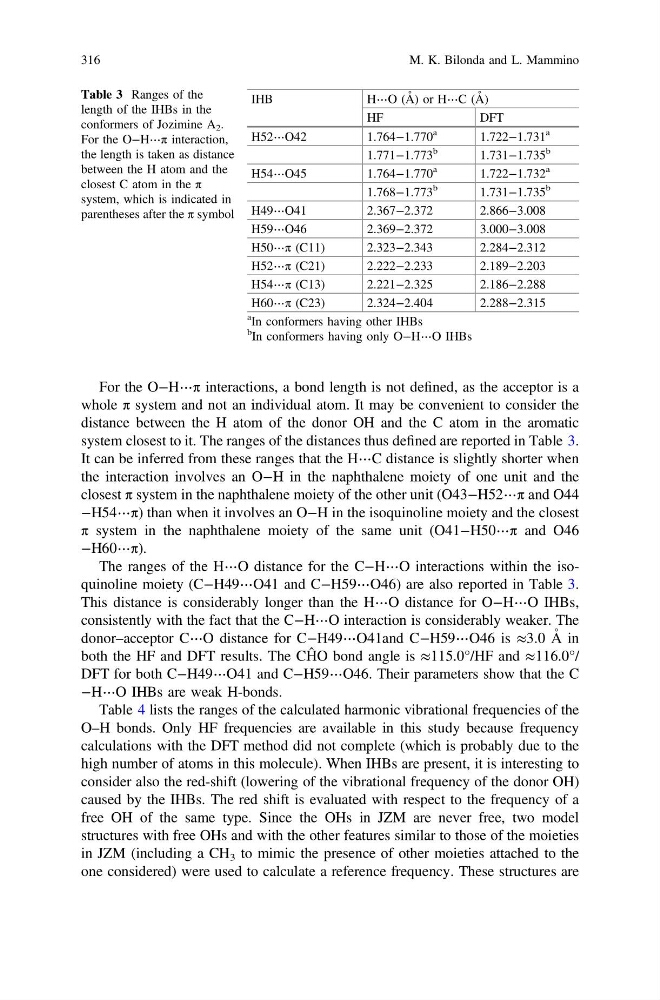
For the O−H⋯π interactions, a bond length is not defined, as the acceptor is a
whole π system and not an individual atom. It may be convenient to consider the
distance between the H atom of the donor OH and the C atom in the aromatic
system closest to it. The ranges of the distances thus defined are reported in Table 3.
It can be inferred from these ranges that the H⋯C distance is slightly shorter when
the interaction involves an O−H in the naphthalene moiety of one unit and the
closest π system in the naphthalene moiety of the other unit (O43−H52⋯π and O44
−H54⋯π) than when it involves an O−H in the isoquinoline moiety and the closest
π system in the naphthalene moiety of the same unit (O41−H50⋯π and O46
−H60⋯π).
The ranges of the H⋯O distance for the C−H⋯O interactions within the isoquinoline moiety (C−H49⋯O41 and C−H59⋯O46) are also reported in Table 3.
This distance is considerably longer than the H⋯O distance for O−H⋯O IHBs,
consistently with the fact that the C−H⋯O interaction is considerably weaker. The
donor–acceptor C⋯O distance for C−H49⋯O41and C−H59⋯O46 is ≈3.0 Å in
both the HF and DFT results. The CĤO bond angle is ≈115.0°/HF and ≈116.0°/
DFT for both C−H49⋯O41 and C−H59⋯O46. Their parameters show that the C
−H⋯O IHBs are weak H-bonds.
Table 4 lists the ranges of the calculated harmonic vibrational frequencies of the
O–H bonds. Only HF frequencies are available in this study because frequency
calculations with the DFT method did not complete (which is probably due to the
high number of atoms in this molecule). When IHBs are present, it is interesting to
consider also the red-shift (lowering of the vibrational frequency of the donor OH)
caused by the IHBs. The red shift is evaluated with respect to the frequency of a
free OH of the same type. Since the OHs in JZM are never free, two model
structures with free OHs and with the other features similar to those of the moieties
in JZM (including a CH 3 to mimic the presence of other moieties attached to the
one considered) were used to calculate a reference frequency. These structures are
Table 3 Ranges of the
length of the IHBs in the
conformers of Jozimine A 2 .
For the O−H⋯π interaction,
the length is taken as distance
between the H atom and the
closest C atom in the π
system, which is indicated in
parentheses after the π symbol
IHB
H⋯O (Å) or H⋯C (Å)
HF
DFT
H52⋯O42
1.764−1.770
a
1.722−1.731
a
1.771−1.773
b
1.731−1.735
b
H54⋯O45
1.764−1.770
a
1.722−1.732
a
1.768−1.773
b
1.731−1.735
b
H49⋯O41
2.367−2.372
2.866−3.008
H59⋯O46
2.369−2.372
3.000−3.008
H50⋯π (C11)
2.323−2.343
2.284−2.312
H52⋯π (C21)
2.222−2.233
2.189−2.203
H54⋯π (C13)
2.221−2.325
2.186−2.288
H60⋯π (C23)
2.324−2.404
2.288−2.315
a In conformers having other IHBs
b
In conformers having only O−H⋯O IHBs
316
M. K. Bilonda and L. Mammino
whole π system and not an individual atom. It may be convenient to consider the
distance between the H atom of the donor OH and the C atom in the aromatic
system closest to it. The ranges of the distances thus defined are reported in Table 3.
It can be inferred from these ranges that the H⋯C distance is slightly shorter when
the interaction involves an O−H in the naphthalene moiety of one unit and the
closest π system in the naphthalene moiety of the other unit (O43−H52⋯π and O44
−H54⋯π) than when it involves an O−H in the isoquinoline moiety and the closest
π system in the naphthalene moiety of the same unit (O41−H50⋯π and O46
−H60⋯π).
The ranges of the H⋯O distance for the C−H⋯O interactions within the isoquinoline moiety (C−H49⋯O41 and C−H59⋯O46) are also reported in Table 3.
This distance is considerably longer than the H⋯O distance for O−H⋯O IHBs,
consistently with the fact that the C−H⋯O interaction is considerably weaker. The
donor–acceptor C⋯O distance for C−H49⋯O41and C−H59⋯O46 is ≈3.0 Å in
both the HF and DFT results. The CĤO bond angle is ≈115.0°/HF and ≈116.0°/
DFT for both C−H49⋯O41 and C−H59⋯O46. Their parameters show that the C
−H⋯O IHBs are weak H-bonds.
Table 4 lists the ranges of the calculated harmonic vibrational frequencies of the
O–H bonds. Only HF frequencies are available in this study because frequency
calculations with the DFT method did not complete (which is probably due to the
high number of atoms in this molecule). When IHBs are present, it is interesting to
consider also the red-shift (lowering of the vibrational frequency of the donor OH)
caused by the IHBs. The red shift is evaluated with respect to the frequency of a
free OH of the same type. Since the OHs in JZM are never free, two model
structures with free OHs and with the other features similar to those of the moieties
in JZM (including a CH 3 to mimic the presence of other moieties attached to the
one considered) were used to calculate a reference frequency. These structures are
Table 3 Ranges of the
length of the IHBs in the
conformers of Jozimine A 2 .
For the O−H⋯π interaction,
the length is taken as distance
between the H atom and the
closest C atom in the π
system, which is indicated in
parentheses after the π symbol
IHB
H⋯O (Å) or H⋯C (Å)
HF
DFT
H52⋯O42
1.764−1.770
a
1.722−1.731
a
1.771−1.773
b
1.731−1.735
b
H54⋯O45
1.764−1.770
a
1.722−1.732
a
1.768−1.773
b
1.731−1.735
b
H49⋯O41
2.367−2.372
2.866−3.008
H59⋯O46
2.369−2.372
3.000−3.008
H50⋯π (C11)
2.323−2.343
2.284−2.312
H52⋯π (C21)
2.222−2.233
2.189−2.203
H54⋯π (C13)
2.221−2.325
2.186−2.288
H60⋯π (C23)
2.324−2.404
2.288−2.315
a In conformers having other IHBs
b
In conformers having only O−H⋯O IHBs
316
M. K. Bilonda and L. Mammino