

were used to perform the calculations. Calculations in solution were performed using
the PCM model.
The results highlight the dominant stabilizing effect of the O−H⋯O
intramolecular hydrogen bonds (IHBs) and of other H-bond-type intramolecular
interactions (for instance, O−H⋯π interaction) and the preference for all the
moieties to be mutually perpendicular. Other computable molecular properties
(dipole moments, HOMO-LUMO energy gaps, solvent effect, etc.) also show some
dependence on IHB patterns.
Comparisons are also made with the results of a study of michellamine A [12]—
a dimeric naphthylisoquinoline alkaloid with anti-HIV activity [13] and with the
same ring systems as JZM. The two molecules differ by the substituents in the
moieties and by the fact that the two naphthalene moieties in michellamine A are
not identical. The stabilising effects show interesting similarities. The main difference is that no IHB between the two naphthalene moieties is possible in JZM,
whereas it is possible in michellamine A.
25
26
27
30
29
24
28
21
22
23
31
32
33
39
40
38
34
35
36
N
37
13
12
11
20
19
14
18
17
16
15
5
6
7
10
9
4
8
1
2
N
3
O
45
O
44
42
O
43
O
46
O
56
CH 3
H
48
41
O
52
H
60
H
58
H
54
H
H 3
55
C
H 3
59
C
49
CH 3
47
CH 3
57
CH 3
H 3
53
C
51
CH 3
H
50
A
B
C
D
D'
C'
B'
A'
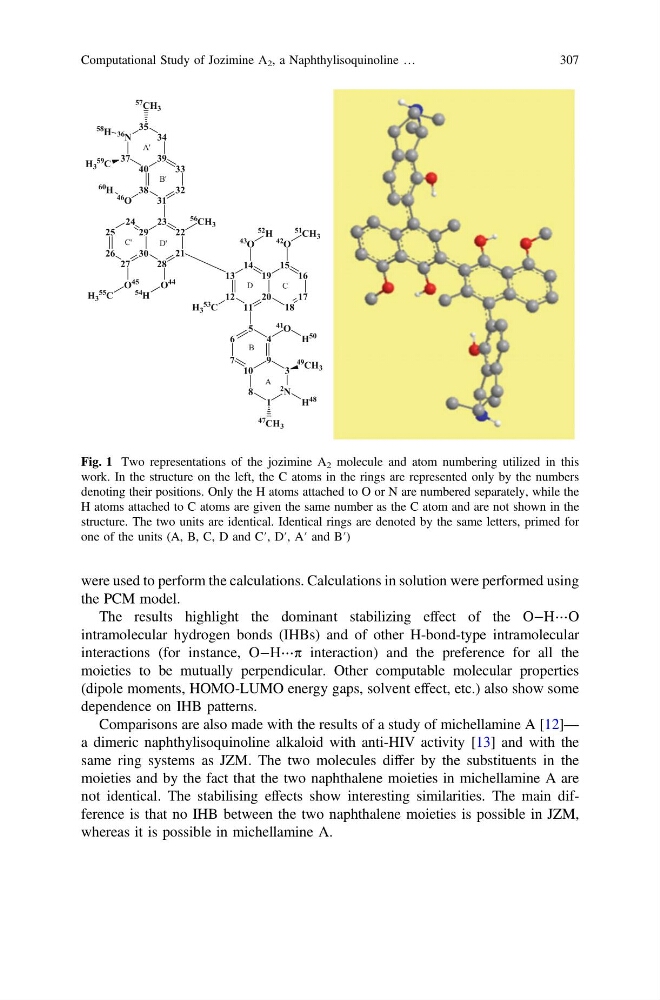
Fig. 1 Two representations of the jozimine A 2 molecule and atom numbering utilized in this
work. In the structure on the left, the C atoms in the rings are represented only by the numbers
denoting their positions. Only the H atoms attached to O or N are numbered separately, while the
H atoms attached to C atoms are given the same number as the C atom and are not shown in the
structure. The two units are identical. Identical rings are denoted by the same letters, primed for
one of the units (A, B, C, D and C′, D′, A′ and B′)
Computational Study of Jozimine A 2 , a Naphthylisoquinoline …
307
the PCM model.
The results highlight the dominant stabilizing effect of the O−H⋯O
intramolecular hydrogen bonds (IHBs) and of other H-bond-type intramolecular
interactions (for instance, O−H⋯π interaction) and the preference for all the
moieties to be mutually perpendicular. Other computable molecular properties
(dipole moments, HOMO-LUMO energy gaps, solvent effect, etc.) also show some
dependence on IHB patterns.
Comparisons are also made with the results of a study of michellamine A [12]—
a dimeric naphthylisoquinoline alkaloid with anti-HIV activity [13] and with the
same ring systems as JZM. The two molecules differ by the substituents in the
moieties and by the fact that the two naphthalene moieties in michellamine A are
not identical. The stabilising effects show interesting similarities. The main difference is that no IHB between the two naphthalene moieties is possible in JZM,
whereas it is possible in michellamine A.
25
26
27
30
29
24
28
21
22
23
31
32
33
39
40
38
34
35
36
N
37
13
12
11
20
19
14
18
17
16
15
5
6
7
10
9
4
8
1
2
N
3
O
45
O
44
42
O
43
O
46
O
56
CH 3
H
48
41
O
52
H
60
H
58
H
54
H
H 3
55
C
H 3
59
C
49
CH 3
47
CH 3
57
CH 3
H 3
53
C
51
CH 3
H
50
A
B
C
D
D'
C'
B'
A'
Fig. 1 Two representations of the jozimine A 2 molecule and atom numbering utilized in this
work. In the structure on the left, the C atoms in the rings are represented only by the numbers
denoting their positions. Only the H atoms attached to O or N are numbered separately, while the
H atoms attached to C atoms are given the same number as the C atom and are not shown in the
structure. The two units are identical. Identical rings are denoted by the same letters, primed for
one of the units (A, B, C, D and C′, D′, A′ and B′)
Computational Study of Jozimine A 2 , a Naphthylisoquinoline …
307