

dataType property, hasMultiplicity, might relate a class of SCF calculations to the
Literal 1 or 3 to indicate singlet or triplet.
Chemical Semantics, Inc. is in the middle of defining an ontology for computational chemistry. The current Release is usable but certainly not final. The Gainesville Core web site describes the current status. A very professional version of
this will not be available quickly. A view of a very preliminary current version is
shown below.
One of the most important efforts of Chemical Semantics, Inc. is the development of a proper ontology for computational chemistry. The effort will require
contributions from many members of this particular scientific community. Funding
for such an effort is being sought.
2.5 SPARQL—Searching
The acronym SPARQL Protocol and RDF Query Language (SPARQL) is officially
recursive but sometimes is referred to as Simple Protocol and RDF Query Language. It bears some similarity to SQL but is a W3C standard for querying data on
the semantic web (graph databases) rather than data in relational databases.
There are a number of commercial SPARQL software packages including Virtuoso which Chemical Semantics’ portal uses. The following is an example of a
SPARQL query that searches for all molecules that have 5 atoms and include a
Chlorine atom.
prefix gc:
prefix rdfs:
select
?molecule ?moleculeLabel ?inchikey
where {
graph ?graph {
?molecule rdf:type gc:Molecule ;
rdfs:label ?moleculeLabel ;
gc:hasNumberOfAtoms “5”;
gc:hasAtom ?atom;
gc:hasInChIKey ?inchikey .
?atom gc:isElement “Cl” .
}
}
order by ?molecule
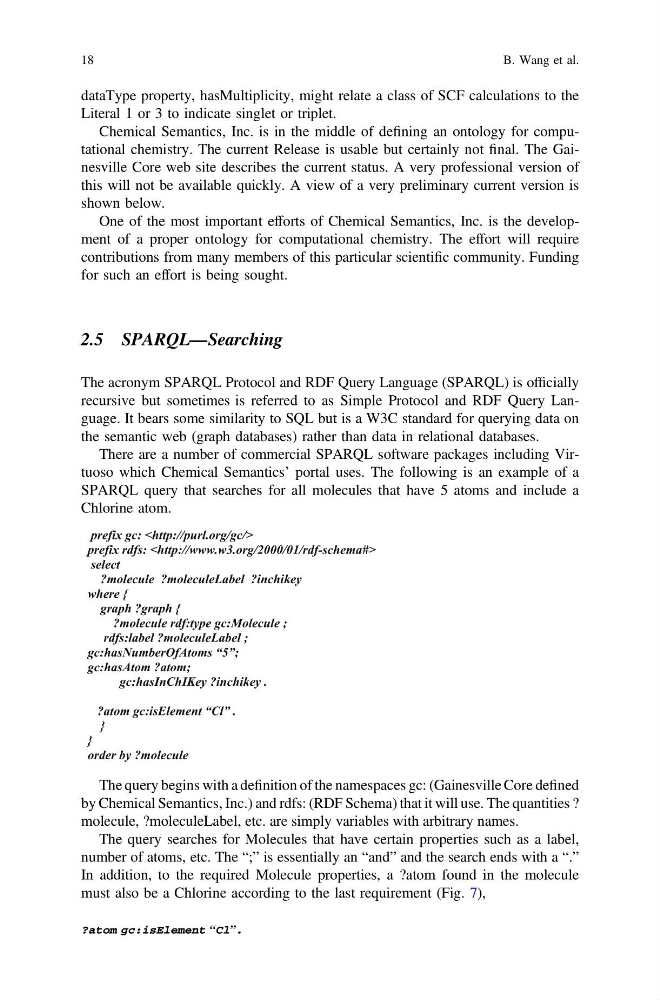
The query begins with a definition of the namespaces gc: (Gainesville Core defined
by Chemical Semantics, Inc.) and rdfs: (RDF Schema) that it will use. The quantities ?
molecule, ?moleculeLabel, etc. are simply variables with arbitrary names.
The query searches for Molecules that have certain properties such as a label,
number of atoms, etc. The “;” is essentially an “and” and the search ends with a “.”
In addition, to the required Molecule properties, a ?atom found in the molecule
must also be a Chlorine according to the last requirement (Fig. 7),
?atom gc:isElement “Cl”.
18
B. Wang et al.
Literal 1 or 3 to indicate singlet or triplet.
Chemical Semantics, Inc. is in the middle of defining an ontology for computational chemistry. The current Release is usable but certainly not final. The Gainesville Core web site describes the current status. A very professional version of
this will not be available quickly. A view of a very preliminary current version is
shown below.
One of the most important efforts of Chemical Semantics, Inc. is the development of a proper ontology for computational chemistry. The effort will require
contributions from many members of this particular scientific community. Funding
for such an effort is being sought.
2.5 SPARQL—Searching
The acronym SPARQL Protocol and RDF Query Language (SPARQL) is officially
recursive but sometimes is referred to as Simple Protocol and RDF Query Language. It bears some similarity to SQL but is a W3C standard for querying data on
the semantic web (graph databases) rather than data in relational databases.
There are a number of commercial SPARQL software packages including Virtuoso which Chemical Semantics’ portal uses. The following is an example of a
SPARQL query that searches for all molecules that have 5 atoms and include a
Chlorine atom.
prefix gc:
prefix rdfs:
select
?molecule ?moleculeLabel ?inchikey
where {
graph ?graph {
?molecule rdf:type gc:Molecule ;
rdfs:label ?moleculeLabel ;
gc:hasNumberOfAtoms “5”;
gc:hasAtom ?atom;
gc:hasInChIKey ?inchikey .
?atom gc:isElement “Cl” .
}
}
order by ?molecule
The query begins with a definition of the namespaces gc: (Gainesville Core defined
by Chemical Semantics, Inc.) and rdfs: (RDF Schema) that it will use. The quantities ?
molecule, ?moleculeLabel, etc. are simply variables with arbitrary names.
The query searches for Molecules that have certain properties such as a label,
number of atoms, etc. The “;” is essentially an “and” and the search ends with a “.”
In addition, to the required Molecule properties, a ?atom found in the molecule
must also be a Chlorine according to the last requirement (Fig. 7),
?atom gc:isElement “Cl”.
18
B. Wang et al.