

molecular structures and results among computational and other chemists. It is a
beginning and other options may become available but we believe it is a valuable
contribution.
2.4 A Quantum Chemistry Ontology
The RDF standard for a graph database and the associated serialized files, like RDF/
XML or Turtle, contain the scientific data (consisting of URI’s and literals). The
interpretation or meaning of that data, however, requires a vocabulary for defining
the data. That vocabulary is an ontology, in this case an ontology for computational
chemistry. Simple ontologies use a schema for RDF (RDFS) but in general the Web
Ontology Language (OWL) and OWL files are better used to describe the ontology.
An OWL file is usually formatted as RDF/XML for convenience although an OWL
ontology is not to be confused with the fundamental data described by RDF. It is
just simply convenient to use RDF to describe an ontology. This shows the power
of RDF in that the ontology can be described by the same structure as the data.
2.4.1 Simple OWL File
An OWL file begins by describing the classes (and subclasses) that are basic
entities of the ontology. For example the classes might be MolecularSystem,
Molecule and Atom, where the MolecularSystem is what a calculation is performed
on and which is assumed to be a collection of atoms and molecules. These classes
have ObjectProperties that relate one class to another. The ObjectProperty, hasMolecule, relates the class MolecularSystem (the Domain) to the class Molecule
(the Range). The ObjectProperty, hasAtom, similarly relates the class Molecule to
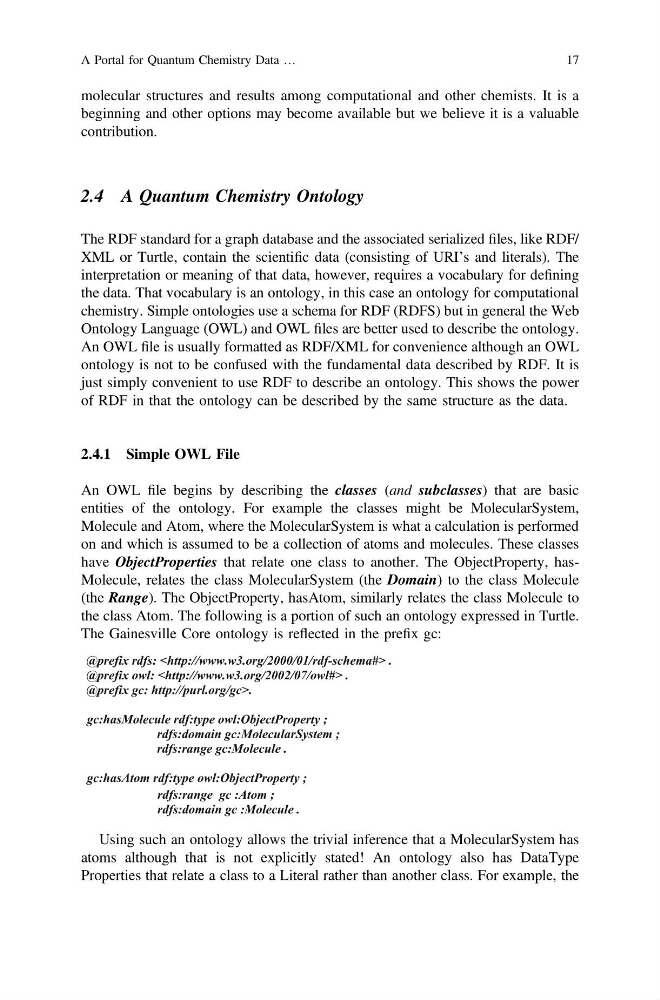
the class Atom. The following is a portion of such an ontology expressed in Turtle.
The Gainesville Core ontology is reflected in the prefix gc:
@prefix rdfs: .
@prefix owl: .
@prefix gc: http://purl.org/gc>.
gc:hasMolecule rdf:type owl:ObjectProperty ;
rdfs:domain gc:MolecularSystem ;
rdfs:range gc:Molecule .
gc:hasAtom rdf:type owl:ObjectProperty ;
rdfs:range gc :Atom ;
rdfs:domain gc :Molecule .
Using such an ontology allows the trivial inference that a MolecularSystem has
atoms although that is not explicitly stated! An ontology also has DataType
Properties that relate a class to a Literal rather than another class. For example, the
A Portal for Quantum Chemistry Data …
17
beginning and other options may become available but we believe it is a valuable
contribution.
2.4 A Quantum Chemistry Ontology
The RDF standard for a graph database and the associated serialized files, like RDF/
XML or Turtle, contain the scientific data (consisting of URI’s and literals). The
interpretation or meaning of that data, however, requires a vocabulary for defining
the data. That vocabulary is an ontology, in this case an ontology for computational
chemistry. Simple ontologies use a schema for RDF (RDFS) but in general the Web
Ontology Language (OWL) and OWL files are better used to describe the ontology.
An OWL file is usually formatted as RDF/XML for convenience although an OWL
ontology is not to be confused with the fundamental data described by RDF. It is
just simply convenient to use RDF to describe an ontology. This shows the power
of RDF in that the ontology can be described by the same structure as the data.
2.4.1 Simple OWL File
An OWL file begins by describing the classes (and subclasses) that are basic
entities of the ontology. For example the classes might be MolecularSystem,
Molecule and Atom, where the MolecularSystem is what a calculation is performed
on and which is assumed to be a collection of atoms and molecules. These classes
have ObjectProperties that relate one class to another. The ObjectProperty, hasMolecule, relates the class MolecularSystem (the Domain) to the class Molecule
(the Range). The ObjectProperty, hasAtom, similarly relates the class Molecule to
the class Atom. The following is a portion of such an ontology expressed in Turtle.
The Gainesville Core ontology is reflected in the prefix gc:
@prefix rdfs:
@prefix owl:
@prefix gc: http://purl.org/gc>.
gc:hasMolecule rdf:type owl:ObjectProperty ;
rdfs:domain gc:MolecularSystem ;
rdfs:range gc:Molecule .
gc:hasAtom rdf:type owl:ObjectProperty ;
rdfs:range gc :Atom ;
rdfs:domain gc :Molecule .
Using such an ontology allows the trivial inference that a MolecularSystem has
atoms although that is not explicitly stated! An ontology also has DataType
Properties that relate a class to a Literal rather than another class. For example, the
A Portal for Quantum Chemistry Data …
17