

For adducts with only one water molecule, the equation becomes simply
ΔE arz−aq = E adduct − E arz − E aq
ð2Þ
For adducts with n non-interacting water molecules, the equation would be
ΔE arz−n ⋅ aq = E adduct − E arz + n E aq
À
Á
ð3Þ
For adducts with interacting water molecules (which is the most common case
when there are several water molecules), ΔE aq-aq is evaluated through a single point
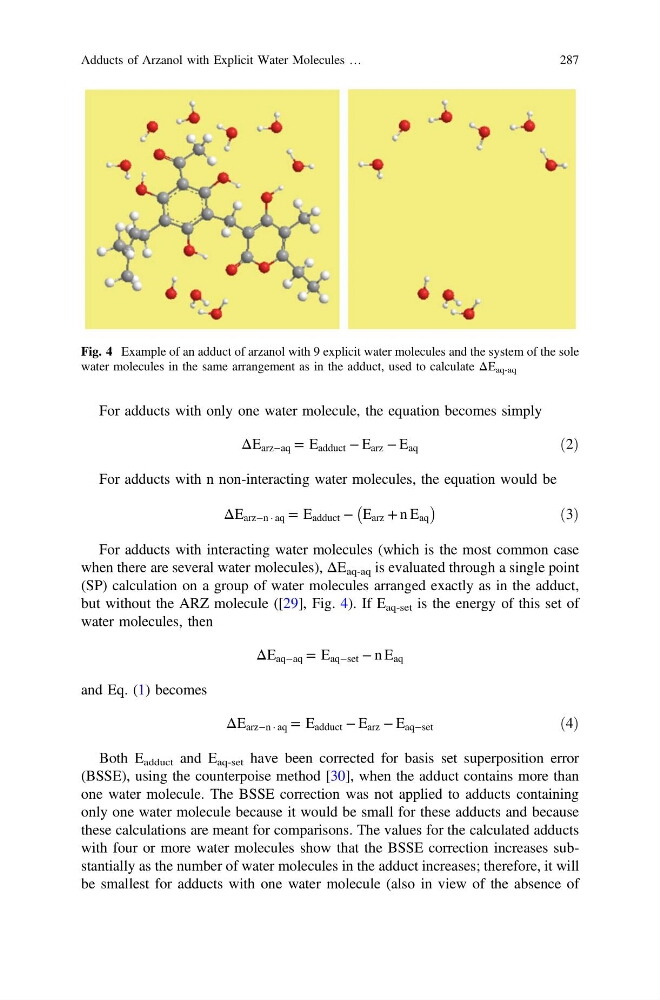
(SP) calculation on a group of water molecules arranged exactly as in the adduct,
but without the ARZ molecule ([29], Fig. 4). If E aq-set is the energy of this set of
water molecules, then
ΔE aq−aq = E aq−set − n E aq
and Eq. (1) becomes
ΔE arz−n ⋅ aq = E adduct − E arz − E aq−set
ð4Þ
Both E adduct and E aq-set have been corrected for basis set superposition error
(BSSE), using the counterpoise method [30], when the adduct contains more than
one water molecule. The BSSE correction was not applied to adducts containing
only one water molecule because it would be small for these adducts and because
these calculations are meant for comparisons. The values for the calculated adducts
with four or more water molecules show that the BSSE correction increases substantially as the number of water molecules in the adduct increases; therefore, it will
be smallest for adducts with one water molecule (also in view of the absence of
Fig. 4 Example of an adduct of arzanol with 9 explicit water molecules and the system of the sole
water molecules in the same arrangement as in the adduct, used to calculate ΔE aq-aq
Adducts of Arzanol with Explicit Water Molecules …
287
ΔE arz−aq = E adduct − E arz − E aq
ð2Þ
For adducts with n non-interacting water molecules, the equation would be
ΔE arz−n ⋅ aq = E adduct − E arz + n E aq
À
Á
ð3Þ
For adducts with interacting water molecules (which is the most common case
when there are several water molecules), ΔE aq-aq is evaluated through a single point
(SP) calculation on a group of water molecules arranged exactly as in the adduct,
but without the ARZ molecule ([29], Fig. 4). If E aq-set is the energy of this set of
water molecules, then
ΔE aq−aq = E aq−set − n E aq
and Eq. (1) becomes
ΔE arz−n ⋅ aq = E adduct − E arz − E aq−set
ð4Þ
Both E adduct and E aq-set have been corrected for basis set superposition error
(BSSE), using the counterpoise method [30], when the adduct contains more than
one water molecule. The BSSE correction was not applied to adducts containing
only one water molecule because it would be small for these adducts and because
these calculations are meant for comparisons. The values for the calculated adducts
with four or more water molecules show that the BSSE correction increases substantially as the number of water molecules in the adduct increases; therefore, it will
be smallest for adducts with one water molecule (also in view of the absence of
Fig. 4 Example of an adduct of arzanol with 9 explicit water molecules and the system of the sole
water molecules in the same arrangement as in the adduct, used to calculate ΔE aq-aq
Adducts of Arzanol with Explicit Water Molecules …
287