

relevant for the first solvation layer, such as the stabilising effect of a water
molecule bridging two water molecules H-bonded to ARZ. On the other hand, the
tendency of water molecules to cluster together limits the number of water molecules in an adduct, if one wishes them to ‘remain’ in the first solvation layer on
optimisation. For the case of ARZ, it was found that when more than 9–10 water
molecules are present, their tendency to cluster becomes dominant and several of
them may move away from their initial binding sites of ARZ, yielding arrangements
in which they ‘crowd’ in the vicinity of only a portion of ARZ, and one or more of
them may move beyond the first solvation layer.
2.2 Computational Approaches
All the adducts were calculated in vacuo, performing optimisation with fully
relaxed geometry at the same levels utilised in all the previous calculations on
ACPLs [6–10, 16, 17, 19–25], i.e., Hartree Fock (HF) with the 6-31G(d,p) basis set
and Density Functional Theory (DFT) with the B3LYP functional [26–28] and the
6-31+G(d,p) basis set. The reasons for the selection of the two levels of theory and
basis sets are explained in the previous works [6–10, 16–24]; it is considered
important to maintain them in this and further studies involving ACPLs, to enable
informative and straightforward comparisons.
In the previous studies [5–10], DFT calculations have mostly been performed as
post-HF calculations; random testing had shown that the same inputs optimise to
the same conformers with the two methods; thus, treating DFT as post-HF calculations was expedient to decrease computational costs. In the case of the adducts of
ARZ considered here, HF and DFT calculations were performed independently for
each input because the presence of several H-bond donor and acceptor sites and the
non-covalent nature of the solute-solvent H-bonds suggests the possibility that the
two methods may lead to different arrangements of water molecules. In most cases,
the same input optimised to similar arrangements, but, in a number of cases, the
optimised adducts differed substantially. Such outputs were then utilised as inputs
for the other method, what enabled the consideration of additional geometries that
had not been envisaged on the initial input-preparation.
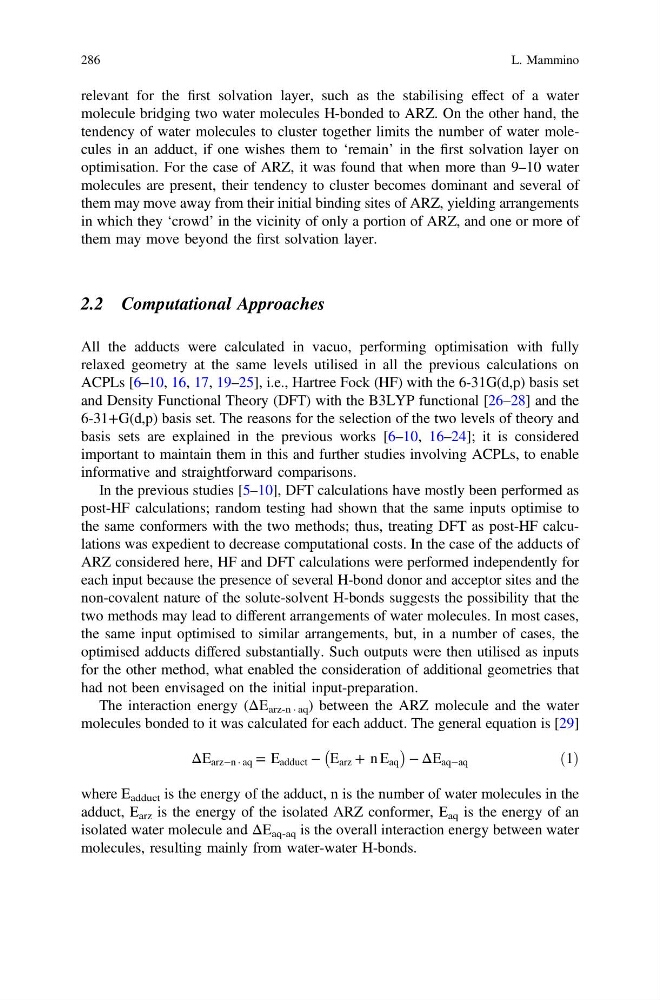
The interaction energy (ΔE arz-n ⋅ aq ) between the ARZ molecule and the water
molecules bonded to it was calculated for each adduct. The general equation is [29]
ΔE arz−n ⋅ aq = E adduct − E arz + n E aq
À
Á − ΔE aq−aq
ð1Þ
where E adduct is the energy of the adduct, n is the number of water molecules in the
adduct, E arz is the energy of the isolated ARZ conformer, E aq is the energy of an
isolated water molecule and ΔE aq-aq is the overall interaction energy between water
molecules, resulting mainly from water-water H-bonds.
286
L. Mammino
molecule bridging two water molecules H-bonded to ARZ. On the other hand, the
tendency of water molecules to cluster together limits the number of water molecules in an adduct, if one wishes them to ‘remain’ in the first solvation layer on
optimisation. For the case of ARZ, it was found that when more than 9–10 water
molecules are present, their tendency to cluster becomes dominant and several of
them may move away from their initial binding sites of ARZ, yielding arrangements
in which they ‘crowd’ in the vicinity of only a portion of ARZ, and one or more of
them may move beyond the first solvation layer.
2.2 Computational Approaches
All the adducts were calculated in vacuo, performing optimisation with fully
relaxed geometry at the same levels utilised in all the previous calculations on
ACPLs [6–10, 16, 17, 19–25], i.e., Hartree Fock (HF) with the 6-31G(d,p) basis set
and Density Functional Theory (DFT) with the B3LYP functional [26–28] and the
6-31+G(d,p) basis set. The reasons for the selection of the two levels of theory and
basis sets are explained in the previous works [6–10, 16–24]; it is considered
important to maintain them in this and further studies involving ACPLs, to enable
informative and straightforward comparisons.
In the previous studies [5–10], DFT calculations have mostly been performed as
post-HF calculations; random testing had shown that the same inputs optimise to
the same conformers with the two methods; thus, treating DFT as post-HF calculations was expedient to decrease computational costs. In the case of the adducts of
ARZ considered here, HF and DFT calculations were performed independently for
each input because the presence of several H-bond donor and acceptor sites and the
non-covalent nature of the solute-solvent H-bonds suggests the possibility that the
two methods may lead to different arrangements of water molecules. In most cases,
the same input optimised to similar arrangements, but, in a number of cases, the
optimised adducts differed substantially. Such outputs were then utilised as inputs
for the other method, what enabled the consideration of additional geometries that
had not been envisaged on the initial input-preparation.
The interaction energy (ΔE arz-n ⋅ aq ) between the ARZ molecule and the water
molecules bonded to it was calculated for each adduct. The general equation is [29]
ΔE arz−n ⋅ aq = E adduct − E arz + n E aq
À
Á − ΔE aq−aq
ð1Þ
where E adduct is the energy of the adduct, n is the number of water molecules in the
adduct, E arz is the energy of the isolated ARZ conformer, E aq is the energy of an
isolated water molecule and ΔE aq-aq is the overall interaction energy between water
molecules, resulting mainly from water-water H-bonds.
286
L. Mammino