

248
D. G. Green and G. F. Gribakin
+
+
+. . .
≡
μ 2
ν 2
ν 1
μ 1
μ 2
ν 2
ν 1
μ 1
μ 2
ν 2
ν 1
μ 1
+
=
μ 2
ν 2
ν 1
μ 1
ν
μ
ν 1
μ 1
μ 2
ν 2
μ 2
ν 2
ν 1
μ 1
Γ
Γ
P
ε
n
=
+
P
ε
n
+
ν
P
ε
n
μ μ
Γ
P
μ 2
ε
ν 1
μ 1
ν 2
n
+
(a)
(b)
(c)
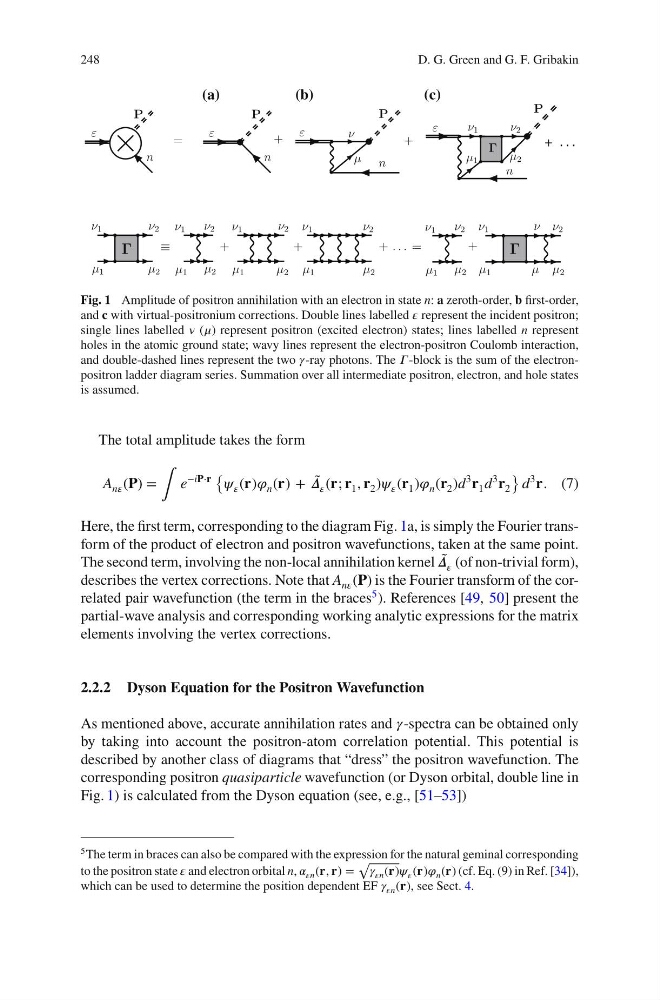
Fig. 1 Amplitude of positron annihilation with an electron in state n: a zeroth-order, b first-order,
and c with virtual-positronium corrections. Double lines labelled í µí¼ represent the incident positron;
single lines labelled í µí¼ (í µí¼) represent positron (excited electron) states; lines labelled n represent
holes in the atomic ground state; wavy lines represent the electron-positron Coulomb interaction,
and double-dashed lines represent the two í µí»¾-ray photons. The í µí»¤ -block is the sum of the electronpositron ladder diagram series. Summation over all intermediate positron, electron, and hole states
is assumed.
The total amplitude takes the form
A ní µí¼ (í µí°) = ∫
e
−ií µí°⋅í µí°«
{ í µí¼ í µí¼ (í µí°«)í µí¼ n (í µí°«) + ̃
í µí»¥ í µí¼ (í µí°«; í µí°« 1 , í µí°« 2 )í µí¼ í µí¼ (í µí°« 1 )í µí¼ n (í µí°« 2 )d
3
í µí°« 1 d
3
í µí°« 2
}
d
3
í µí°«. (7)
Here, the first term, corresponding to the diagram Fig. 1a, is simply the Fourier transform of the product of electron and positron wavefunctions, taken at the same point.
The second term, involving the non-local annihilation kernel ̃
í µí»¥ í µí¼ (of non-trivial form),
describes the vertex corrections. Note that A ní µí¼ (í µí°) is the Fourier transform of the correlated pair wavefunction (the term in the braces 5 ). References [49, 50] present the
partial-wave analysis and corresponding working analytic expressions for the matrix
elements involving the vertex corrections.
2.2.2 Dyson Equation for the Positron Wavefunction
As mentioned above, accurate annihilation rates and í µí»¾-spectra can be obtained only
by taking into account the positron-atom correlation potential. This potential is
described by another class of diagrams that “dress” the positron wavefunction. The
corresponding positron quasiparticle wavefunction (or Dyson orbital, double line in
Fig. 1) is calculated from the Dyson equation (see, e.g., [51–53])
5 The term in braces can also be compared with the expression for the natural geminal corresponding
to the positron state í µí¼ and electron orbital n, í µí»¼ í µí¼n (í µí°«, í µí°«) =
√ í µí»¾ í µí¼n (í µí°«)í µí¼ í µí¼ (í µí°«)í µí¼ n (í µí°«) (cf. Eq. (9) in Ref. [34]),
which can be used to determine the position dependent EF í µí»¾ í µí¼n (í µí°«), see Sect. 4.
D. G. Green and G. F. Gribakin
+
+
+. . .
≡
μ 2
ν 2
ν 1
μ 1
μ 2
ν 2
ν 1
μ 1
μ 2
ν 2
ν 1
μ 1
+
=
μ 2
ν 2
ν 1
μ 1
ν
μ
ν 1
μ 1
μ 2
ν 2
μ 2
ν 2
ν 1
μ 1
Γ
Γ
P
ε
n
=
+
P
ε
n
+
ν
P
ε
n
μ μ
Γ
P
μ 2
ε
ν 1
μ 1
ν 2
n
+
(a)
(b)
(c)
Fig. 1 Amplitude of positron annihilation with an electron in state n: a zeroth-order, b first-order,
and c with virtual-positronium corrections. Double lines labelled í µí¼ represent the incident positron;
single lines labelled í µí¼ (í µí¼) represent positron (excited electron) states; lines labelled n represent
holes in the atomic ground state; wavy lines represent the electron-positron Coulomb interaction,
and double-dashed lines represent the two í µí»¾-ray photons. The í µí»¤ -block is the sum of the electronpositron ladder diagram series. Summation over all intermediate positron, electron, and hole states
is assumed.
The total amplitude takes the form
A ní µí¼ (í µí°) = ∫
e
−ií µí°⋅í µí°«
{ í µí¼ í µí¼ (í µí°«)í µí¼ n (í µí°«) + ̃
í µí»¥ í µí¼ (í µí°«; í µí°« 1 , í µí°« 2 )í µí¼ í µí¼ (í µí°« 1 )í µí¼ n (í µí°« 2 )d
3
í µí°« 1 d
3
í µí°« 2
}
d
3
í µí°«. (7)
Here, the first term, corresponding to the diagram Fig. 1a, is simply the Fourier transform of the product of electron and positron wavefunctions, taken at the same point.
The second term, involving the non-local annihilation kernel ̃
í µí»¥ í µí¼ (of non-trivial form),
describes the vertex corrections. Note that A ní µí¼ (í µí°) is the Fourier transform of the correlated pair wavefunction (the term in the braces 5 ). References [49, 50] present the
partial-wave analysis and corresponding working analytic expressions for the matrix
elements involving the vertex corrections.
2.2.2 Dyson Equation for the Positron Wavefunction
As mentioned above, accurate annihilation rates and í µí»¾-spectra can be obtained only
by taking into account the positron-atom correlation potential. This potential is
described by another class of diagrams that “dress” the positron wavefunction. The
corresponding positron quasiparticle wavefunction (or Dyson orbital, double line in
Fig. 1) is calculated from the Dyson equation (see, e.g., [51–53])
5 The term in braces can also be compared with the expression for the natural geminal corresponding
to the positron state í µí¼ and electron orbital n, í µí»¼ í µí¼n (í µí°«, í µí°«) =
√ í µí»¾ í µí¼n (í µí°«)í µí¼ í µí¼ (í µí°«)í µí¼ n (í µí°«) (cf. Eq. (9) in Ref. [34]),
which can be used to determine the position dependent EF í µí»¾ í µí¼n (í µí°«), see Sect. 4.