

ψ MO2α He − H
ð
Þ= 0.24 ϕ Hð1s ′ Þ + 0.51 ϕ Hð1s ′′ Þ + 0.38 ϕ Hð1s ′′′ Þ
There is no orbital overlap between helium and neutral hydrogen. From chemical
bonding rule, no covalent bonding is formed in He–H model. Mulliken spin densities of helium and hydrogen are 0.00 and 1.00, respectively. MO2α is responsible
for the spin density.
Figure 5 depicts the schematic drawing of electrons and orbitals in He–H model.
Electron repulsion between two helium 1s electrons and hydrogen 1s electron is
dominative, though Coulomb interaction exists between helium 1s electrons and
positive hydrogen atomic nucleus. It is considered that the repulsion lets the
interatomic He–H distance elongated.
3.3 He–H
− Model
Figure 6 shows potential energy curve of He–H
− model, changing the interatomic
He–H distance. A local minimum is given at 6.452 Å. It is much larger than He–H
+
and He–H models. It is found that He–H
− is weakly bounded. Four electrons
occupy MO1 and MO2. The wave-function of MO1 is
ψ MO1 He − H
−
ð
Þ= 0.35 ϕ Heð1s ′ Þ + 0.48 ϕ Heð1s ′′ Þ + 0.30 ϕ Heð1s ′′′ Þ
On the other hand, the wave-function of MO2 is
-2133.815
-2133.810
-2133.805
-2133.800
-2133.795
-2133.790
-2133.785
-2133.780
-2133.775
-2133.770
3.0
3.2
3.4
3.6
3.8
4.0
4.2
4.4
4.6
4.8
5.0
Total Energy [kcal/mol]
He-H distance [Å]
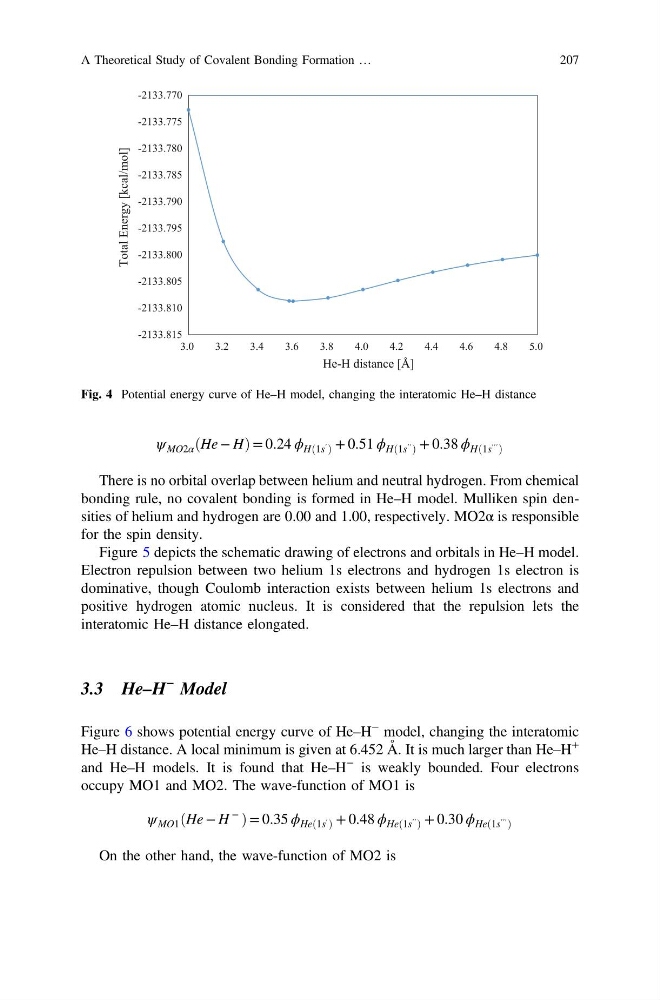
Fig. 4 Potential energy curve of He–H model, changing the interatomic He–H distance
A Theoretical Study of Covalent Bonding Formation …
207
ð
Þ= 0.24 ϕ Hð1s ′ Þ + 0.51 ϕ Hð1s ′′ Þ + 0.38 ϕ Hð1s ′′′ Þ
There is no orbital overlap between helium and neutral hydrogen. From chemical
bonding rule, no covalent bonding is formed in He–H model. Mulliken spin densities of helium and hydrogen are 0.00 and 1.00, respectively. MO2α is responsible
for the spin density.
Figure 5 depicts the schematic drawing of electrons and orbitals in He–H model.
Electron repulsion between two helium 1s electrons and hydrogen 1s electron is
dominative, though Coulomb interaction exists between helium 1s electrons and
positive hydrogen atomic nucleus. It is considered that the repulsion lets the
interatomic He–H distance elongated.
3.3 He–H
− Model
Figure 6 shows potential energy curve of He–H
− model, changing the interatomic
He–H distance. A local minimum is given at 6.452 Å. It is much larger than He–H
+
and He–H models. It is found that He–H
− is weakly bounded. Four electrons
occupy MO1 and MO2. The wave-function of MO1 is
ψ MO1 He − H
−
ð
Þ= 0.35 ϕ Heð1s ′ Þ + 0.48 ϕ Heð1s ′′ Þ + 0.30 ϕ Heð1s ′′′ Þ
On the other hand, the wave-function of MO2 is
-2133.815
-2133.810
-2133.805
-2133.800
-2133.795
-2133.790
-2133.785
-2133.780
-2133.775
-2133.770
3.0
3.2
3.4
3.6
3.8
4.0
4.2
4.4
4.6
4.8
5.0
Total Energy [kcal/mol]
He-H distance [Å]
Fig. 4 Potential energy curve of He–H model, changing the interatomic He–H distance
A Theoretical Study of Covalent Bonding Formation …
207