

has been widely used. However, they has not been confirmed whether the obtained
diabatic potentials produce the reliable adiabatic potentials or not, although these
functions are obtained to fit in some data. Additionally, to obtain these analytical
functions with parameters uniquely or using fewer data is important to construct the
PES for various chemical reactions. Therefore, a proposal of simple method for
light or more uniquely construction of the diabatic potentials (V
di
11 and V
di
22 ) and
non-diagonal matrix element (V
di
12 ) using the analytical functions is important to
analyze the chemical reaction and it can be widely applied to describing the large
molecular systems such as proteins.
In this study, we focus on one-dimensional proton transfer models and suggest a
simple construction method of global PES for intermolecular proton transfer by use
of Morse potential as V
di
11 and V
di
22 and Gaussian function as V
di
12 in the diabatic
potential matrix and confirm the validity to use these potential functions. In addition, we investigate whether it is possible to apply to the proton transfer for various
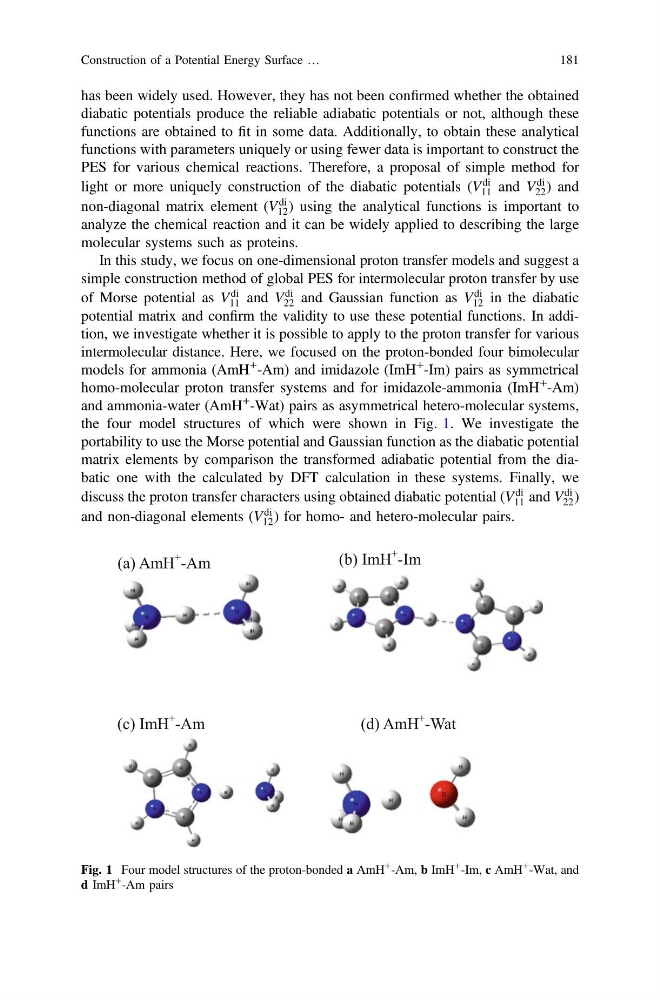
intermolecular distance. Here, we focused on the proton-bonded four bimolecular
models for ammonia (AmH
+ -Am) and imidazole (ImH
+ -Im) pairs as symmetrical
homo-molecular proton transfer systems and for imidazole-ammonia (ImH
+
-Am)
and ammonia-water (AmH
+
-Wat) pairs as asymmetrical hetero-molecular systems,
the four model structures of which were shown in Fig. 1. We investigate the
portability to use the Morse potential and Gaussian function as the diabatic potential
matrix elements by comparison the transformed adiabatic potential from the diabatic one with the calculated by DFT calculation in these systems. Finally, we
discuss the proton transfer characters using obtained diabatic potential (V
di
11 and V
di
22 )
and non-diagonal elements (V
di
12 ) for homo- and hetero-molecular pairs.
(b) ImH
+
-Im
(a) AmH
+ -Am
(d) AmH
+
-Wat
(c) ImH
+
-Am
Fig. 1 Four model structures of the proton-bonded a AmH
+
-Am, b ImH
+ -Im, c AmH
+ -Wat, and
d ImH
+ -Am pairs
Construction of a Potential Energy Surface …
181
diabatic potentials produce the reliable adiabatic potentials or not, although these
functions are obtained to fit in some data. Additionally, to obtain these analytical
functions with parameters uniquely or using fewer data is important to construct the
PES for various chemical reactions. Therefore, a proposal of simple method for
light or more uniquely construction of the diabatic potentials (V
di
11 and V
di
22 ) and
non-diagonal matrix element (V
di
12 ) using the analytical functions is important to
analyze the chemical reaction and it can be widely applied to describing the large
molecular systems such as proteins.
In this study, we focus on one-dimensional proton transfer models and suggest a
simple construction method of global PES for intermolecular proton transfer by use
of Morse potential as V
di
11 and V
di
22 and Gaussian function as V
di
12 in the diabatic
potential matrix and confirm the validity to use these potential functions. In addition, we investigate whether it is possible to apply to the proton transfer for various
intermolecular distance. Here, we focused on the proton-bonded four bimolecular
models for ammonia (AmH
+ -Am) and imidazole (ImH
+ -Im) pairs as symmetrical
homo-molecular proton transfer systems and for imidazole-ammonia (ImH
+
-Am)
and ammonia-water (AmH
+
-Wat) pairs as asymmetrical hetero-molecular systems,
the four model structures of which were shown in Fig. 1. We investigate the
portability to use the Morse potential and Gaussian function as the diabatic potential
matrix elements by comparison the transformed adiabatic potential from the diabatic one with the calculated by DFT calculation in these systems. Finally, we
discuss the proton transfer characters using obtained diabatic potential (V
di
11 and V
di
22 )
and non-diagonal elements (V
di
12 ) for homo- and hetero-molecular pairs.
(b) ImH
+
-Im
(a) AmH
+ -Am
(d) AmH
+
-Wat
(c) ImH
+
-Am
Fig. 1 Four model structures of the proton-bonded a AmH
+
-Am, b ImH
+ -Im, c AmH
+ -Wat, and
d ImH
+ -Am pairs
Construction of a Potential Energy Surface …
181