

Rather than examine the adiabatic PES, another approach to chemical reactions is
to analyze the diabatic PES. In contrast to the adiabatic potential, the diabatic
potential presents electronic states that change constantly to confine the eigenstates
of the electronic Hamiltonian. The approaches using diabatic picture have been
utilized various area in chemistry and physics where the coupling between nuclei
and electrons such as vibronic coupling [4–6]. There are some approaches to
describing the diabatic potential [7], constructing using some valence bond
(VB) electronic wave functions [8–11]. Especially, empirical valence bond
(EVB) [12] or multistate empirical valence bond (MS-EVB) [13] approach extended
EVB is used the molecular mechanical functions to construct the PES and applied to
the molecular dynamics (MD) simulations for many proton transfer systems [12, 14–
29]. Furthermore, quantum dynamical approach using molecular mechanical functions (double Morse potential) for proton transfer was also performed [30]. However, to construct PES using diabatic potentials corresponding to reactant and
product states, which is based on VB picture, is important for understanding
chemical reactions in terms on chemical bond character. Although VB structures are
usually not orthogonal, in this study we consider orthonormal VB structures. To
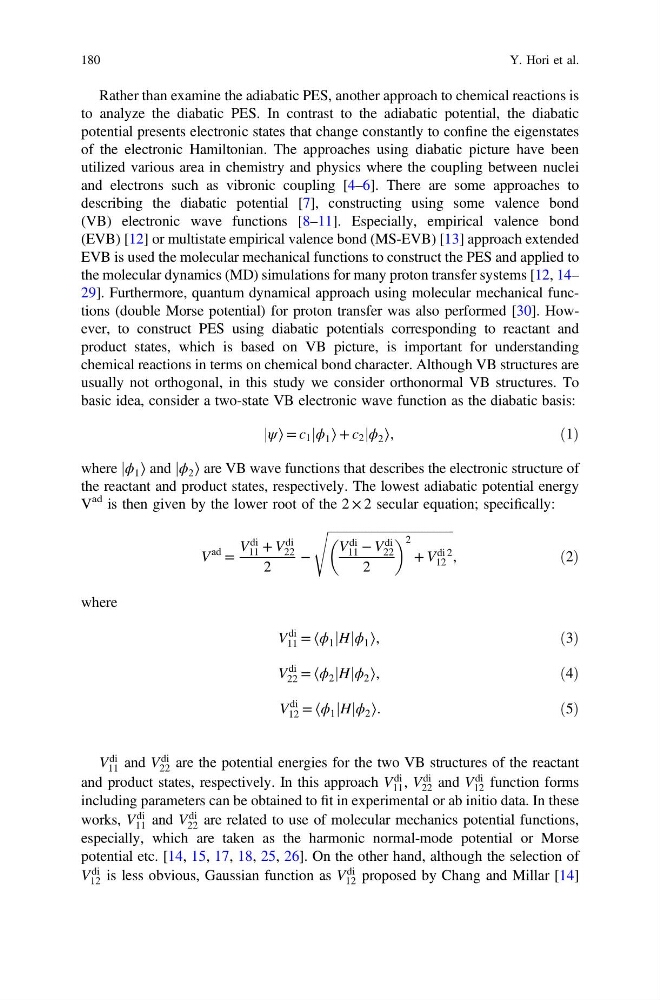
basic idea, consider a two-state VB electronic wave function as the diabatic basis:
ψ⟩ = c 1
j
jϕ 1 ⟩ + c 2 jϕ 2 ⟩,
ð1Þ
where jϕ 1 ⟩ and jϕ 2 ⟩ are VB wave functions that describes the electronic structure of
the reactant and product states, respectively. The lowest adiabatic potential energy
V
ad is then given by the lower root of the 2 × 2 secular equation; specifically:
V
ad =
V
di
11 + V
di
22
2
−
ffiffiffiffiffiffiffiffiffiffiffiffiffiffiffiffiffiffiffiffiffiffiffiffiffiffiffiffiffiffiffiffiffiffiffiffiffiffiffiffi ffi
V di
11 − V di
22
2
2
+ V di 2
12
s
,
ð2Þ
where
V
di
11 = ⟨ϕ 1 H
j jϕ 1 ⟩,
ð3Þ
V
di
22 = ⟨ϕ 2 H
j jϕ 2 ⟩,
ð4Þ
V
di
12 = ⟨ϕ 1 H
j jϕ 2 ⟩.
ð5Þ
V
di
11 and V
di
22 are the potential energies for the two VB structures of the reactant
and product states, respectively. In this approach V
di
11 , V
di
22 and V
di
12 function forms
including parameters can be obtained to fit in experimental or ab initio data. In these
works, V
di
11 and V
di
22 are related to use of molecular mechanics potential functions,
especially, which are taken as the harmonic normal-mode potential or Morse
potential etc. [14, 15, 17, 18, 25, 26]. On the other hand, although the selection of
V
di
12 is less obvious, Gaussian function as V
di
12 proposed by Chang and Millar [14]
180
Y. Hori et al.
to analyze the diabatic PES. In contrast to the adiabatic potential, the diabatic
potential presents electronic states that change constantly to confine the eigenstates
of the electronic Hamiltonian. The approaches using diabatic picture have been
utilized various area in chemistry and physics where the coupling between nuclei
and electrons such as vibronic coupling [4–6]. There are some approaches to
describing the diabatic potential [7], constructing using some valence bond
(VB) electronic wave functions [8–11]. Especially, empirical valence bond
(EVB) [12] or multistate empirical valence bond (MS-EVB) [13] approach extended
EVB is used the molecular mechanical functions to construct the PES and applied to
the molecular dynamics (MD) simulations for many proton transfer systems [12, 14–
29]. Furthermore, quantum dynamical approach using molecular mechanical functions (double Morse potential) for proton transfer was also performed [30]. However, to construct PES using diabatic potentials corresponding to reactant and
product states, which is based on VB picture, is important for understanding
chemical reactions in terms on chemical bond character. Although VB structures are
usually not orthogonal, in this study we consider orthonormal VB structures. To
basic idea, consider a two-state VB electronic wave function as the diabatic basis:
ψ⟩ = c 1
j
jϕ 1 ⟩ + c 2 jϕ 2 ⟩,
ð1Þ
where jϕ 1 ⟩ and jϕ 2 ⟩ are VB wave functions that describes the electronic structure of
the reactant and product states, respectively. The lowest adiabatic potential energy
V
ad is then given by the lower root of the 2 × 2 secular equation; specifically:
V
ad =
V
di
11 + V
di
22
2
−
ffiffiffiffiffiffiffiffiffiffiffiffiffiffiffiffiffiffiffiffiffiffiffiffiffiffiffiffiffiffiffiffiffiffiffiffiffiffiffiffi ffi
V di
11 − V di
22
2
2
+ V di 2
12
s
,
ð2Þ
where
V
di
11 = ⟨ϕ 1 H
j jϕ 1 ⟩,
ð3Þ
V
di
22 = ⟨ϕ 2 H
j jϕ 2 ⟩,
ð4Þ
V
di
12 = ⟨ϕ 1 H
j jϕ 2 ⟩.
ð5Þ
V
di
11 and V
di
22 are the potential energies for the two VB structures of the reactant
and product states, respectively. In this approach V
di
11 , V
di
22 and V
di
12 function forms
including parameters can be obtained to fit in experimental or ab initio data. In these
works, V
di
11 and V
di
22 are related to use of molecular mechanics potential functions,
especially, which are taken as the harmonic normal-mode potential or Morse
potential etc. [14, 15, 17, 18, 25, 26]. On the other hand, although the selection of
V
di
12 is less obvious, Gaussian function as V
di
12 proposed by Chang and Millar [14]
180
Y. Hori et al.