

Difference of Chirality of the Electron Between Enantiomers of H 2 X 2
101
-4.0×10
-6
-2.0×10
-6
0.0×10
0
2.0×10
-6
4.0×10
-6
0
50
100
150
200
250
300
350
M
PV
O
[a.u.]
dihedral angle [degrees]
-1.0×10
-4
-5.0×10
-5
0.0×10
0
5.0×10
-5
1.0×10
-4
0
50
100
150
200
250
300
350
M
PV
S
[a.u.]
dihedral angle [degrees]
(a) H 2 O 2
(b) H2S2
-4.0×10
-3
-2.0×10
-3
0.0×10
0
2.0×10
-3
4.0×10
-3
0
50
100
150
200
250
300
350
M
PV
Se
[a.u.]
dihedral angle [degrees]
-4.0×10
-2
-2.0×10
-2
0.0×10
0
2.0×10
-2
4.0×10
-2
0
50
100
150
200
250
300
350
M
PV
Te
[a.u.]
dihedral angle [degrees]
(c) H 2 Se 2
(d) H 2 Te 2
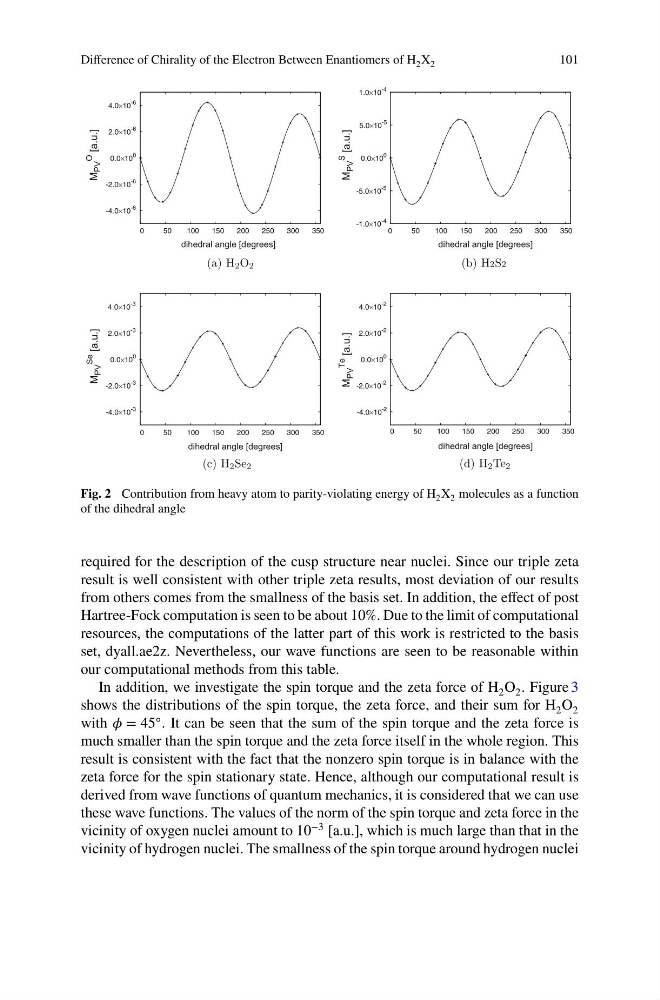
Fig. 2 Contribution from heavy atom to parity-violating energy of H 2 X 2 molecules as a function
of the dihedral angle
required for the description of the cusp structure near nuclei. Since our triple zeta
result is well consistent with other triple zeta results, most deviation of our results
from others comes from the smallness of the basis set. In addition, the effect of post
Hartree-Fock computation is seen to be about 10%. Due to the limit of computational
resources, the computations of the latter part of this work is restricted to the basis
set, dyall.ae2z. Nevertheless, our wave functions are seen to be reasonable within
our computational methods from this table.
In addition, we investigate the spin torque and the zeta force of H 2 O 2 . Figure 3
shows the distributions of the spin torque, the zeta force, and their sum for H 2 O 2
with í µí¼ = 45 ◦ . It can be seen that the sum of the spin torque and the zeta force is
much smaller than the spin torque and the zeta force itself in the whole region. This
result is consistent with the fact that the nonzero spin torque is in balance with the
zeta force for the spin stationary state. Hence, although our computational result is
derived from wave functions of quantum mechanics, it is considered that we can use
these wave functions. The values of the norm of the spin torque and zeta force in the
vicinity of oxygen nuclei amount to 10 −3 [a.u.], which is much large than that in the
vicinity of hydrogen nuclei. The smallness of the spin torque around hydrogen nuclei
101
-4.0×10
-6
-2.0×10
-6
0.0×10
0
2.0×10
-6
4.0×10
-6
0
50
100
150
200
250
300
350
M
PV
O
[a.u.]
dihedral angle [degrees]
-1.0×10
-4
-5.0×10
-5
0.0×10
0
5.0×10
-5
1.0×10
-4
0
50
100
150
200
250
300
350
M
PV
S
[a.u.]
dihedral angle [degrees]
(a) H 2 O 2
(b) H2S2
-4.0×10
-3
-2.0×10
-3
0.0×10
0
2.0×10
-3
4.0×10
-3
0
50
100
150
200
250
300
350
M
PV
Se
[a.u.]
dihedral angle [degrees]
-4.0×10
-2
-2.0×10
-2
0.0×10
0
2.0×10
-2
4.0×10
-2
0
50
100
150
200
250
300
350
M
PV
Te
[a.u.]
dihedral angle [degrees]
(c) H 2 Se 2
(d) H 2 Te 2
Fig. 2 Contribution from heavy atom to parity-violating energy of H 2 X 2 molecules as a function
of the dihedral angle
required for the description of the cusp structure near nuclei. Since our triple zeta
result is well consistent with other triple zeta results, most deviation of our results
from others comes from the smallness of the basis set. In addition, the effect of post
Hartree-Fock computation is seen to be about 10%. Due to the limit of computational
resources, the computations of the latter part of this work is restricted to the basis
set, dyall.ae2z. Nevertheless, our wave functions are seen to be reasonable within
our computational methods from this table.
In addition, we investigate the spin torque and the zeta force of H 2 O 2 . Figure 3
shows the distributions of the spin torque, the zeta force, and their sum for H 2 O 2
with í µí¼ = 45 ◦ . It can be seen that the sum of the spin torque and the zeta force is
much smaller than the spin torque and the zeta force itself in the whole region. This
result is consistent with the fact that the nonzero spin torque is in balance with the
zeta force for the spin stationary state. Hence, although our computational result is
derived from wave functions of quantum mechanics, it is considered that we can use
these wave functions. The values of the norm of the spin torque and zeta force in the
vicinity of oxygen nuclei amount to 10 −3 [a.u.], which is much large than that in the
vicinity of hydrogen nuclei. The smallness of the spin torque around hydrogen nuclei