

100
M. Senami et al.
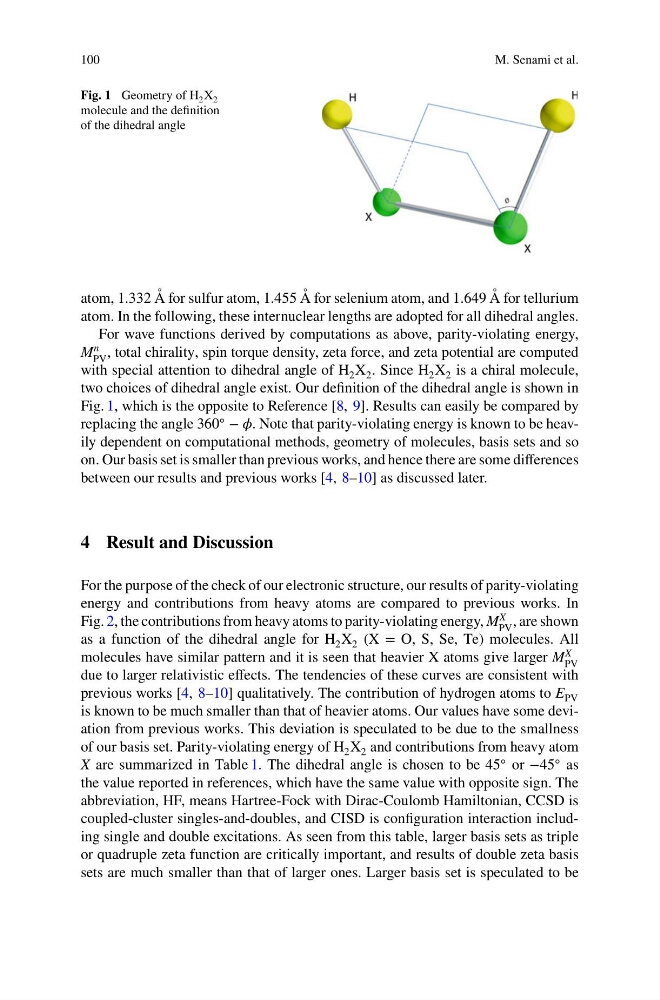
Fig. 1 Geometry of H 2 X 2
molecule and the definition
of the dihedral angle
atom, 1.332 Å for sulfur atom, 1.455 Å for selenium atom, and 1.649 Å for tellurium
atom. In the following, these internuclear lengths are adopted for all dihedral angles.
For wave functions derived by computations as above, parity-violating energy,
M
n
PV
, total chirality, spin torque density, zeta force, and zeta potential are computed
with special attention to dihedral angle of H 2 X 2 . Since H 2 X 2 is a chiral molecule,
two choices of dihedral angle exist. Our definition of the dihedral angle is shown in
Fig. 1, which is the opposite to Reference [8, 9]. Results can easily be compared by
replacing the angle 360 ◦ − í µí¼. Note that parity-violating energy is known to be heavily dependent on computational methods, geometry of molecules, basis sets and so
on. Our basis set is smaller than previous works, and hence there are some differences
between our results and previous works [4, 8–10] as discussed later.
4 Result and Discussion
For the purpose of the check of our electronic structure, our results of parity-violating
energy and contributions from heavy atoms are compared to previous works. In
Fig. 2, the contributions from heavy atoms to parity-violating energy, M
X
PV
, are shown
as a function of the dihedral angle for H 2 X 2 (X = O, S, Se, Te) molecules. All
molecules have similar pattern and it is seen that heavier X atoms give larger M
X
PV
due to larger relativistic effects. The tendencies of these curves are consistent with
previous works [4, 8–10] qualitatively. The contribution of hydrogen atoms to E PV
is known to be much smaller than that of heavier atoms. Our values have some deviation from previous works. This deviation is speculated to be due to the smallness
of our basis set. Parity-violating energy of H 2 X 2 and contributions from heavy atom
X are summarized in Table 1. The dihedral angle is chosen to be 45 ◦ or −45 ◦ as
the value reported in references, which have the same value with opposite sign. The
abbreviation, HF, means Hartree-Fock with Dirac-Coulomb Hamiltonian, CCSD is
coupled-cluster singles-and-doubles, and CISD is configuration interaction including single and double excitations. As seen from this table, larger basis sets as triple
or quadruple zeta function are critically important, and results of double zeta basis
sets are much smaller than that of larger ones. Larger basis set is speculated to be
M. Senami et al.
Fig. 1 Geometry of H 2 X 2
molecule and the definition
of the dihedral angle
atom, 1.332 Å for sulfur atom, 1.455 Å for selenium atom, and 1.649 Å for tellurium
atom. In the following, these internuclear lengths are adopted for all dihedral angles.
For wave functions derived by computations as above, parity-violating energy,
M
n
PV
, total chirality, spin torque density, zeta force, and zeta potential are computed
with special attention to dihedral angle of H 2 X 2 . Since H 2 X 2 is a chiral molecule,
two choices of dihedral angle exist. Our definition of the dihedral angle is shown in
Fig. 1, which is the opposite to Reference [8, 9]. Results can easily be compared by
replacing the angle 360 ◦ − í µí¼. Note that parity-violating energy is known to be heavily dependent on computational methods, geometry of molecules, basis sets and so
on. Our basis set is smaller than previous works, and hence there are some differences
between our results and previous works [4, 8–10] as discussed later.
4 Result and Discussion
For the purpose of the check of our electronic structure, our results of parity-violating
energy and contributions from heavy atoms are compared to previous works. In
Fig. 2, the contributions from heavy atoms to parity-violating energy, M
X
PV
, are shown
as a function of the dihedral angle for H 2 X 2 (X = O, S, Se, Te) molecules. All
molecules have similar pattern and it is seen that heavier X atoms give larger M
X
PV
due to larger relativistic effects. The tendencies of these curves are consistent with
previous works [4, 8–10] qualitatively. The contribution of hydrogen atoms to E PV
is known to be much smaller than that of heavier atoms. Our values have some deviation from previous works. This deviation is speculated to be due to the smallness
of our basis set. Parity-violating energy of H 2 X 2 and contributions from heavy atom
X are summarized in Table 1. The dihedral angle is chosen to be 45 ◦ or −45 ◦ as
the value reported in references, which have the same value with opposite sign. The
abbreviation, HF, means Hartree-Fock with Dirac-Coulomb Hamiltonian, CCSD is
coupled-cluster singles-and-doubles, and CISD is configuration interaction including single and double excitations. As seen from this table, larger basis sets as triple
or quadruple zeta function are critically important, and results of double zeta basis
sets are much smaller than that of larger ones. Larger basis set is speculated to be