

98
M. Senami et al.
̂
í µí¼ 5 (x) =
ℏc
2
[ ̂
í µí¼
†
e (x)í µí»¾ 5 ̂
í µí¼ e (x)
] =
ℏc
2
(
̂
í µí¼
†
eR
(x) ̂
í µí¼ eR (x) − ̂
í µí¼
†
eL
(x) ̂
í µí¼ eL (x)
)
,
(5)
where ̂
í µí¼ eL (x) ≡
1
2
(1 − í µí»¾ 5 ) ̂
í µí¼ e and ̂
í µí¼ eR (x) ≡
1
2
(1 + í µí»¾ 5 ) ̂
í µí¼ e are fields with the left-handed
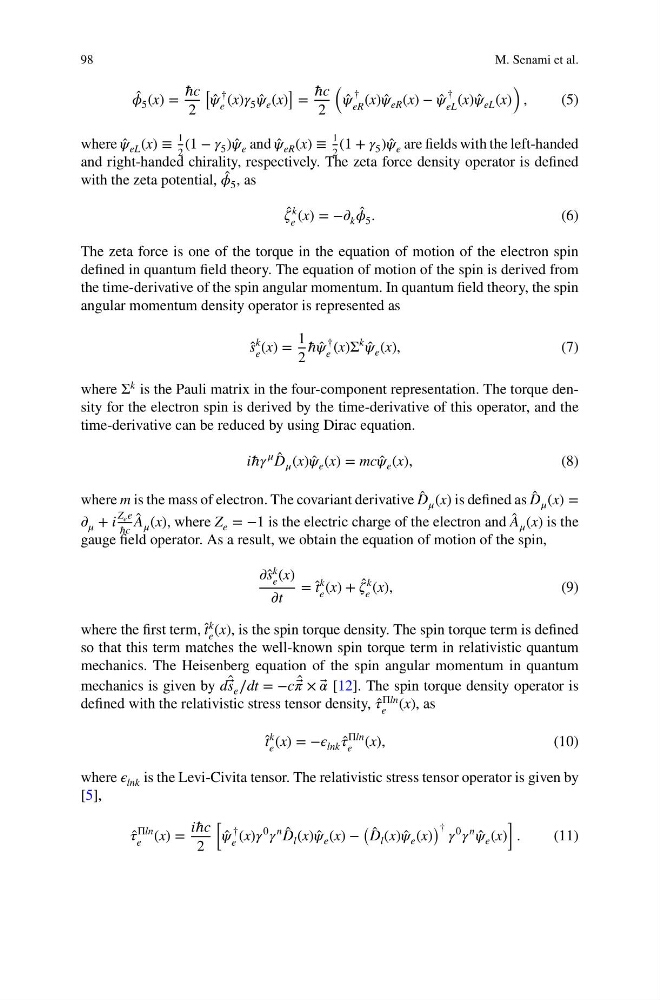
and right-handed chirality, respectively. The zeta force density operator is defined
with the zeta potential, ̂
í µí¼ 5 , as
̂
í µí¼
k
e
(x) = −í µí¼ k ̂
í µí¼ 5 .
(6)
The zeta force is one of the torque in the equation of motion of the electron spin
defined in quantum field theory. The equation of motion of the spin is derived from
the time-derivative of the spin angular momentum. In quantum field theory, the spin
angular momentum density operator is represented as
̂
s
k
e (x) =
1
2
ℏ ̂
í µí¼
†
e (x)Σ
k
̂
í µí¼ e (x),
(7)
where Σ
k is the Pauli matrix in the four-component representation. The torque density for the electron spin is derived by the time-derivative of this operator, and the
time-derivative can be reduced by using Dirac equation.
iℏí µí»¾
í µí¼ ̂
D í µí¼ (x) ̂
í µí¼ e (x) = mc ̂
í µí¼ e (x),
(8)
where m is the mass of electron. The covariant derivative ̂
D í µí¼ (x) is defined as ̂
D í µí¼ (x) =
í µí¼ í µí¼ + i
Z e e
ℏc
̂
A í µí¼ (x), where Z e = −1 is the electric charge of the electron and ̂
A í µí¼ (x) is the
gauge field operator. As a result, we obtain the equation of motion of the spin,
í µí¼̂ s k
e (x)
í µí¼t
= ̂ t
k
e (x) + ̂
í µí¼
k
e (x),
(9)
where the first term, ̂ t k
e
(x), is the spin torque density. The spin torque term is defined
so that this term matches the well-known spin torque term in relativistic quantum
mechanics. The Heisenberg equation of the spin angular momentum in quantum
mechanics is given by d ̂
⃗ s e ∕dt = −c ̂
⃗
í µí¼ × ⃗
í µí»¼ [12]. The spin torque density operator is
defined with the relativistic stress tensor density, ̂
í µí¼ Πln
e
(x), as
̂ t
k
e (x) = −í µí¼ lnk ̂
í µí¼
Πln
e (x),
(10)
where í µí¼ lnk is the Levi-Civita tensor. The relativistic stress tensor operator is given by
[5],
̂
í µí¼
Πln
e (x) =
iℏc
2
[
̂
í µí¼
†
e (x)í µí»¾
0
í µí»¾
n ̂
D l (x) ̂
í µí¼ e (x) −
( ̂
D l (x) ̂
í µí¼ e (x)
) † í µí»¾
0
í µí»¾
n
̂
í µí¼ e (x)
]
.
(11)
M. Senami et al.
̂
í µí¼ 5 (x) =
ℏc
2
[ ̂
í µí¼
†
e (x)í µí»¾ 5 ̂
í µí¼ e (x)
] =
ℏc
2
(
̂
í µí¼
†
eR
(x) ̂
í µí¼ eR (x) − ̂
í µí¼
†
eL
(x) ̂
í µí¼ eL (x)
)
,
(5)
where ̂
í µí¼ eL (x) ≡
1
2
(1 − í µí»¾ 5 ) ̂
í µí¼ e and ̂
í µí¼ eR (x) ≡
1
2
(1 + í µí»¾ 5 ) ̂
í µí¼ e are fields with the left-handed
and right-handed chirality, respectively. The zeta force density operator is defined
with the zeta potential, ̂
í µí¼ 5 , as
̂
í µí¼
k
e
(x) = −í µí¼ k ̂
í µí¼ 5 .
(6)
The zeta force is one of the torque in the equation of motion of the electron spin
defined in quantum field theory. The equation of motion of the spin is derived from
the time-derivative of the spin angular momentum. In quantum field theory, the spin
angular momentum density operator is represented as
̂
s
k
e (x) =
1
2
ℏ ̂
í µí¼
†
e (x)Σ
k
̂
í µí¼ e (x),
(7)
where Σ
k is the Pauli matrix in the four-component representation. The torque density for the electron spin is derived by the time-derivative of this operator, and the
time-derivative can be reduced by using Dirac equation.
iℏí µí»¾
í µí¼ ̂
D í µí¼ (x) ̂
í µí¼ e (x) = mc ̂
í µí¼ e (x),
(8)
where m is the mass of electron. The covariant derivative ̂
D í µí¼ (x) is defined as ̂
D í µí¼ (x) =
í µí¼ í µí¼ + i
Z e e
ℏc
̂
A í µí¼ (x), where Z e = −1 is the electric charge of the electron and ̂
A í µí¼ (x) is the
gauge field operator. As a result, we obtain the equation of motion of the spin,
í µí¼̂ s k
e (x)
í µí¼t
= ̂ t
k
e (x) + ̂
í µí¼
k
e (x),
(9)
where the first term, ̂ t k
e
(x), is the spin torque density. The spin torque term is defined
so that this term matches the well-known spin torque term in relativistic quantum
mechanics. The Heisenberg equation of the spin angular momentum in quantum
mechanics is given by d ̂
⃗ s e ∕dt = −c ̂
⃗
í µí¼ × ⃗
í µí»¼ [12]. The spin torque density operator is
defined with the relativistic stress tensor density, ̂
í µí¼ Πln
e
(x), as
̂ t
k
e (x) = −í µí¼ lnk ̂
í µí¼
Πln
e (x),
(10)
where í µí¼ lnk is the Levi-Civita tensor. The relativistic stress tensor operator is given by
[5],
̂
í µí¼
Πln
e (x) =
iℏc
2
[
̂
í µí¼
†
e (x)í µí»¾
0
í µí»¾
n ̂
D l (x) ̂
í µí¼ e (x) −
( ̂
D l (x) ̂
í µí¼ e (x)
) † í µí»¾
0
í µí»¾
n
̂
í µí¼ e (x)
]
.
(11)