

Difference of Chirality of the Electron Between Enantiomers of H 2 X 2
97
2 Theory
First we briefly review the parity-violating energy. The dominant contribution to the
parity-violating energy is the parity odd interaction between electrons and nuclei.
This interaction is given as the coupling of vector and axial-vector currents of electrons and nucleons. For low energy nuclei, nonrelativistic approximation is good,
and then the space-like component of vector current and the time-like component of
axial-vector current vanishes. The internal structure of nuclei is not affected by the
geometry of molecules, and hence the space-like component of axial-vector current
is considered to be negligibly small. Hence, the most important contribution arises
from the coupling of the time-like components of nucleon vector current and electron
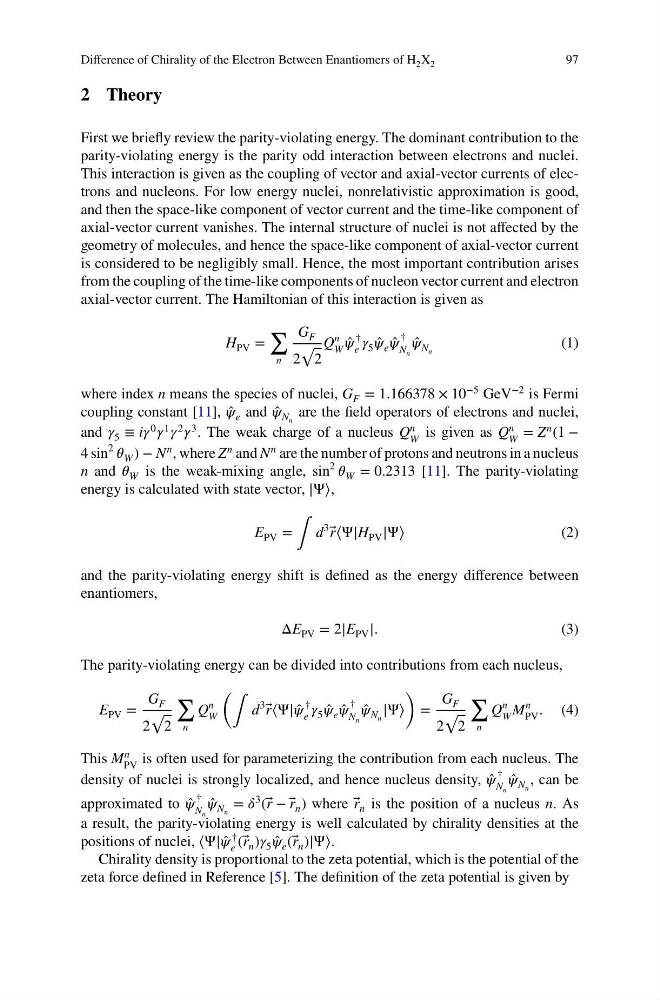
axial-vector current. The Hamiltonian of this interaction is given as
H PV =
∑
n
G F
2
√
2
Q
n
W ̂
í µí¼
†
e í µí»¾ 5 ̂
í µí¼ e ̂
í µí¼
†
N n
̂
í µí¼ N n
(1)
where index n means the species of nuclei, G F = 1.166378 × 10
−5 GeV
−2 is Fermi
coupling constant [11], ̂
í µí¼ e and ̂
í µí¼ N n are the field operators of electrons and nuclei,
and í µí»¾ 5 ≡ ií µí»¾ 0 í µí»¾ 1 í µí»¾ 2 í µí»¾ 3 . The weak charge of a nucleus Q
n
W
is given as Q
n
W
= Z n (1 −
4 sin
2
í µí¼ W ) − N
n , where Z
n and N
n are the number of protons and neutrons in a nucleus
n and í µí¼ W is the weak-mixing angle, sin
2
í µí¼ W = 0.2313 [11]. The parity-violating
energy is calculated with state vector, |Ψ⟩,
E PV = ∫
d
3
⃗ r⟨Ψ|H PV |Ψ⟩
(2)
and the parity-violating energy shift is defined as the energy difference between
enantiomers,
ΔE PV = 2|E PV |.
(3)
The parity-violating energy can be divided into contributions from each nucleus,
E PV =
G F
2
√
2
∑
n
Q
n
W
(
∫
d
3
⃗ r⟨Ψ| ̂
í µí¼
†
e
í µí»¾ 5 ̂
í µí¼ e ̂
í µí¼
†
N n
̂
í µí¼ N n |Ψ⟩
)
=
G F
2
√
2
∑
n
Q
n
W
M
n
PV
. (4)
This M
n
PV
is often used for parameterizing the contribution from each nucleus. The
density of nuclei is strongly localized, and hence nucleus density, ̂
í µí¼
†
N n
̂
í µí¼ N n , can be
approximated to ̂
í µí¼
†
N n
̂
í µí¼ N n = í µí»¿
3
(⃗ r − ⃗ r n ) where ⃗ r n is the position of a nucleus n. As
a result, the parity-violating energy is well calculated by chirality densities at the
positions of nuclei, ⟨Ψ| ̂
í µí¼
†
e (⃗ r n )í µí»¾ 5 ̂
í µí¼ e (⃗ r n )|Ψ⟩.
Chirality density is proportional to the zeta potential, which is the potential of the
zeta force defined in Reference [5]. The definition of the zeta potential is given by
97
2 Theory
First we briefly review the parity-violating energy. The dominant contribution to the
parity-violating energy is the parity odd interaction between electrons and nuclei.
This interaction is given as the coupling of vector and axial-vector currents of electrons and nucleons. For low energy nuclei, nonrelativistic approximation is good,
and then the space-like component of vector current and the time-like component of
axial-vector current vanishes. The internal structure of nuclei is not affected by the
geometry of molecules, and hence the space-like component of axial-vector current
is considered to be negligibly small. Hence, the most important contribution arises
from the coupling of the time-like components of nucleon vector current and electron
axial-vector current. The Hamiltonian of this interaction is given as
H PV =
∑
n
G F
2
√
2
Q
n
W ̂
í µí¼
†
e í µí»¾ 5 ̂
í µí¼ e ̂
í µí¼
†
N n
̂
í µí¼ N n
(1)
where index n means the species of nuclei, G F = 1.166378 × 10
−5 GeV
−2 is Fermi
coupling constant [11], ̂
í µí¼ e and ̂
í µí¼ N n are the field operators of electrons and nuclei,
and í µí»¾ 5 ≡ ií µí»¾ 0 í µí»¾ 1 í µí»¾ 2 í µí»¾ 3 . The weak charge of a nucleus Q
n
W
is given as Q
n
W
= Z n (1 −
4 sin
2
í µí¼ W ) − N
n , where Z
n and N
n are the number of protons and neutrons in a nucleus
n and í µí¼ W is the weak-mixing angle, sin
2
í µí¼ W = 0.2313 [11]. The parity-violating
energy is calculated with state vector, |Ψ⟩,
E PV = ∫
d
3
⃗ r⟨Ψ|H PV |Ψ⟩
(2)
and the parity-violating energy shift is defined as the energy difference between
enantiomers,
ΔE PV = 2|E PV |.
(3)
The parity-violating energy can be divided into contributions from each nucleus,
E PV =
G F
2
√
2
∑
n
Q
n
W
(
∫
d
3
⃗ r⟨Ψ| ̂
í µí¼
†
e
í µí»¾ 5 ̂
í µí¼ e ̂
í µí¼
†
N n
̂
í µí¼ N n |Ψ⟩
)
=
G F
2
√
2
∑
n
Q
n
W
M
n
PV
. (4)
This M
n
PV
is often used for parameterizing the contribution from each nucleus. The
density of nuclei is strongly localized, and hence nucleus density, ̂
í µí¼
†
N n
̂
í µí¼ N n , can be
approximated to ̂
í µí¼
†
N n
̂
í µí¼ N n = í µí»¿
3
(⃗ r − ⃗ r n ) where ⃗ r n is the position of a nucleus n. As
a result, the parity-violating energy is well calculated by chirality densities at the
positions of nuclei, ⟨Ψ| ̂
í µí¼
†
e (⃗ r n )í µí»¾ 5 ̂
í µí¼ e (⃗ r n )|Ψ⟩.
Chirality density is proportional to the zeta potential, which is the potential of the
zeta force defined in Reference [5]. The definition of the zeta potential is given by