

Serpentinicella alkaliphila [32] can be noted. All three are anaerobic; the latter two
uses a rather limited set of substrates including fructose, lactate, pyruvate, crotonate,
and proteinaceous substances. Three strains of obligate alkaliphiles with an optimum
for growth at pH 11 and are capable of autotrophic growth using hydrogen, calcium
carbonate, and oxygen have been isolated from highly alkaline (pH 11.6)
serpentinizing springs at the Cedars, California [33]. It is proposed to place them in
a new genus “Serpentinomonas”; however, it has not been validated yet. An earlier
publication describes strictly aerobic, heterotrophic Algoriphagus alkaliphilus (former Chimaereicella alkaliphila) isolated from a highly alkaline (pH 11.4) groundwater environment at Cabeço de Vide, in Southern Portugal [34]. All isolated cultures
were natronophilic, and the lack of NaCl requirements for organisms isolated from
terrestrial serpentinization sites may be a consequence of their adaptation to a habitat
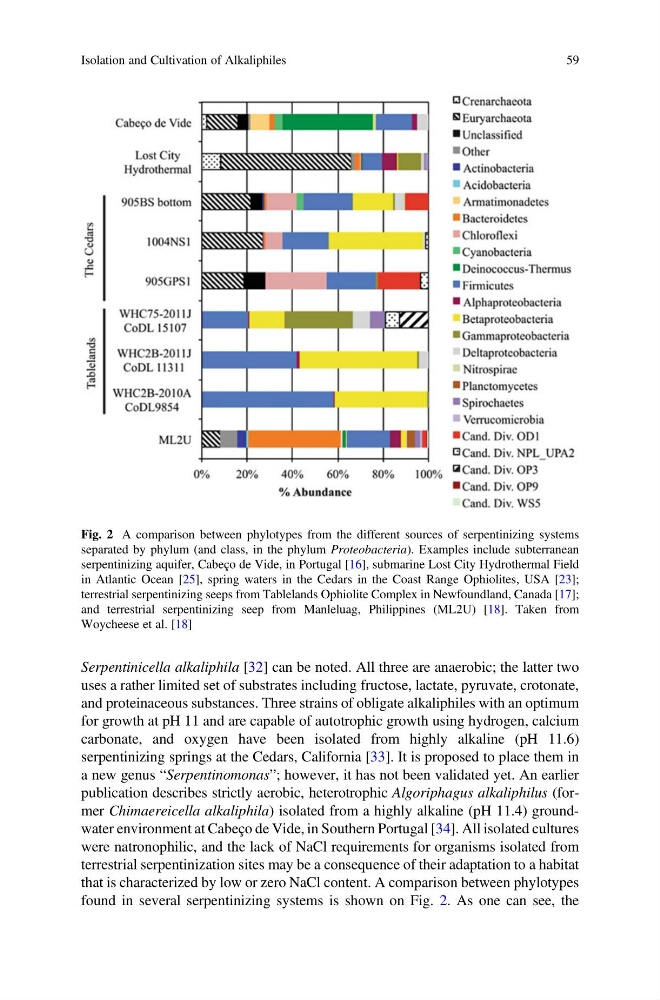
that is characterized by low or zero NaCl content. A comparison between phylotypes
found in several serpentinizing systems is shown on Fig. 2. As one can see, the
Fig. 2 A comparison between phylotypes from the different sources of serpentinizing systems
separated by phylum (and class, in the phylum Proteobacteria). Examples include subterranean
serpentinizing aquifer, Cabeço de Vide, in Portugal [16], submarine Lost City Hydrothermal Field
in Atlantic Ocean [25], spring waters in the Cedars in the Coast Range Ophiolites, USA [23];
terrestrial serpentinizing seeps from Tablelands Ophiolite Complex in Newfoundland, Canada [17];
and terrestrial serpentinizing seep from Manleluag, Philippines (ML2U) [18]. Taken from
Woycheese et al. [18]
Isolation and Cultivation of Alkaliphiles
59
uses a rather limited set of substrates including fructose, lactate, pyruvate, crotonate,
and proteinaceous substances. Three strains of obligate alkaliphiles with an optimum
for growth at pH 11 and are capable of autotrophic growth using hydrogen, calcium
carbonate, and oxygen have been isolated from highly alkaline (pH 11.6)
serpentinizing springs at the Cedars, California [33]. It is proposed to place them in
a new genus “Serpentinomonas”; however, it has not been validated yet. An earlier
publication describes strictly aerobic, heterotrophic Algoriphagus alkaliphilus (former Chimaereicella alkaliphila) isolated from a highly alkaline (pH 11.4) groundwater environment at Cabeço de Vide, in Southern Portugal [34]. All isolated cultures
were natronophilic, and the lack of NaCl requirements for organisms isolated from
terrestrial serpentinization sites may be a consequence of their adaptation to a habitat
that is characterized by low or zero NaCl content. A comparison between phylotypes
found in several serpentinizing systems is shown on Fig. 2. As one can see, the
Fig. 2 A comparison between phylotypes from the different sources of serpentinizing systems
separated by phylum (and class, in the phylum Proteobacteria). Examples include subterranean
serpentinizing aquifer, Cabeço de Vide, in Portugal [16], submarine Lost City Hydrothermal Field
in Atlantic Ocean [25], spring waters in the Cedars in the Coast Range Ophiolites, USA [23];
terrestrial serpentinizing seeps from Tablelands Ophiolite Complex in Newfoundland, Canada [17];
and terrestrial serpentinizing seep from Manleluag, Philippines (ML2U) [18]. Taken from
Woycheese et al. [18]
Isolation and Cultivation of Alkaliphiles
59