

strains are the most common biological agents used in these studies [165], which may
be primarily due to the formation of resistant spores, alkaliphilicity, high carbonate
productivity, and ability of precipitating high amount of calcite [218].
As the survival rate of unprotected cells or spores is low (Table 4), recent studies
use protected cells/spores as self-healing agents [161]. The efficiency of the system
significantly varies depending on the method of protection used. The type of the cell
immobilization material and the method of immobilization not only affect the
healing efficiency but also affects the strength regain [9]. For instance, this study
revealed that calcite precipitation was higher in silica gel immobilized cells than
those immobilized by polyurethane. However, the strength regain was better when
polyurethane was used as immobilizing matrix than silica gel. The concrete treated
with polyurethane-immobilized bacteria regained 50–80% of its initial strength
which is much better than the 5% strength regain achieved using silica gel
immobilized bacteria. The authors also reported a lower water permeability coefficient (10
À10
–10
À11 m/s) in the mortar treated by polyurethane-immobilized cells. On
the other hand, the water permeability coefficient of the specimen treated with silica
gel immobilized cells was in the range of 10
À7
–10
À9 m/s. Another material used in
protecting the bioagents is diatomaceous earth. Concrete treated by cells
immobilized in diatomaceous earth resulted in about a 70% reduction in water
permeability [209]. This material has another important feature; it is the only cell
carrier used that has a positive impact on the strength of the concrete [219, 220]. The
observed improvement in the concrete strength is believed to be due to the
CaCO 3
CO(NH 2 ) 2 + H 2 O
2NH 3 + CO 2
CO(NH 2 ) 2
Calcite crystals
Flagellum
Saturation
Endospore
Negative charge
Cell wall
Cell membrane
Cytoplasm
urease
Ca
2+
Ca
2+ Ca
2+ Ca
2+ Ca
2+ Ca
2+
Ca
2+ Ca
2+
Ca
2+ Ca
2+
Ca
2+
Ca
2+
Ca
2+
Ca
2+
Ca
2+
Ca
2+
Ca
2+
Ca
2+
Ca
2+
Ca
2+
Ca
2+
Ca
2+
Ca
2+
Ca
2+
Ca
2+
Ca
2+
Ca
2+
Ca
2+
Ca
2+ Ca
2+
Ca
2+
Ca
2+
Ca
2+
Ca
2+
Ca
2+
Ca
2+
Ca
2+
Ca
2+
Ca
2+
Ca
2+
With
H 2 O
NH 4
+
pH
CO 3
2–
Ca 2+ + CO 3
2–
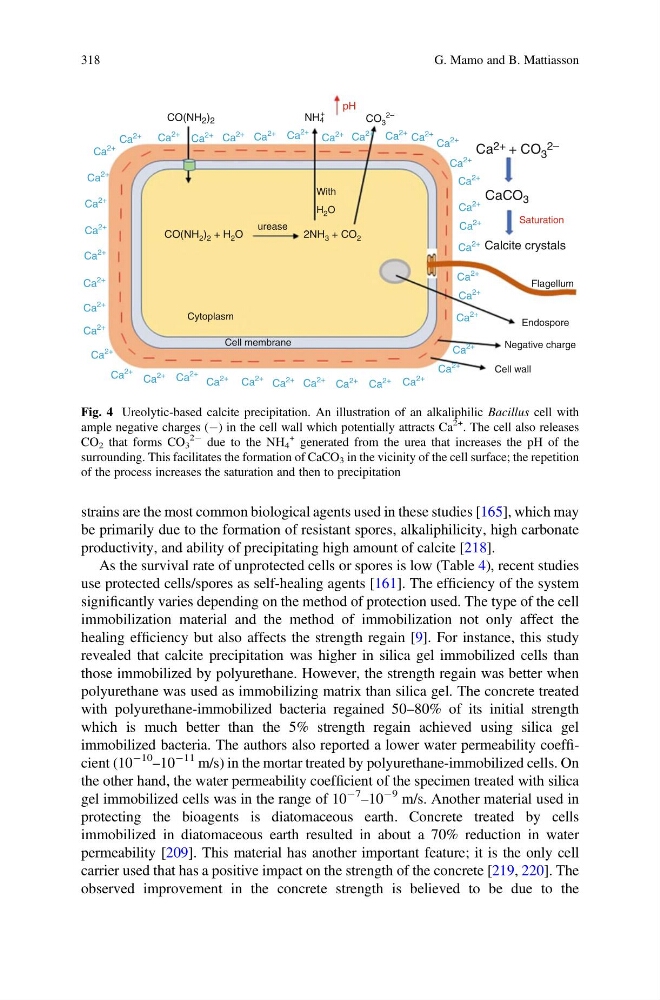
Fig. 4 Ureolytic-based calcite precipitation. An illustration of an alkaliphilic Bacillus cell with
ample negative charges (À) in the cell wall which potentially attracts Ca
2+ . The cell also releases
CO 2 that forms CO 3
2À due to the NH 4
+ generated from the urea that increases the pH of the
surrounding. This facilitates the formation of CaCO 3 in the vicinity of the cell surface; the repetition
of the process increases the saturation and then to precipitation
318
G. Mamo and B. Mattiasson
be primarily due to the formation of resistant spores, alkaliphilicity, high carbonate
productivity, and ability of precipitating high amount of calcite [218].
As the survival rate of unprotected cells or spores is low (Table 4), recent studies
use protected cells/spores as self-healing agents [161]. The efficiency of the system
significantly varies depending on the method of protection used. The type of the cell
immobilization material and the method of immobilization not only affect the
healing efficiency but also affects the strength regain [9]. For instance, this study
revealed that calcite precipitation was higher in silica gel immobilized cells than
those immobilized by polyurethane. However, the strength regain was better when
polyurethane was used as immobilizing matrix than silica gel. The concrete treated
with polyurethane-immobilized bacteria regained 50–80% of its initial strength
which is much better than the 5% strength regain achieved using silica gel
immobilized bacteria. The authors also reported a lower water permeability coefficient (10
À10
–10
À11 m/s) in the mortar treated by polyurethane-immobilized cells. On
the other hand, the water permeability coefficient of the specimen treated with silica
gel immobilized cells was in the range of 10
À7
–10
À9 m/s. Another material used in
protecting the bioagents is diatomaceous earth. Concrete treated by cells
immobilized in diatomaceous earth resulted in about a 70% reduction in water
permeability [209]. This material has another important feature; it is the only cell
carrier used that has a positive impact on the strength of the concrete [219, 220]. The
observed improvement in the concrete strength is believed to be due to the
CaCO 3
CO(NH 2 ) 2 + H 2 O
2NH 3 + CO 2
CO(NH 2 ) 2
Calcite crystals
Flagellum
Saturation
Endospore
Negative charge
Cell wall
Cell membrane
Cytoplasm
urease
Ca
2+
Ca
2+ Ca
2+ Ca
2+ Ca
2+ Ca
2+
Ca
2+ Ca
2+
Ca
2+ Ca
2+
Ca
2+
Ca
2+
Ca
2+
Ca
2+
Ca
2+
Ca
2+
Ca
2+
Ca
2+
Ca
2+
Ca
2+
Ca
2+
Ca
2+
Ca
2+
Ca
2+
Ca
2+
Ca
2+
Ca
2+
Ca
2+
Ca
2+ Ca
2+
Ca
2+
Ca
2+
Ca
2+
Ca
2+
Ca
2+
Ca
2+
Ca
2+
Ca
2+
Ca
2+
Ca
2+
With
H 2 O
NH 4
+
pH
CO 3
2–
Ca 2+ + CO 3
2–
Fig. 4 Ureolytic-based calcite precipitation. An illustration of an alkaliphilic Bacillus cell with
ample negative charges (À) in the cell wall which potentially attracts Ca
2+ . The cell also releases
CO 2 that forms CO 3
2À due to the NH 4
+ generated from the urea that increases the pH of the
surrounding. This facilitates the formation of CaCO 3 in the vicinity of the cell surface; the repetition
of the process increases the saturation and then to precipitation
318
G. Mamo and B. Mattiasson