

enzymes are alkaline active; hence alkaliphiles which are producing alkaline active
enzymes by far and large are expected to demonstrate at least equally excellent
bioactive peptide production properties; however, this needs to be experimentally
proven. In addition to bioactive peptides, alkaline active proteases can be used
directly in treatments. Studies have indicated the potential of alkaline active proteases with fibrinolytic activities in the treatment of thrombosis and cancer [171–
173]. Moreover, an alkaline active serine protease with elastolytic property has been
used to make elastoterase [174], a formulation used to treat burns, abscesses,
carbuncles, and other wounds [175].
4.3 Carotenoids of Alkaliphiles
Different plants, algae, and microorganisms are known producing carotenoids,
pigment molecules with polyene backbone which consist of a series of conjugated
C¼C bonds. The modification of the carbon chain due to oxidation, hydroxylation,
and other reactions led to the presence of a large variety of carotenoids, with more
than 700 known structures so far. These substances are yellow, orange, or red in
color and among other things are known to offer photoprotection and antioxidant
activity, properties that led to applications of carotenoids as food colorants, source of
vitamin A, feed supplements, and nutraceuticals for cosmetic and pharmaceutical
applications [176]. Due to increasing eye problems and cancer cases, and the shift of
consumers to organic and natural products, the carotenoid market is expected to
grow from about 2.3 billion USD in 2017 to USD 3.6 billion by 2025 as reported by
[177]. This indicates that the carotenoid market is expanding. This has led to look for
new products as well as better alternatives to the traditional synthetic production
method. Due to the low cost, high yield, and safety to consumers and the environment, microbial-based production of carotenoids has become a trend [178, 179].
A wide variety of alkaliphiles are known producing carotenoids, and it is believed
that these substances are possibly involved in the high pH adaptation mechanisms of
alkaliphiles (see [60]). For instance, astaxanthin, the most important commercial
carotenoid which is known for its anticancer [180, 181], antioxidant, and immunomodulatory activity [182], is known to be produced by a range of alkaliphiles.
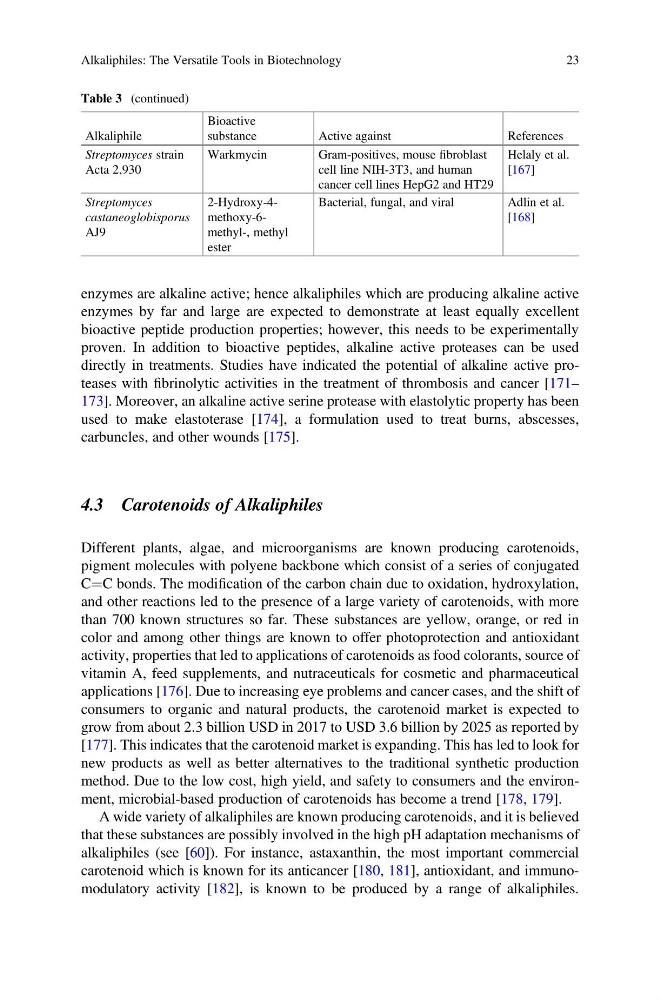
Table 3 (continued)
Alkaliphile
Bioactive
substance
Active against
References
Streptomyces strain
Acta 2,930
Warkmycin
Gram-positives, mouse fibroblast
cell line NIH-3T3, and human
cancer cell lines HepG2 and HT29
Helaly et al.
[167]
Streptomyces
castaneoglobisporus
AJ9
methoxy-6methyl-, methyl
ester
Bacterial, fungal, and viral
Adlin et al.
[168]
Alkaliphiles: The Versatile Tools in Biotechnology
23
enzymes by far and large are expected to demonstrate at least equally excellent
bioactive peptide production properties; however, this needs to be experimentally
proven. In addition to bioactive peptides, alkaline active proteases can be used
directly in treatments. Studies have indicated the potential of alkaline active proteases with fibrinolytic activities in the treatment of thrombosis and cancer [171–
173]. Moreover, an alkaline active serine protease with elastolytic property has been
used to make elastoterase [174], a formulation used to treat burns, abscesses,
carbuncles, and other wounds [175].
4.3 Carotenoids of Alkaliphiles
Different plants, algae, and microorganisms are known producing carotenoids,
pigment molecules with polyene backbone which consist of a series of conjugated
C¼C bonds. The modification of the carbon chain due to oxidation, hydroxylation,
and other reactions led to the presence of a large variety of carotenoids, with more
than 700 known structures so far. These substances are yellow, orange, or red in
color and among other things are known to offer photoprotection and antioxidant
activity, properties that led to applications of carotenoids as food colorants, source of
vitamin A, feed supplements, and nutraceuticals for cosmetic and pharmaceutical
applications [176]. Due to increasing eye problems and cancer cases, and the shift of
consumers to organic and natural products, the carotenoid market is expected to
grow from about 2.3 billion USD in 2017 to USD 3.6 billion by 2025 as reported by
[177]. This indicates that the carotenoid market is expanding. This has led to look for
new products as well as better alternatives to the traditional synthetic production
method. Due to the low cost, high yield, and safety to consumers and the environment, microbial-based production of carotenoids has become a trend [178, 179].
A wide variety of alkaliphiles are known producing carotenoids, and it is believed
that these substances are possibly involved in the high pH adaptation mechanisms of
alkaliphiles (see [60]). For instance, astaxanthin, the most important commercial
carotenoid which is known for its anticancer [180, 181], antioxidant, and immunomodulatory activity [182], is known to be produced by a range of alkaliphiles.
Table 3 (continued)
Alkaliphile
Bioactive
substance
Active against
References
Streptomyces strain
Acta 2,930
Warkmycin
Gram-positives, mouse fibroblast
cell line NIH-3T3, and human
cancer cell lines HepG2 and HT29
Helaly et al.
[167]
Streptomyces
castaneoglobisporus
AJ9
methoxy-6methyl-, methyl
ester
Bacterial, fungal, and viral
Adlin et al.
[168]
Alkaliphiles: The Versatile Tools in Biotechnology
23