

4.2 Pharmaceutically Important Metabolites
The rate of new bioactive substance discovery from conventional sources has been
declining, and, hence, there has been interest in expanding the search for pharmaceutically important compounds to non-conventional sources such as extremophiles.
Alkaliphiles, being one of the prominent extremophiles, have been subject to such
explorations, and several interesting bioactive compounds are already reported.
Some of these compounds are shown in Table 3.
In addition to metabolites, alkaline active enzymes have also been considered in
therapeutic applications. Bioactive peptides which have health-promoting effects are
often obtained from proteins through enzymatic hydrolysis. These peptides are
known to have, among others, antimicrobial, antihypertensive, and antitype 2 diabetes mellitus activities [169]. The protein amino acid sequence and the specificity of
the protease used to hydrolyze the protein are the two most important parameters in
the production of peptides with desired effects. In this line, alkaline active proteases
which are optimally active in the pH range of 9–10 such as those from Cryptococcus
aureus, Issatchenkia orientalis, Aureobasidium pullulans, and Yarrowia lipolytica
have been reported for their promising bioactive peptide production properties from
different protein sources [170]. These organisms are not alkaliphiles, but their
H 2 O
+
+
+
Lipase from
B. atrophaeus
A. mediolanus
Epoxide hydrolase
Esterase from
B. cereus
Epoxide hydrolase
A. mediolanus
Valeric acid
Ethyl alcohol
Ethyl valerate
O-benzyl lactic
acid ethyl ester
Levofloxacin
P. halotolerans
Esterase PE8
3-DFG
3-FGA
(R)-3-MFG
(s)-3-MFG
+
+
Dioxane
(-)-Paroxetine
a)
b)
c)
d)
e)
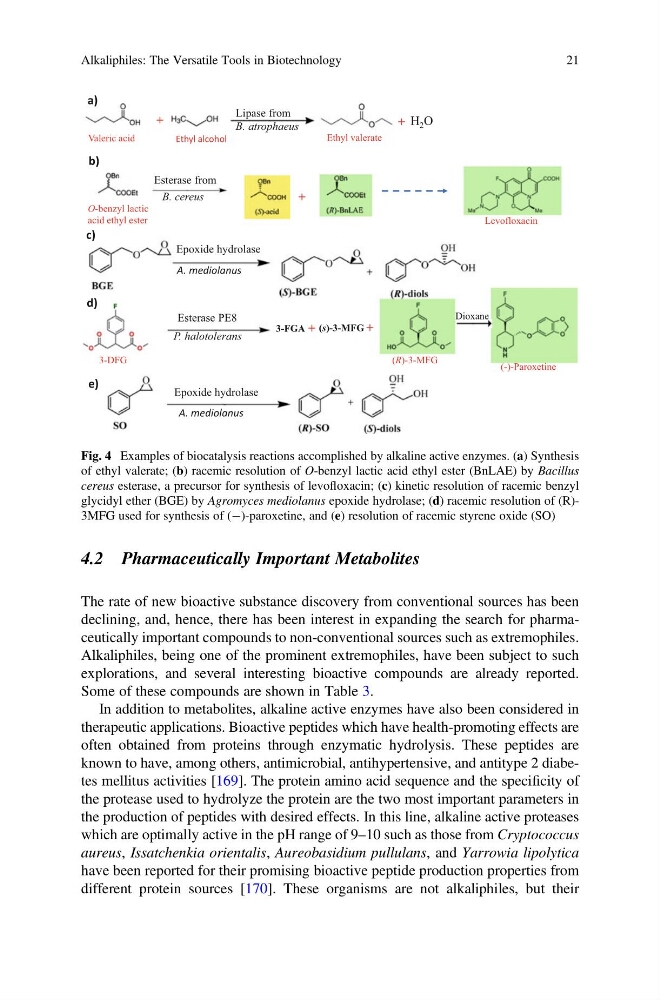
Fig. 4 Examples of biocatalysis reactions accomplished by alkaline active enzymes. (a) Synthesis
of ethyl valerate; (b) racemic resolution of O-benzyl lactic acid ethyl ester (BnLAE) by Bacillus
cereus esterase, a precursor for synthesis of levofloxacin; (c) kinetic resolution of racemic benzyl
glycidyl ether (BGE) by Agromyces mediolanus epoxide hydrolase; (d) racemic resolution of (R)3MFG used for synthesis of (À)-paroxetine, and (e) resolution of racemic styrene oxide (SO)
Alkaliphiles: The Versatile Tools in Biotechnology
21
The rate of new bioactive substance discovery from conventional sources has been
declining, and, hence, there has been interest in expanding the search for pharmaceutically important compounds to non-conventional sources such as extremophiles.
Alkaliphiles, being one of the prominent extremophiles, have been subject to such
explorations, and several interesting bioactive compounds are already reported.
Some of these compounds are shown in Table 3.
In addition to metabolites, alkaline active enzymes have also been considered in
therapeutic applications. Bioactive peptides which have health-promoting effects are
often obtained from proteins through enzymatic hydrolysis. These peptides are
known to have, among others, antimicrobial, antihypertensive, and antitype 2 diabetes mellitus activities [169]. The protein amino acid sequence and the specificity of
the protease used to hydrolyze the protein are the two most important parameters in
the production of peptides with desired effects. In this line, alkaline active proteases
which are optimally active in the pH range of 9–10 such as those from Cryptococcus
aureus, Issatchenkia orientalis, Aureobasidium pullulans, and Yarrowia lipolytica
have been reported for their promising bioactive peptide production properties from
different protein sources [170]. These organisms are not alkaliphiles, but their
H 2 O
+
+
+
Lipase from
B. atrophaeus
A. mediolanus
Epoxide hydrolase
Esterase from
B. cereus
Epoxide hydrolase
A. mediolanus
Valeric acid
Ethyl alcohol
Ethyl valerate
O-benzyl lactic
acid ethyl ester
Levofloxacin
P. halotolerans
Esterase PE8
3-DFG
3-FGA
(R)-3-MFG
(s)-3-MFG
+
+
Dioxane
(-)-Paroxetine
a)
b)
c)
d)
e)
Fig. 4 Examples of biocatalysis reactions accomplished by alkaline active enzymes. (a) Synthesis
of ethyl valerate; (b) racemic resolution of O-benzyl lactic acid ethyl ester (BnLAE) by Bacillus
cereus esterase, a precursor for synthesis of levofloxacin; (c) kinetic resolution of racemic benzyl
glycidyl ether (BGE) by Agromyces mediolanus epoxide hydrolase; (d) racemic resolution of (R)3MFG used for synthesis of (À)-paroxetine, and (e) resolution of racemic styrene oxide (SO)
Alkaliphiles: The Versatile Tools in Biotechnology
21