

from inefficiency and unsustainability. Most of the products are expensive and
susceptible to degradation, exhibit poor bonding to the cracked concrete surfaces,
and are characterized by different physical properties such as thermal expansion
coefficients which are different to that of concrete. Moreover, many of these repair
agents contain chemicals that pose environmental and health hazards. Thus, there
has been interest in developing concrete crack repair agents that are efficient, long
lasting, safe, and benign to the environment and exhibit physical properties which
resemble that of the concrete. The search initiated by these desires brought the use of
biomineralization processes as tools in mending concrete cracks. Among biomineralization processes, microbially initiated calcite precipitation has emerged as an
interesting alternative to the existing chemical-based concrete crack repairing system. Indeed, results of several studies on the use of microbial-based concrete repair
agents revealed the remarkable potential of this approach in the fight against concrete
deterioration. In addition to repairing existing concrete cracks, microorganisms have
also been considered to make protective surface coating (biodeposition) on concrete
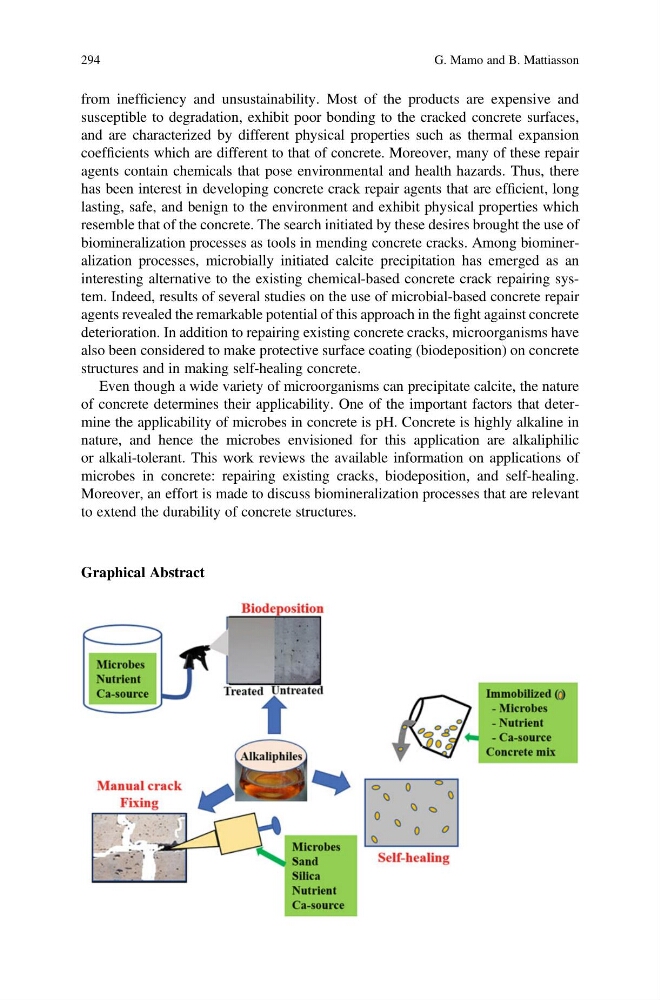
structures and in making self-healing concrete.
Even though a wide variety of microorganisms can precipitate calcite, the nature
of concrete determines their applicability. One of the important factors that determine the applicability of microbes in concrete is pH. Concrete is highly alkaline in
nature, and hence the microbes envisioned for this application are alkaliphilic
or alkali-tolerant. This work reviews the available information on applications of
microbes in concrete: repairing existing cracks, biodeposition, and self-healing.
Moreover, an effort is made to discuss biomineralization processes that are relevant
to extend the durability of concrete structures.
Graphical Abstract
294
G. Mamo and B. Mattiasson
susceptible to degradation, exhibit poor bonding to the cracked concrete surfaces,
and are characterized by different physical properties such as thermal expansion
coefficients which are different to that of concrete. Moreover, many of these repair
agents contain chemicals that pose environmental and health hazards. Thus, there
has been interest in developing concrete crack repair agents that are efficient, long
lasting, safe, and benign to the environment and exhibit physical properties which
resemble that of the concrete. The search initiated by these desires brought the use of
biomineralization processes as tools in mending concrete cracks. Among biomineralization processes, microbially initiated calcite precipitation has emerged as an
interesting alternative to the existing chemical-based concrete crack repairing system. Indeed, results of several studies on the use of microbial-based concrete repair
agents revealed the remarkable potential of this approach in the fight against concrete
deterioration. In addition to repairing existing concrete cracks, microorganisms have
also been considered to make protective surface coating (biodeposition) on concrete
structures and in making self-healing concrete.
Even though a wide variety of microorganisms can precipitate calcite, the nature
of concrete determines their applicability. One of the important factors that determine the applicability of microbes in concrete is pH. Concrete is highly alkaline in
nature, and hence the microbes envisioned for this application are alkaliphilic
or alkali-tolerant. This work reviews the available information on applications of
microbes in concrete: repairing existing cracks, biodeposition, and self-healing.
Moreover, an effort is made to discuss biomineralization processes that are relevant
to extend the durability of concrete structures.
Graphical Abstract
294
G. Mamo and B. Mattiasson