

while γ-cyclodextrin can accommodate a wider variety of large organic compounds
such as macrocycles (molecules and ions containing twelve or more membered
rings) and steroids [51].
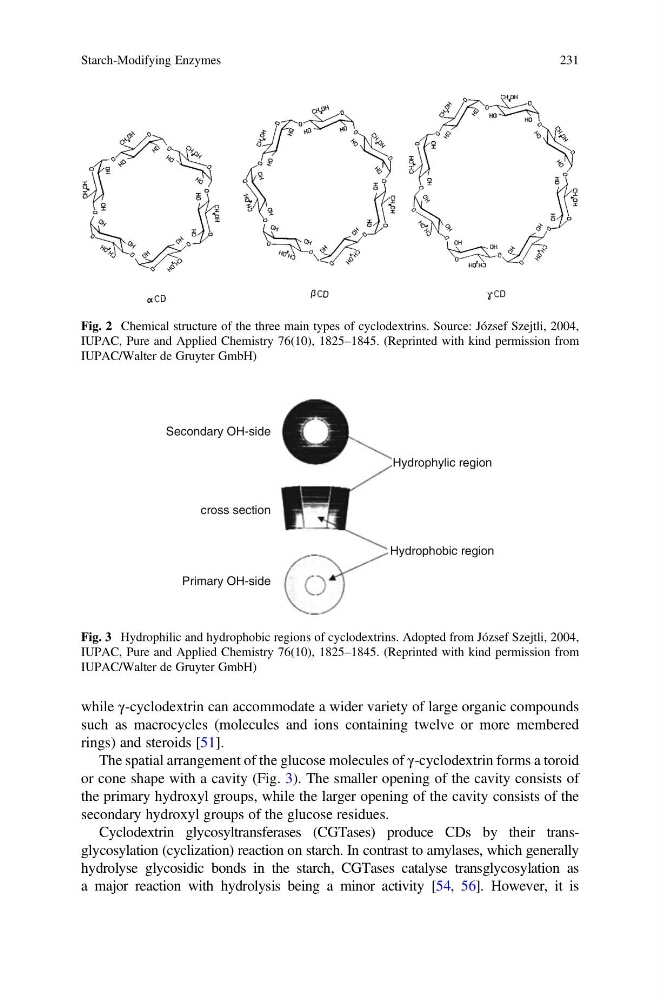
The spatial arrangement of the glucose molecules of γ-cyclodextrin forms a toroid
or cone shape with a cavity (Fig. 3). The smaller opening of the cavity consists of
the primary hydroxyl groups, while the larger opening of the cavity consists of the
secondary hydroxyl groups of the glucose residues.
Cyclodextrin glycosyltransferases (CGTases) produce CDs by their transglycosylation (cyclization) reaction on starch. In contrast to amylases, which generally
hydrolyse glycosidic bonds in the starch, CGTases catalyse transglycosylation as
a major reaction with hydrolysis being a minor activity [54, 56]. However, it is
Secondary OH-side
cross section
Primary OH-side
Hydrophylic region
Hydrophobic region
Fig. 3 Hydrophilic and hydrophobic regions of cyclodextrins. Adopted from József Szejtli, 2004,
IUPAC, Pure and Applied Chemistry 76(10), 1825–1845. (Reprinted with kind permission from
IUPAC/Walter de Gruyter GmbH)
Fig. 2 Chemical structure of the three main types of cyclodextrins. Source: József Szejtli, 2004,
IUPAC, Pure and Applied Chemistry 76(10), 1825–1845. (Reprinted with kind permission from
IUPAC/Walter de Gruyter GmbH)
Starch-Modifying Enzymes
231
such as macrocycles (molecules and ions containing twelve or more membered
rings) and steroids [51].
The spatial arrangement of the glucose molecules of γ-cyclodextrin forms a toroid
or cone shape with a cavity (Fig. 3). The smaller opening of the cavity consists of
the primary hydroxyl groups, while the larger opening of the cavity consists of the
secondary hydroxyl groups of the glucose residues.
Cyclodextrin glycosyltransferases (CGTases) produce CDs by their transglycosylation (cyclization) reaction on starch. In contrast to amylases, which generally
hydrolyse glycosidic bonds in the starch, CGTases catalyse transglycosylation as
a major reaction with hydrolysis being a minor activity [54, 56]. However, it is
Secondary OH-side
cross section
Primary OH-side
Hydrophylic region
Hydrophobic region
Fig. 3 Hydrophilic and hydrophobic regions of cyclodextrins. Adopted from József Szejtli, 2004,
IUPAC, Pure and Applied Chemistry 76(10), 1825–1845. (Reprinted with kind permission from
IUPAC/Walter de Gruyter GmbH)
Fig. 2 Chemical structure of the three main types of cyclodextrins. Source: József Szejtli, 2004,
IUPAC, Pure and Applied Chemistry 76(10), 1825–1845. (Reprinted with kind permission from
IUPAC/Walter de Gruyter GmbH)
Starch-Modifying Enzymes
231