

2 Conventional Leather Processing and Environmental
Pollution
The essential protein component of leather, collagen, exists in hides and skins is
association with various globular proteins specifically, globulin, albumin, mucoids
and fibrous proteins such as α-keratin, elastin, and reticular fibres [3]. During leather
preparation processes, the hair or scales attached to the skins/hide is often removed.
In addition, the non-collagenous constituents such as fat, blood remains and flesh are
also removed in pre-tanning and tanning operations. The degree of their removal and
the method used determine the leather product quality. Conventional leathermanufacturing processes use huge quantities of fresh water, lime, acid, pigments,
sodium sulphide, heavy oils, fungicide, salts, soap, dyes, solvents and energy. When
all these chemicals are mixed at different stages of leather processing, they form a
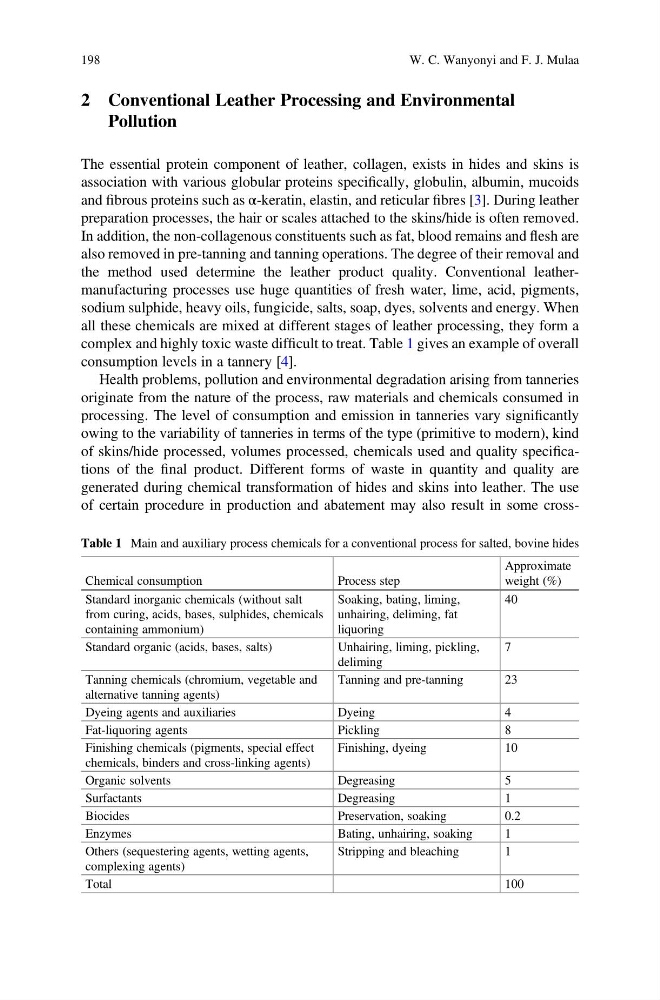
complex and highly toxic waste difficult to treat. Table 1 gives an example of overall
consumption levels in a tannery [4].
Health problems, pollution and environmental degradation arising from tanneries
originate from the nature of the process, raw materials and chemicals consumed in
processing. The level of consumption and emission in tanneries vary significantly
owing to the variability of tanneries in terms of the type (primitive to modern), kind
of skins/hide processed, volumes processed, chemicals used and quality specifications of the final product. Different forms of waste in quantity and quality are
generated during chemical transformation of hides and skins into leather. The use
of certain procedure in production and abatement may also result in some crossTable 1 Main and auxiliary process chemicals for a conventional process for salted, bovine hides
Chemical consumption
Process step
Approximate
weight (%)
Standard inorganic chemicals (without salt
from curing, acids, bases, sulphides, chemicals
containing ammonium)
Soaking, bating, liming,
unhairing, deliming, fat
liquoring
40
Standard organic (acids, bases, salts)
Unhairing, liming, pickling,
deliming
7
Tanning chemicals (chromium, vegetable and
alternative tanning agents)
Tanning and pre-tanning
23
Dyeing agents and auxiliaries
Dyeing
4
Fat-liquoring agents
Pickling
8
Finishing chemicals (pigments, special effect
chemicals, binders and cross-linking agents)
Finishing, dyeing
10
Organic solvents
Degreasing
5
Surfactants
Degreasing
1
Biocides
Preservation, soaking
0.2
Enzymes
Bating, unhairing, soaking
1
Others (sequestering agents, wetting agents,
complexing agents)
Stripping and bleaching
1
Total
100
198
W. C. Wanyonyi and F. J. Mulaa
Pollution
The essential protein component of leather, collagen, exists in hides and skins is
association with various globular proteins specifically, globulin, albumin, mucoids
and fibrous proteins such as α-keratin, elastin, and reticular fibres [3]. During leather
preparation processes, the hair or scales attached to the skins/hide is often removed.
In addition, the non-collagenous constituents such as fat, blood remains and flesh are
also removed in pre-tanning and tanning operations. The degree of their removal and
the method used determine the leather product quality. Conventional leathermanufacturing processes use huge quantities of fresh water, lime, acid, pigments,
sodium sulphide, heavy oils, fungicide, salts, soap, dyes, solvents and energy. When
all these chemicals are mixed at different stages of leather processing, they form a
complex and highly toxic waste difficult to treat. Table 1 gives an example of overall
consumption levels in a tannery [4].
Health problems, pollution and environmental degradation arising from tanneries
originate from the nature of the process, raw materials and chemicals consumed in
processing. The level of consumption and emission in tanneries vary significantly
owing to the variability of tanneries in terms of the type (primitive to modern), kind
of skins/hide processed, volumes processed, chemicals used and quality specifications of the final product. Different forms of waste in quantity and quality are
generated during chemical transformation of hides and skins into leather. The use
of certain procedure in production and abatement may also result in some crossTable 1 Main and auxiliary process chemicals for a conventional process for salted, bovine hides
Chemical consumption
Process step
Approximate
weight (%)
Standard inorganic chemicals (without salt
from curing, acids, bases, sulphides, chemicals
containing ammonium)
Soaking, bating, liming,
unhairing, deliming, fat
liquoring
40
Standard organic (acids, bases, salts)
Unhairing, liming, pickling,
deliming
7
Tanning chemicals (chromium, vegetable and
alternative tanning agents)
Tanning and pre-tanning
23
Dyeing agents and auxiliaries
Dyeing
4
Fat-liquoring agents
Pickling
8
Finishing chemicals (pigments, special effect
chemicals, binders and cross-linking agents)
Finishing, dyeing
10
Organic solvents
Degreasing
5
Surfactants
Degreasing
1
Biocides
Preservation, soaking
0.2
Enzymes
Bating, unhairing, soaking
1
Others (sequestering agents, wetting agents,
complexing agents)
Stripping and bleaching
1
Total
100
198
W. C. Wanyonyi and F. J. Mulaa