

can be applied widely in food industries. The neutralized wastewater can be introduced to communal drainage systems for further bioprocessing.
Lactic acid has many applications in food chemistry, medicine, organic syntheses, and as monomers for bioplastics. In a previous study [5], none of four different
alkaliphilic Bacillus species grown in various sugars produced lactic acid. However,
Yokaryo and Tokiwa [15] isolated alkaliphiles including Bacillus sp. producing
lactic acid. Enterococcus casseliflavus sp. produced L(+)-lactic acid 103 g/L from
129 g/L of glucose with optical purity of 99.5%. During the conversion, the pH was
maintained at 8. The stereoisomers and their ratios appeared to be stable and typical
for each strain. D-Lactate with high optical purity was efficiently produced in
fed-batch fermentation in non-sterile conditions by an engineered alkaliphilic
Bacillus sp. with maximum concentration of 144 g/L. The yield was even better
than in sterile conditions implying to a synergy of a microbial association. Moreover,
cheap nitrogen source was used. The exopolysaccharide production was disrupted
by gene engineering to lower viscosity and energy consumption. The use of NaOH
to maintain the culture pH instead of CaCO 3 avoided precipitation. Polymer-grade
D-lactate was also produced by an engineered alkaliphilic Bacillus under non-sterile
conditions [16].
The metabolic engineering of alkaliphiles has advanced only slowly because of
the technical difficulties. Could alkaliphiles have benefits as the host organisms? Are
the metabolic rates high enough? Are there specific reactions which are faster than in
neutral conditions? Rationally thinking, the growth rates of alkaliphiles should be
lower than in neutral conditions, but it does not seem to be always true. Functioning
in non-sterile conditions is clearly beneficial, but such processes may be exceptions.
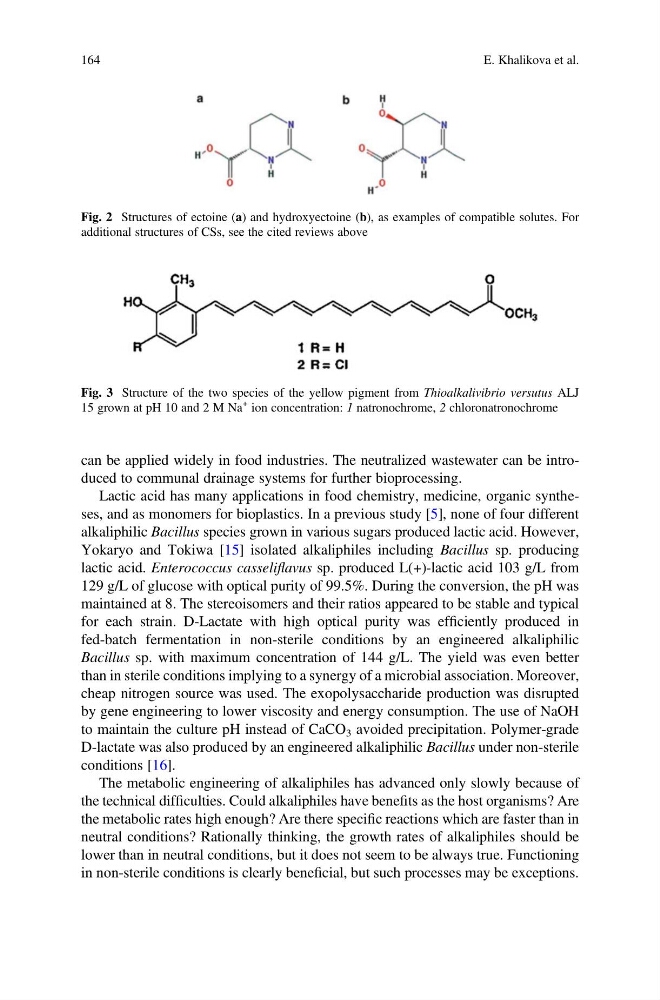
Fig. 2 Structures of ectoine (a) and hydroxyectoine (b), as examples of compatible solutes. For
additional structures of CSs, see the cited reviews above
Fig. 3 Structure of the two species of the yellow pigment from Thioalkalivibrio versutus ALJ
15 grown at pH 10 and 2 M Na
+ ion concentration: 1 natronochrome, 2 chloronatronochrome
164
E. Khalikova et al.
Lactic acid has many applications in food chemistry, medicine, organic syntheses, and as monomers for bioplastics. In a previous study [5], none of four different
alkaliphilic Bacillus species grown in various sugars produced lactic acid. However,
Yokaryo and Tokiwa [15] isolated alkaliphiles including Bacillus sp. producing
lactic acid. Enterococcus casseliflavus sp. produced L(+)-lactic acid 103 g/L from
129 g/L of glucose with optical purity of 99.5%. During the conversion, the pH was
maintained at 8. The stereoisomers and their ratios appeared to be stable and typical
for each strain. D-Lactate with high optical purity was efficiently produced in
fed-batch fermentation in non-sterile conditions by an engineered alkaliphilic
Bacillus sp. with maximum concentration of 144 g/L. The yield was even better
than in sterile conditions implying to a synergy of a microbial association. Moreover,
cheap nitrogen source was used. The exopolysaccharide production was disrupted
by gene engineering to lower viscosity and energy consumption. The use of NaOH
to maintain the culture pH instead of CaCO 3 avoided precipitation. Polymer-grade
D-lactate was also produced by an engineered alkaliphilic Bacillus under non-sterile
conditions [16].
The metabolic engineering of alkaliphiles has advanced only slowly because of
the technical difficulties. Could alkaliphiles have benefits as the host organisms? Are
the metabolic rates high enough? Are there specific reactions which are faster than in
neutral conditions? Rationally thinking, the growth rates of alkaliphiles should be
lower than in neutral conditions, but it does not seem to be always true. Functioning
in non-sterile conditions is clearly beneficial, but such processes may be exceptions.
Fig. 2 Structures of ectoine (a) and hydroxyectoine (b), as examples of compatible solutes. For
additional structures of CSs, see the cited reviews above
Fig. 3 Structure of the two species of the yellow pigment from Thioalkalivibrio versutus ALJ
15 grown at pH 10 and 2 M Na
+ ion concentration: 1 natronochrome, 2 chloronatronochrome
164
E. Khalikova et al.