

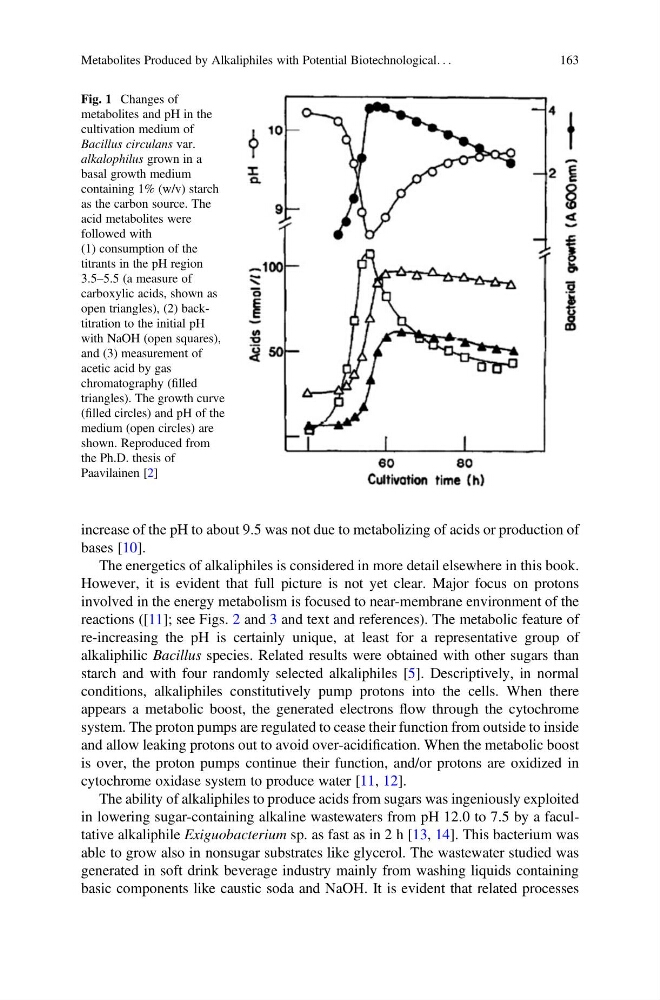
increase of the pH to about 9.5 was not due to metabolizing of acids or production of
bases [10].
The energetics of alkaliphiles is considered in more detail elsewhere in this book.
However, it is evident that full picture is not yet clear. Major focus on protons
involved in the energy metabolism is focused to near-membrane environment of the
reactions ([11]; see Figs. 2 and 3 and text and references). The metabolic feature of
re-increasing the pH is certainly unique, at least for a representative group of
alkaliphilic Bacillus species. Related results were obtained with other sugars than
starch and with four randomly selected alkaliphiles [5]. Descriptively, in normal
conditions, alkaliphiles constitutively pump protons into the cells. When there
appears a metabolic boost, the generated electrons flow through the cytochrome
system. The proton pumps are regulated to cease their function from outside to inside
and allow leaking protons out to avoid over-acidification. When the metabolic boost
is over, the proton pumps continue their function, and/or protons are oxidized in
cytochrome oxidase system to produce water [11, 12].
The ability of alkaliphiles to produce acids from sugars was ingeniously exploited
in lowering sugar-containing alkaline wastewaters from pH 12.0 to 7.5 by a facultative alkaliphile Exiguobacterium sp. as fast as in 2 h [13, 14]. This bacterium was
able to grow also in nonsugar substrates like glycerol. The wastewater studied was
generated in soft drink beverage industry mainly from washing liquids containing
basic components like caustic soda and NaOH. It is evident that related processes
Fig. 1 Changes of
metabolites and pH in the
cultivation medium of
Bacillus circulans var.
alkalophilus grown in a
basal growth medium
containing 1% (w/v) starch
as the carbon source. The
acid metabolites were
followed with
(1) consumption of the
titrants in the pH region
3.5–5.5 (a measure of
carboxylic acids, shown as
open triangles), (2) backtitration to the initial pH
with NaOH (open squares),
and (3) measurement of
acetic acid by gas
chromatography (filled
triangles). The growth curve
(filled circles) and pH of the
medium (open circles) are
shown. Reproduced from
the Ph.D. thesis of
Paavilainen [2]
Metabolites Produced by Alkaliphiles with Potential Biotechnological. . .
163
bases [10].
The energetics of alkaliphiles is considered in more detail elsewhere in this book.
However, it is evident that full picture is not yet clear. Major focus on protons
involved in the energy metabolism is focused to near-membrane environment of the
reactions ([11]; see Figs. 2 and 3 and text and references). The metabolic feature of
re-increasing the pH is certainly unique, at least for a representative group of
alkaliphilic Bacillus species. Related results were obtained with other sugars than
starch and with four randomly selected alkaliphiles [5]. Descriptively, in normal
conditions, alkaliphiles constitutively pump protons into the cells. When there
appears a metabolic boost, the generated electrons flow through the cytochrome
system. The proton pumps are regulated to cease their function from outside to inside
and allow leaking protons out to avoid over-acidification. When the metabolic boost
is over, the proton pumps continue their function, and/or protons are oxidized in
cytochrome oxidase system to produce water [11, 12].
The ability of alkaliphiles to produce acids from sugars was ingeniously exploited
in lowering sugar-containing alkaline wastewaters from pH 12.0 to 7.5 by a facultative alkaliphile Exiguobacterium sp. as fast as in 2 h [13, 14]. This bacterium was
able to grow also in nonsugar substrates like glycerol. The wastewater studied was
generated in soft drink beverage industry mainly from washing liquids containing
basic components like caustic soda and NaOH. It is evident that related processes
Fig. 1 Changes of
metabolites and pH in the
cultivation medium of
Bacillus circulans var.
alkalophilus grown in a
basal growth medium
containing 1% (w/v) starch
as the carbon source. The
acid metabolites were
followed with
(1) consumption of the
titrants in the pH region
3.5–5.5 (a measure of
carboxylic acids, shown as
open triangles), (2) backtitration to the initial pH
with NaOH (open squares),
and (3) measurement of
acetic acid by gas
chromatography (filled
triangles). The growth curve
(filled circles) and pH of the
medium (open circles) are
shown. Reproduced from
the Ph.D. thesis of
Paavilainen [2]
Metabolites Produced by Alkaliphiles with Potential Biotechnological. . .
163