

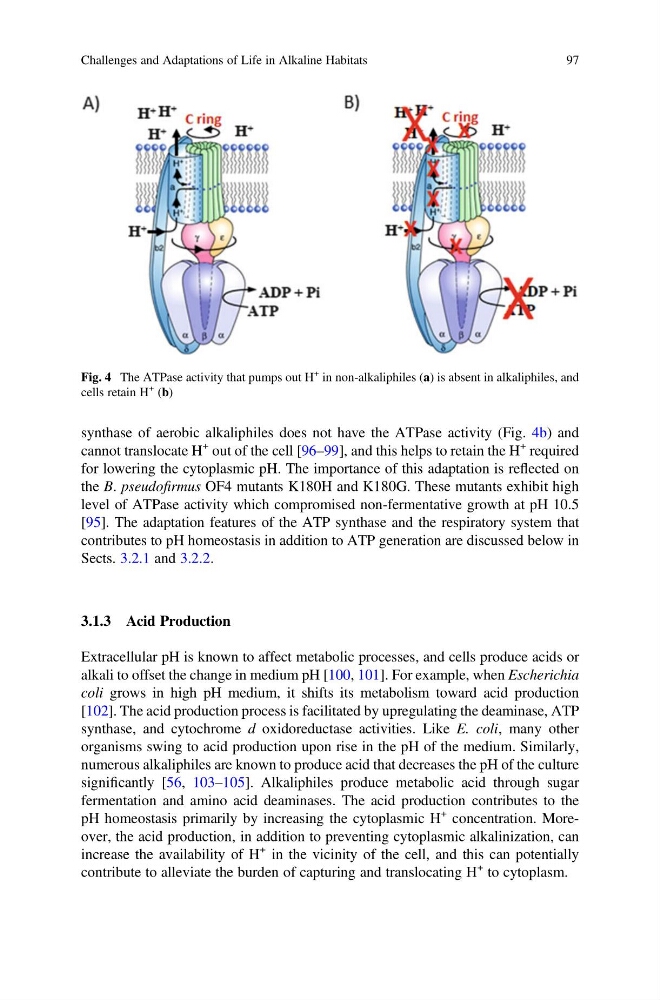
synthase of aerobic alkaliphiles does not have the ATPase activity (Fig. 4b) and
cannot translocate H
+ out of the cell [96–99], and this helps to retain the H
+ required
for lowering the cytoplasmic pH. The importance of this adaptation is reflected on
the B. pseudofirmus OF4 mutants K180H and K180G. These mutants exhibit high
level of ATPase activity which compromised non-fermentative growth at pH 10.5
[95]. The adaptation features of the ATP synthase and the respiratory system that
contributes to pH homeostasis in addition to ATP generation are discussed below in
Sects. 3.2.1 and 3.2.2.
3.1.3 Acid Production
Extracellular pH is known to affect metabolic processes, and cells produce acids or
alkali to offset the change in medium pH [100, 101]. For example, when Escherichia
coli grows in high pH medium, it shifts its metabolism toward acid production
[102]. The acid production process is facilitated by upregulating the deaminase, ATP
synthase, and cytochrome d oxidoreductase activities. Like E. coli, many other
organisms swing to acid production upon rise in the pH of the medium. Similarly,
numerous alkaliphiles are known to produce acid that decreases the pH of the culture
significantly [56, 103–105]. Alkaliphiles produce metabolic acid through sugar
fermentation and amino acid deaminases. The acid production contributes to the
pH homeostasis primarily by increasing the cytoplasmic H
+ concentration. Moreover, the acid production, in addition to preventing cytoplasmic alkalinization, can
increase the availability of H
+ in the vicinity of the cell, and this can potentially
contribute to alleviate the burden of capturing and translocating H
+ to cytoplasm.
Fig. 4 The ATPase activity that pumps out H
+ in non-alkaliphiles (a) is absent in alkaliphiles, and
cells retain H
+ (b)
Challenges and Adaptations of Life in Alkaline Habitats
97
cannot translocate H
+ out of the cell [96–99], and this helps to retain the H
+ required
for lowering the cytoplasmic pH. The importance of this adaptation is reflected on
the B. pseudofirmus OF4 mutants K180H and K180G. These mutants exhibit high
level of ATPase activity which compromised non-fermentative growth at pH 10.5
[95]. The adaptation features of the ATP synthase and the respiratory system that
contributes to pH homeostasis in addition to ATP generation are discussed below in
Sects. 3.2.1 and 3.2.2.
3.1.3 Acid Production
Extracellular pH is known to affect metabolic processes, and cells produce acids or
alkali to offset the change in medium pH [100, 101]. For example, when Escherichia
coli grows in high pH medium, it shifts its metabolism toward acid production
[102]. The acid production process is facilitated by upregulating the deaminase, ATP
synthase, and cytochrome d oxidoreductase activities. Like E. coli, many other
organisms swing to acid production upon rise in the pH of the medium. Similarly,
numerous alkaliphiles are known to produce acid that decreases the pH of the culture
significantly [56, 103–105]. Alkaliphiles produce metabolic acid through sugar
fermentation and amino acid deaminases. The acid production contributes to the
pH homeostasis primarily by increasing the cytoplasmic H
+ concentration. Moreover, the acid production, in addition to preventing cytoplasmic alkalinization, can
increase the availability of H
+ in the vicinity of the cell, and this can potentially
contribute to alleviate the burden of capturing and translocating H
+ to cytoplasm.
Fig. 4 The ATPase activity that pumps out H
+ in non-alkaliphiles (a) is absent in alkaliphiles, and
cells retain H
+ (b)
Challenges and Adaptations of Life in Alkaline Habitats
97