

3.1.2 Effective Proton Capturing by ATP Synthase and Inhibition
of ATPase Activity
The capture and translocation of H
+ by F 1 F 0 -ATP synthases of cells adapted to
neutral or acidic habitats are energetically favored as the H
+ concentration outside
the cell is higher than that of the cytoplasm. On the other hand, alkaliphiles do not
have the luxury of high H
+ concentration in their environment. H
+ is scarce in
alkaline habitats, and hence, organisms adapted in such environments require an
efficient system for capturing and translocating H
+ . The analysis of the atp operon,
the cluster of genes coding for F 1 F 0 -ATP synthase, of alkaliphilic Bacillus bacteria
revealed a conserved lysine residue at position 180 (based on that of B. pseudofirmus
OF4 numbering) of a-subunit [94] which exists only in alkaliphilic Bacillus gene
sequences [95]. This conserved lysine in a thermoalkaliphilic strain, Bacillus
sp. TA2.A1, was mutated to His, Arg, and Gly. Analyses of the ATP synthases
carrying these mutations have shown that L180 is a specific adaptation of
alkaliphiles that facilitate H
+ capture at high pH [94]. A broader mutational study
on the ATP synthase of a-subunit of B. pseudofirmus OF4 indicated that the ATP
synthase of alkaliphiles evolved to efficiently capture, translocate to the synthase
core, and retain H
+ in the cytoplasm [95]. Therefore, ATP synthase is believed
contributing to alkaliphiles pH homeostasis.
The ATP synthases of alkaliphiles have another remarkable contribution to the
pH homeostasis. The F 1 domain of non-alkaliphiles ATP synthases is known not
only synthesizing ATP but also hydrolyzing (ATPase activity) it. As shown in
Fig. 4a, the hydrolysis of ATP drives the ATP synthase c-ring reverse rotation
which pumps out proton to the extracellular environment. However, the ATP
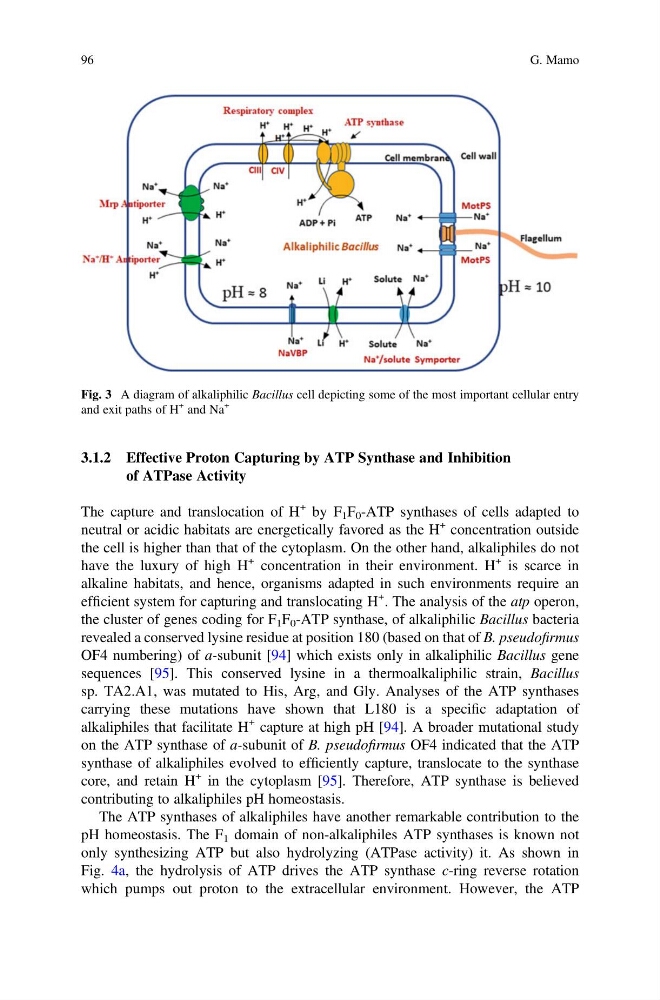
Fig. 3 A diagram of alkaliphilic Bacillus cell depicting some of the most important cellular entry
and exit paths of H
+ and Na
+
96
G. Mamo
of ATPase Activity
The capture and translocation of H
+ by F 1 F 0 -ATP synthases of cells adapted to
neutral or acidic habitats are energetically favored as the H
+ concentration outside
the cell is higher than that of the cytoplasm. On the other hand, alkaliphiles do not
have the luxury of high H
+ concentration in their environment. H
+ is scarce in
alkaline habitats, and hence, organisms adapted in such environments require an
efficient system for capturing and translocating H
+ . The analysis of the atp operon,
the cluster of genes coding for F 1 F 0 -ATP synthase, of alkaliphilic Bacillus bacteria
revealed a conserved lysine residue at position 180 (based on that of B. pseudofirmus
OF4 numbering) of a-subunit [94] which exists only in alkaliphilic Bacillus gene
sequences [95]. This conserved lysine in a thermoalkaliphilic strain, Bacillus
sp. TA2.A1, was mutated to His, Arg, and Gly. Analyses of the ATP synthases
carrying these mutations have shown that L180 is a specific adaptation of
alkaliphiles that facilitate H
+ capture at high pH [94]. A broader mutational study
on the ATP synthase of a-subunit of B. pseudofirmus OF4 indicated that the ATP
synthase of alkaliphiles evolved to efficiently capture, translocate to the synthase
core, and retain H
+ in the cytoplasm [95]. Therefore, ATP synthase is believed
contributing to alkaliphiles pH homeostasis.
The ATP synthases of alkaliphiles have another remarkable contribution to the
pH homeostasis. The F 1 domain of non-alkaliphiles ATP synthases is known not
only synthesizing ATP but also hydrolyzing (ATPase activity) it. As shown in
Fig. 4a, the hydrolysis of ATP drives the ATP synthase c-ring reverse rotation
which pumps out proton to the extracellular environment. However, the ATP
Fig. 3 A diagram of alkaliphilic Bacillus cell depicting some of the most important cellular entry
and exit paths of H
+ and Na
+
96
G. Mamo