

281
Process-Aware Design of Strain-Engineered MOSFETs
onto a set of parallel axes, one for each input and output parameter. A line
connects the corresponding coordinates. In particular, the parallel coordinate plot is an ideal environment in which to perform a visual optimisation
[8]. Automatic optimisation procedures, regardless of the specific optimisation algorithm, suffer from the fact that all optimisation criteria must be
included in a single “fitness function,” which is subsequently maximised.
In practise, the different optimisation criteria flow into the fitness functions through relative weighting. However, since it is usually impossible to
meet all optimisation targets perfectly, it is difficult to select the appropriate
weighting. Often, the weighting can be determined only in hindsight, after
the capabilities of the technology are measured against the requirements.
The combination of fast PCMs in a visual, interactive environment addresses
many of these issues. Using the PCM Studio, we have generated a large number of experiments, for example, 1,200, with uniform random distributions
for each input parameter. This is similar to creating an initial population for
a genetic algorithm. We continue with the visual optimisation by highlighting process-induced strained Si p- and n-MOSFETs examples.
10.4 Performance Optimisation
The combination of SProcess, SDevice, PCM Studio, and Sentaurus
Workbench forms a powerful design for manufacturing (DFM) TCAD environment. In this study, a total of 1,200 experiments were generated. The process and device simulation results are subsequently used as the basis for
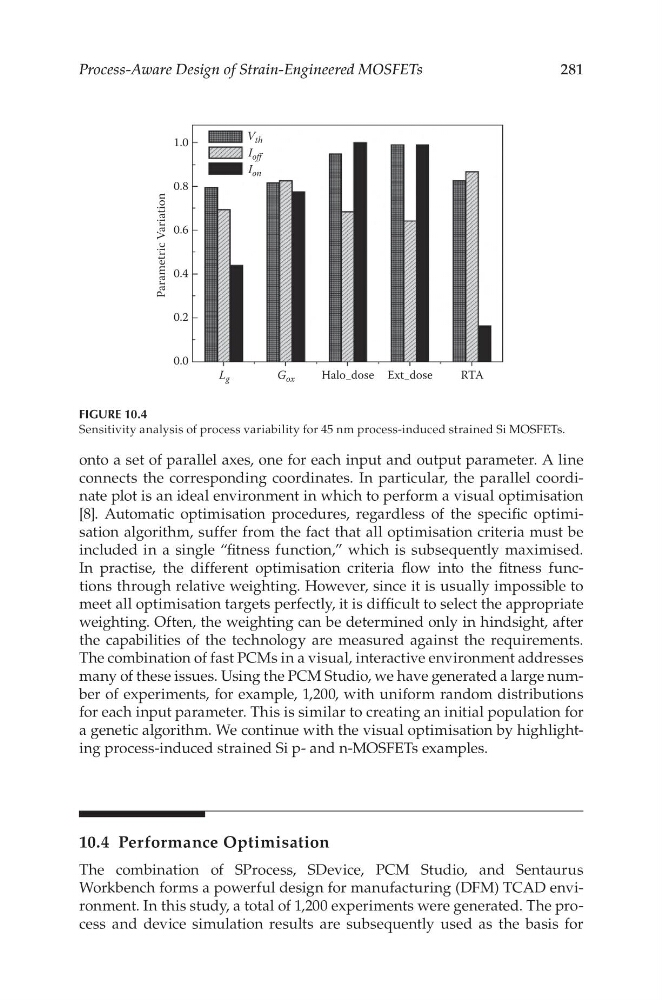
FIGURE 10.4
Sensitivity analysis of process variability for 45 nm process-induced strained Si MOSFETs.
Process-Aware Design of Strain-Engineered MOSFETs
onto a set of parallel axes, one for each input and output parameter. A line
connects the corresponding coordinates. In particular, the parallel coordinate plot is an ideal environment in which to perform a visual optimisation
[8]. Automatic optimisation procedures, regardless of the specific optimisation algorithm, suffer from the fact that all optimisation criteria must be
included in a single “fitness function,” which is subsequently maximised.
In practise, the different optimisation criteria flow into the fitness functions through relative weighting. However, since it is usually impossible to
meet all optimisation targets perfectly, it is difficult to select the appropriate
weighting. Often, the weighting can be determined only in hindsight, after
the capabilities of the technology are measured against the requirements.
The combination of fast PCMs in a visual, interactive environment addresses
many of these issues. Using the PCM Studio, we have generated a large number of experiments, for example, 1,200, with uniform random distributions
for each input parameter. This is similar to creating an initial population for
a genetic algorithm. We continue with the visual optimisation by highlighting process-induced strained Si p- and n-MOSFETs examples.
10.4 Performance Optimisation
The combination of SProcess, SDevice, PCM Studio, and Sentaurus
Workbench forms a powerful design for manufacturing (DFM) TCAD environment. In this study, a total of 1,200 experiments were generated. The process and device simulation results are subsequently used as the basis for
FIGURE 10.4
Sensitivity analysis of process variability for 45 nm process-induced strained Si MOSFETs.