

264
Strain-Engineered MOSFETs
construction of input files for the Paramos extraction engine, which is used
to build SPCMs.
9.4.1 PCM Analysis
Process compact models can be used with various kinds of data to perform
different types of analysis. Possible data sources include in-process measurements, electrical test data, nominal process conditions, electrical target
specifications, and random values. Numerical optimisation allows the use of
response (device characteristics) as input in order to obtain estimated values
for process parameters [10]. The possible analyses are:
1. PCM evaluation. This type of analysis uses in-process measurements, nominals, or randomly generated values for the process
parameters to evaluate the PCM and generate device characteristics.
This is a basic analysis and requires no numeric optimisation.
2. Reverse analysis. Reverse analysis estimates the distribution of certain
nonmeasurable process parameters based on data for the rest of the
parameters and electrical measurements for the device characteristics.
3. Feed-forward analysis. Feed-forward analysis estimates the distribution of critical parameters (to understand the amount of control required) based on data or nominals for the rest of the process
parameters and target device specifications (for the responses).
Technically, this corresponds to a reverse analysis with a fixed target value for the responses. Feed-forward analysis does not support SPCMs.
All three analyses have a commonality: they use data from measurements or specifications to estimate process parameters or device characteristics that are difficult or expensive to measure. Conceptually, there may be
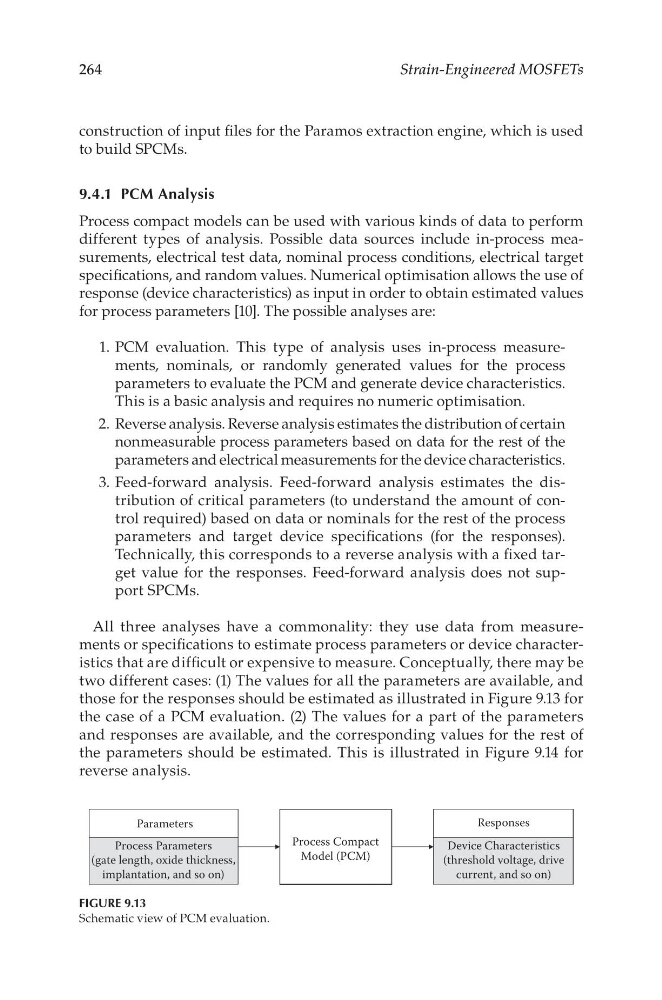
two different cases: (1) The values for all the parameters are available, and
those for the responses should be estimated as illustrated in Figure 9.13 for
the case of a PCM evaluation. (2) The values for a part of the parameters
and responses are available, and the corresponding values for the rest of
the parameters should be estimated. This is illustrated in Figure 9.14 for
reverse analysis.
Parameters
Process Parameters
(gate length, oxide thickness,
implantation, and so on)
Process Compact
Model (PCM)
Responses
Device Characteristics
(threshold voltage, drive
current, and so on)
FIGURE 9.13
Schematic view of PCM evaluation.
Strain-Engineered MOSFETs
construction of input files for the Paramos extraction engine, which is used
to build SPCMs.
9.4.1 PCM Analysis
Process compact models can be used with various kinds of data to perform
different types of analysis. Possible data sources include in-process measurements, electrical test data, nominal process conditions, electrical target
specifications, and random values. Numerical optimisation allows the use of
response (device characteristics) as input in order to obtain estimated values
for process parameters [10]. The possible analyses are:
1. PCM evaluation. This type of analysis uses in-process measurements, nominals, or randomly generated values for the process
parameters to evaluate the PCM and generate device characteristics.
This is a basic analysis and requires no numeric optimisation.
2. Reverse analysis. Reverse analysis estimates the distribution of certain
nonmeasurable process parameters based on data for the rest of the
parameters and electrical measurements for the device characteristics.
3. Feed-forward analysis. Feed-forward analysis estimates the distribution of critical parameters (to understand the amount of control required) based on data or nominals for the rest of the process
parameters and target device specifications (for the responses).
Technically, this corresponds to a reverse analysis with a fixed target value for the responses. Feed-forward analysis does not support SPCMs.
All three analyses have a commonality: they use data from measurements or specifications to estimate process parameters or device characteristics that are difficult or expensive to measure. Conceptually, there may be
two different cases: (1) The values for all the parameters are available, and
those for the responses should be estimated as illustrated in Figure 9.13 for
the case of a PCM evaluation. (2) The values for a part of the parameters
and responses are available, and the corresponding values for the rest of
the parameters should be estimated. This is illustrated in Figure 9.14 for
reverse analysis.
Parameters
Process Parameters
(gate length, oxide thickness,
implantation, and so on)
Process Compact
Model (PCM)
Responses
Device Characteristics
(threshold voltage, drive
current, and so on)
FIGURE 9.13
Schematic view of PCM evaluation.