

153
Noise in Strain-Engineered Devices
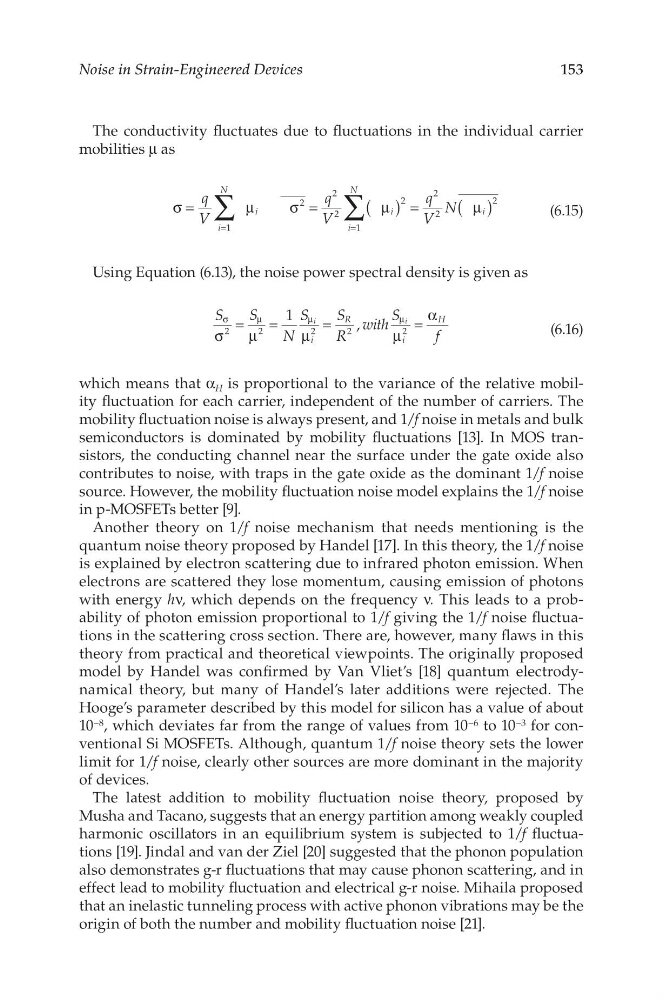
The conductivity fluctuates due to fluctuations in the individual carrier
mobilities μ as
q
V
q
V
q
V
N
i
i
N
i
i
N
i
1
2
2
2
2
1
2
2
2
∑
∑ ( )
( )
σ =
µ
σ =
µ =
µ
=
=
(6.15)
Using Equation (6.13), the noise power spectral density is given as
S
S
N
S
S
R
with
S
f
1
,
i
R
i
H
2
2
2
2
2
i
i
σ
= µ
=
µ
=
µ
=
α
σ
µ
µ
µ
(6.16)
which means that α H is proportional to the variance of the relative mobility fluctuation for each carrier, independent of the number of carriers. The
mobility fluctuation noise is always present, and 1/f noise in metals and bulk
semiconductors is dominated by mobility fluctuations [13]. In MOS transistors, the conducting channel near the surface under the gate oxide also
contributes to noise, with traps in the gate oxide as the dominant 1/f noise
source. However, the mobility fluctuation noise model explains the 1/f noise
in p-MOSFETs better [9].
Another theory on 1/f noise mechanism that needs mentioning is the
quantum noise theory proposed by Handel [17]. In this theory, the 1/f noise
is explained by electron scattering due to infrared photon emission. When
electrons are scattered they lose momentum, causing emission of photons
with energy hν, which depends on the frequency ν. This leads to a probability of photon emission proportional to 1/f giving the 1/f noise fluctuations in the scattering cross section. There are, however, many flaws in this
theory from practical and theoretical viewpoints. The originally proposed
model by Handel was confirmed by Van Vliet’s [18] quantum electrodynamical theory, but many of Handel’s later additions were rejected. The
Hooge’s parameter described by this model for silicon has a value of about
10 –8 , which deviates far from the range of values from 10 –6 to 10 –3 for conventional Si MOSFETs. Although, quantum 1/f noise theory sets the lower
limit for 1/f noise, clearly other sources are more dominant in the majority
of devices.
The latest addition to mobility fluctuation noise theory, proposed by
Musha and Tacano, suggests that an energy partition among weakly coupled
harmonic oscillators in an equilibrium system is subjected to 1/f fluctuations [19]. Jindal and van der Ziel [20] suggested that the phonon population
also demonstrates g-r fluctuations that may cause phonon scattering, and in
effect lead to mobility fluctuation and electrical g-r noise. Mihaila proposed
that an inelastic tunneling process with active phonon vibrations may be the
origin of both the number and mobility fluctuation noise [21].
Noise in Strain-Engineered Devices
The conductivity fluctuates due to fluctuations in the individual carrier
mobilities μ as
q
V
q
V
q
V
N
i
i
N
i
i
N
i
1
2
2
2
2
1
2
2
2
∑
∑ ( )
( )
σ =
µ
σ =
µ =
µ
=
=
(6.15)
Using Equation (6.13), the noise power spectral density is given as
S
S
N
S
S
R
with
S
f
1
,
i
R
i
H
2
2
2
2
2
i
i
σ
= µ
=
µ
=
µ
=
α
σ
µ
µ
µ
(6.16)
which means that α H is proportional to the variance of the relative mobility fluctuation for each carrier, independent of the number of carriers. The
mobility fluctuation noise is always present, and 1/f noise in metals and bulk
semiconductors is dominated by mobility fluctuations [13]. In MOS transistors, the conducting channel near the surface under the gate oxide also
contributes to noise, with traps in the gate oxide as the dominant 1/f noise
source. However, the mobility fluctuation noise model explains the 1/f noise
in p-MOSFETs better [9].
Another theory on 1/f noise mechanism that needs mentioning is the
quantum noise theory proposed by Handel [17]. In this theory, the 1/f noise
is explained by electron scattering due to infrared photon emission. When
electrons are scattered they lose momentum, causing emission of photons
with energy hν, which depends on the frequency ν. This leads to a probability of photon emission proportional to 1/f giving the 1/f noise fluctuations in the scattering cross section. There are, however, many flaws in this
theory from practical and theoretical viewpoints. The originally proposed
model by Handel was confirmed by Van Vliet’s [18] quantum electrodynamical theory, but many of Handel’s later additions were rejected. The
Hooge’s parameter described by this model for silicon has a value of about
10 –8 , which deviates far from the range of values from 10 –6 to 10 –3 for conventional Si MOSFETs. Although, quantum 1/f noise theory sets the lower
limit for 1/f noise, clearly other sources are more dominant in the majority
of devices.
The latest addition to mobility fluctuation noise theory, proposed by
Musha and Tacano, suggests that an energy partition among weakly coupled
harmonic oscillators in an equilibrium system is subjected to 1/f fluctuations [19]. Jindal and van der Ziel [20] suggested that the phonon population
also demonstrates g-r fluctuations that may cause phonon scattering, and in
effect lead to mobility fluctuation and electrical g-r noise. Mihaila proposed
that an inelastic tunneling process with active phonon vibrations may be the
origin of both the number and mobility fluctuation noise [21].