

152
Strain-Engineered MOSFETs
that the g-r noise from the traps can simply be added with the traps being
isolated from each other, and they do not interact. G-r noise is obtained with
a time constant given by the reciprocal sum of all time constants if interaction occurs [15]. Also, the traps are assumed to couple in the same way to the
output current so that the value of K is the same for all traps.
The second well-accepted mechanism behind 1/f noise is known as mobility fluctuations. It was first described by Hooge with the following empirical
formula for the resistance fluctuations (S R ) [16]:
S f
R
fN
( )
R
H
2
=
α
(6.13)
The dimensionless parameter α H , known as Hooge’s parameter, was first
suggested to be constant and equal to 2 × 10 –3 . Later, it was found that α H
depends on the crystal quality, and the value may change in different materials. Only phonon scattering contributes to the mobility fluctuations, and
the factor 1/N results from independent mobility fluctuations by each of the
N conducting carriers. The conductivity σ is given as
q
V
qN V qn
/
i
i
N
i
i
1
∑
σ =
µ =
µ
= µ
=
(6.14)
10
–17
10
–18
10
–19
10
–20
10
–21
S
I (A
2
/Hz)
1/f
10
–22
10
0
10
1
10
2
Frequency (Hz)
10
3
10
4
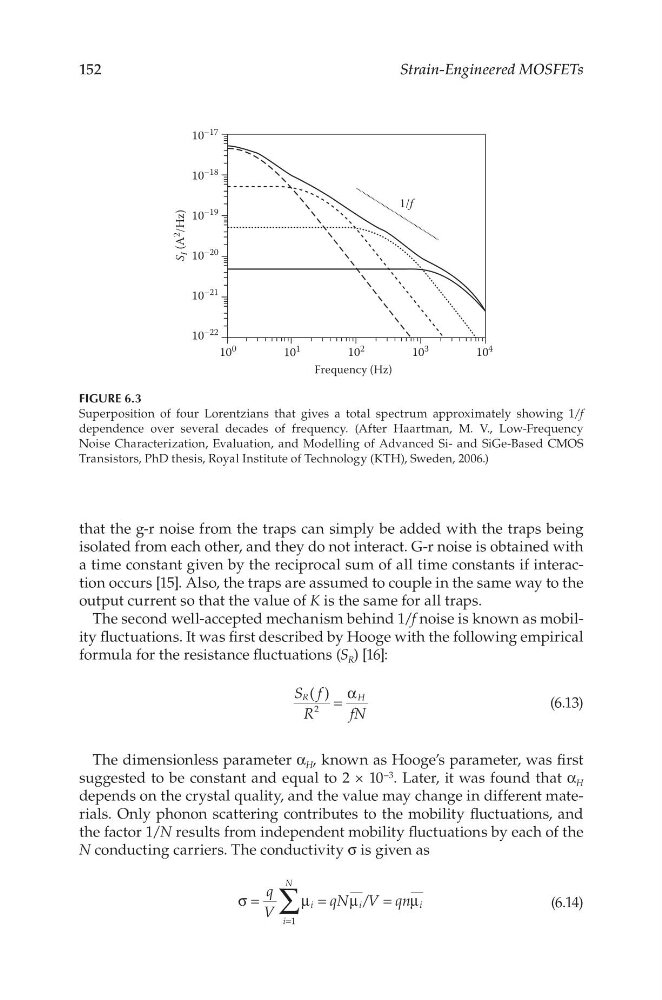
FIGURE 6.3
Superposition of four Lorentzians that gives a total spectrum approximately showing 1/f
dependence over several decades of frequency. (After Haartman, M. V., Low-Frequency
Noise Characterization, Evaluation, and Modelling of Advanced Si- and SiGe-Based CMOS
Transistors, PhD thesis, Royal Institute of Technology (KTH), Sweden, 2006.)
Strain-Engineered MOSFETs
that the g-r noise from the traps can simply be added with the traps being
isolated from each other, and they do not interact. G-r noise is obtained with
a time constant given by the reciprocal sum of all time constants if interaction occurs [15]. Also, the traps are assumed to couple in the same way to the
output current so that the value of K is the same for all traps.
The second well-accepted mechanism behind 1/f noise is known as mobility fluctuations. It was first described by Hooge with the following empirical
formula for the resistance fluctuations (S R ) [16]:
S f
R
fN
( )
R
H
2
=
α
(6.13)
The dimensionless parameter α H , known as Hooge’s parameter, was first
suggested to be constant and equal to 2 × 10 –3 . Later, it was found that α H
depends on the crystal quality, and the value may change in different materials. Only phonon scattering contributes to the mobility fluctuations, and
the factor 1/N results from independent mobility fluctuations by each of the
N conducting carriers. The conductivity σ is given as
q
V
qN V qn
/
i
i
N
i
i
1
∑
σ =
µ =
µ
= µ
=
(6.14)
10
–17
10
–18
10
–19
10
–20
10
–21
S
I (A
2
/Hz)
1/f
10
–22
10
0
10
1
10
2
Frequency (Hz)
10
3
10
4
FIGURE 6.3
Superposition of four Lorentzians that gives a total spectrum approximately showing 1/f
dependence over several decades of frequency. (After Haartman, M. V., Low-Frequency
Noise Characterization, Evaluation, and Modelling of Advanced Si- and SiGe-Based CMOS
Transistors, PhD thesis, Royal Institute of Technology (KTH), Sweden, 2006.)