

149
Noise in Strain-Engineered Devices
Here, f is the frequency. The shape of the spectrum given by Equation (6.6) is
called Lorentzian. G-r noise is only significant when the Fermi level is within
a few kT in energy of the trap energy level. In this case, the capture time τ c
and the emission time τ e are almost equal. If the Fermi level is far above or
below the trap level, the trap will be filled or empty most of the time, and
very few transitions would occur to produce noise. The current density in
n-type bulk semiconductor can be written as
J
E qn
qp E nq E
(
)
n
p
n
= σ =
µ + µ
≈ µ
(6.7)
If n fluctuates (n = N/V, where V is the volume), the current density fluctuates as
S f
S f
N
J
( )
( )
J
N
2
2
=
(6.8)
Thus, S J decreases with increasing N as 1/N 2 . The variation of the PSD with
the number of carriers is one way to distinguish noise originating from traps
from noise related to fluctuations in the mobility.
6.2.4 Random Telegraph Signal (RTS) Noise
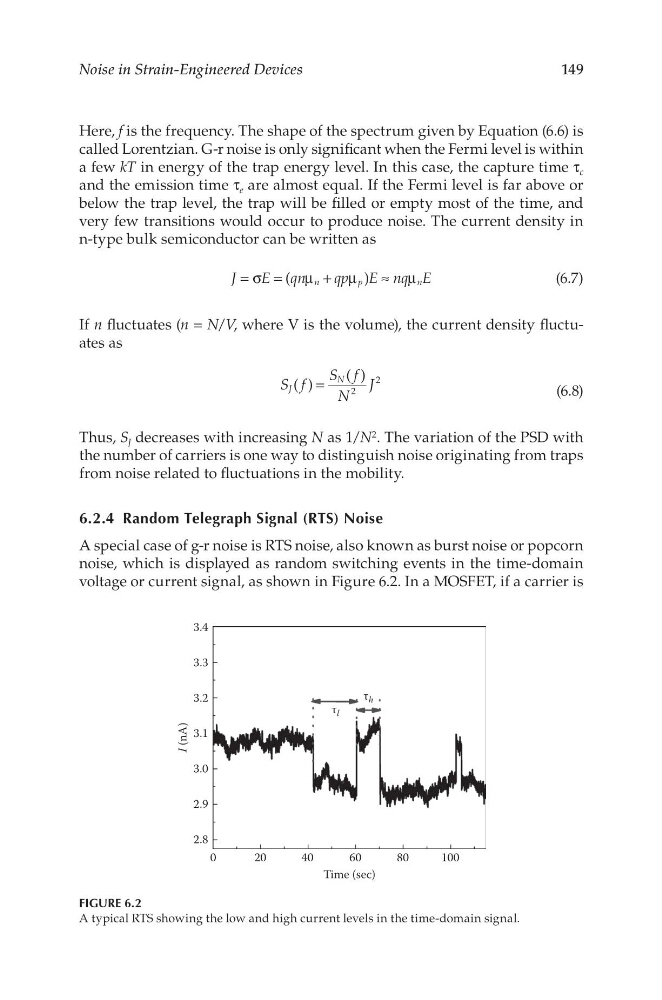
A special case of g-r noise is RTS noise, also known as burst noise or popcorn
noise, which is displayed as random switching events in the time-domain
voltage or current signal, as shown in Figure 6.2. In a MOSFET, if a carrier is
0
2.8
2.9
3.0
I (nA)
3.1
3.2
3.3
3.4
τ h
τ l
20
40
60
Time (sec)
80
100
FIGURE 6.2
A typical RTS showing the low and high current levels in the time-domain signal.
Noise in Strain-Engineered Devices
Here, f is the frequency. The shape of the spectrum given by Equation (6.6) is
called Lorentzian. G-r noise is only significant when the Fermi level is within
a few kT in energy of the trap energy level. In this case, the capture time τ c
and the emission time τ e are almost equal. If the Fermi level is far above or
below the trap level, the trap will be filled or empty most of the time, and
very few transitions would occur to produce noise. The current density in
n-type bulk semiconductor can be written as
J
E qn
qp E nq E
(
)
n
p
n
= σ =
µ + µ
≈ µ
(6.7)
If n fluctuates (n = N/V, where V is the volume), the current density fluctuates as
S f
S f
N
J
( )
( )
J
N
2
2
=
(6.8)
Thus, S J decreases with increasing N as 1/N 2 . The variation of the PSD with
the number of carriers is one way to distinguish noise originating from traps
from noise related to fluctuations in the mobility.
6.2.4 Random Telegraph Signal (RTS) Noise
A special case of g-r noise is RTS noise, also known as burst noise or popcorn
noise, which is displayed as random switching events in the time-domain
voltage or current signal, as shown in Figure 6.2. In a MOSFET, if a carrier is
0
2.8
2.9
3.0
I (nA)
3.1
3.2
3.3
3.4
τ h
τ l
20
40
60
Time (sec)
80
100
FIGURE 6.2
A typical RTS showing the low and high current levels in the time-domain signal.