

145
Noise in Strain-Engineered Devices
is, for example, upconverted to undesired phase noise in voltage-controlled
oscillator (VCO) circuits, which can limit the information capacity of communication systems [3]. Phase noise is a difficult problem in wireless transceivers and radio frequency (RF) circuits; RF oscillators are designed with
sensitive phase noise requirements. Both the unwanted signal from an adjacent channel and the desired single are downconverted by the oscillator and
are mixed at the output. The phase noise from the downconverted interfering signal overlaps with the desired signal, corrupting the signal-to-noise
ratio. The detrimental effects of the phase noise can be limited by placing
the channels farther apart in frequency, at the cost of reduced information
capacity of the communicating system. 1/f noise in semiconductor devices
poses a significant problem for VCOs when upconverted to undesired phase
noise at small frequency offsets from the carrier frequency, and therefore
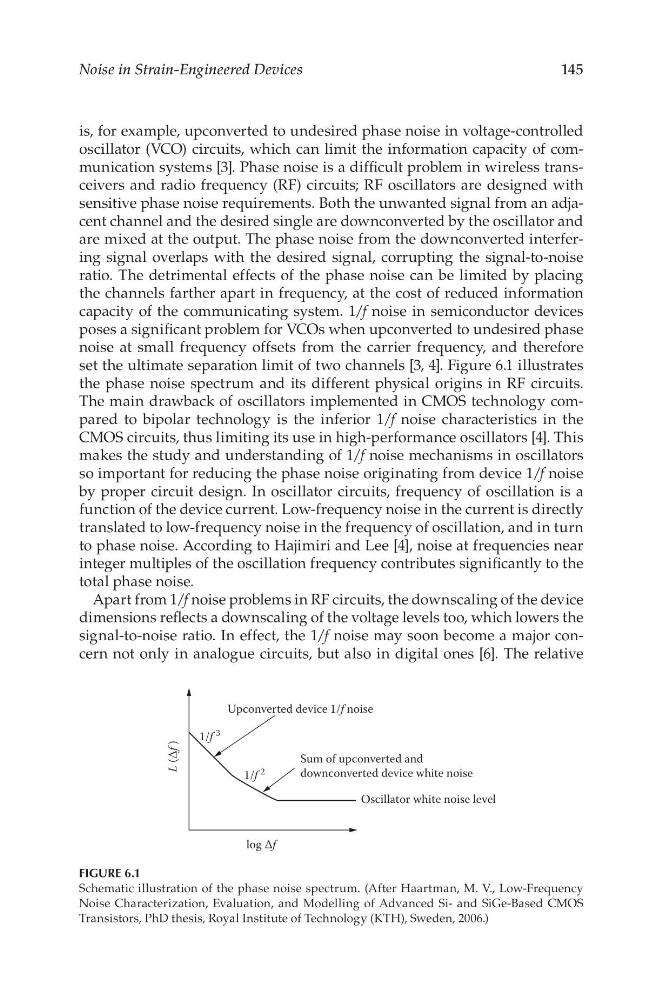
set the ultimate separation limit of two channels [3, 4]. Figure 6.1 illustrates
the phase noise spectrum and its different physical origins in RF circuits.
The main drawback of oscillators implemented in CMOS technology compared to bipolar technology is the inferior 1/f noise characteristics in the
CMOS circuits, thus limiting its use in high-performance oscillators [4]. This
makes the study and understanding of 1/f noise mechanisms in oscillators
so important for reducing the phase noise originating from device 1/f noise
by proper circuit design. In oscillator circuits, frequency of oscillation is a
function of the device current. Low-frequency noise in the current is directly
translated to low-frequency noise in the frequency of oscillation, and in turn
to phase noise. According to Hajimiri and Lee [4], noise at frequencies near
integer multiples of the oscillation frequency contributes significantly to the
total phase noise.
Apart from 1/f noise problems in RF circuits, the downscaling of the device
dimensions reflects a downscaling of the voltage levels too, which lowers the
signal-to-noise ratio. In effect, the 1/f noise may soon become a major concern not only in analogue circuits, but also in digital ones [6]. The relative
Upconverted device 1/f noise
Sum of upconverted and
downconverted device white noise
Oscillator white noise level
L (∆f )
log ∆f
1/f
3
1/f
2
FIGURE 6.1
Schematic illustration of the phase noise spectrum. (After Haartman, M. V., Low-Frequency
Noise Characterization, Evaluation, and Modelling of Advanced Si- and SiGe-Based CMOS
Transistors, PhD thesis, Royal Institute of Technology (KTH), Sweden, 2006.)
Noise in Strain-Engineered Devices
is, for example, upconverted to undesired phase noise in voltage-controlled
oscillator (VCO) circuits, which can limit the information capacity of communication systems [3]. Phase noise is a difficult problem in wireless transceivers and radio frequency (RF) circuits; RF oscillators are designed with
sensitive phase noise requirements. Both the unwanted signal from an adjacent channel and the desired single are downconverted by the oscillator and
are mixed at the output. The phase noise from the downconverted interfering signal overlaps with the desired signal, corrupting the signal-to-noise
ratio. The detrimental effects of the phase noise can be limited by placing
the channels farther apart in frequency, at the cost of reduced information
capacity of the communicating system. 1/f noise in semiconductor devices
poses a significant problem for VCOs when upconverted to undesired phase
noise at small frequency offsets from the carrier frequency, and therefore
set the ultimate separation limit of two channels [3, 4]. Figure 6.1 illustrates
the phase noise spectrum and its different physical origins in RF circuits.
The main drawback of oscillators implemented in CMOS technology compared to bipolar technology is the inferior 1/f noise characteristics in the
CMOS circuits, thus limiting its use in high-performance oscillators [4]. This
makes the study and understanding of 1/f noise mechanisms in oscillators
so important for reducing the phase noise originating from device 1/f noise
by proper circuit design. In oscillator circuits, frequency of oscillation is a
function of the device current. Low-frequency noise in the current is directly
translated to low-frequency noise in the frequency of oscillation, and in turn
to phase noise. According to Hajimiri and Lee [4], noise at frequencies near
integer multiples of the oscillation frequency contributes significantly to the
total phase noise.
Apart from 1/f noise problems in RF circuits, the downscaling of the device
dimensions reflects a downscaling of the voltage levels too, which lowers the
signal-to-noise ratio. In effect, the 1/f noise may soon become a major concern not only in analogue circuits, but also in digital ones [6]. The relative
Upconverted device 1/f noise
Sum of upconverted and
downconverted device white noise
Oscillator white noise level
L (∆f )
log ∆f
1/f
3
1/f
2
FIGURE 6.1
Schematic illustration of the phase noise spectrum. (After Haartman, M. V., Low-Frequency
Noise Characterization, Evaluation, and Modelling of Advanced Si- and SiGe-Based CMOS
Transistors, PhD thesis, Royal Institute of Technology (KTH), Sweden, 2006.)