

109
Electronic Properties of Strain-Engineered Semiconductors
Thus, we get
1
1
(2 )
(
1)
1
cos
cos
(cos )
3
2
0
2
1
1
2
2
min
max
n
E
E
n E
E
q
k
k
q dqd
d
q
k
k
q
q
k
k
q
q
q
q
∫
∫
∫
(
)
(
)
τ
= π
π Ξ
ρ
+ δ
− + ω
+ δ
− − ω
× ω
−
′
′
θ
θ
β φ
′
′
π
−
(4.56)
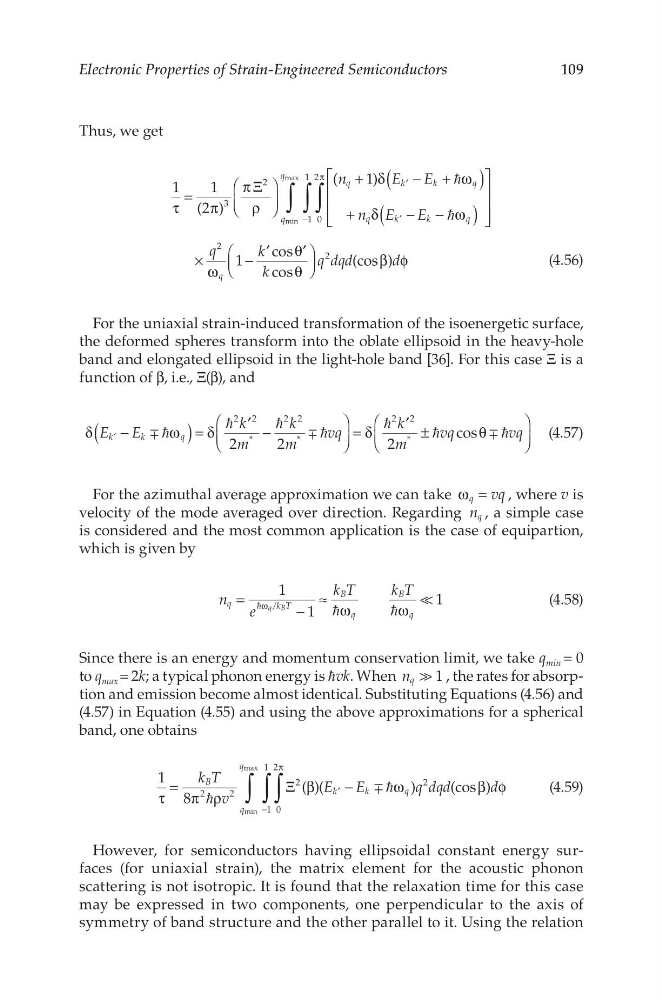
For the uniaxial strain-induced transformation of the isoenergetic surface,
the deformed spheres transform into the oblate ellipsoid in the heavy-hole
band and elongated ellipsoid in the light-hole band [36]. For this case Ξ is a
function of β, i.e., Ξ(β), and
2
2
2
cos
2 2
*
2 2
*
2 2
*
E
E
k
m
k
m
vq
k
m
vq
vq
k
k
q
∓ ∓
∓ ∓
∓
(
)
δ
−
ω = δ
′ −
= δ
′ ±
θ
′
(4.57)
For the azimuthal average approximation we can take
vq
q
ω = , where v is
velocity of the mode averaged over direction. Regarding n q , a simple case
is considered and the most common application is the case of equipartion,
which is given by
1
1
1
/
n e
k T
k T
q
k T
B
q
B
q
q B
=
−
≈ ω
ω
ω
(4.58)
Since there is an energy and momentum conservation limit, we take q min = 0
to q max = 2k; a typical phonon energy is ℏvk. When
1
n q , the rates for absorption and emission become almost identical. Substituting Equations (4.56) and
(4.57) in Equation (4.55) and using the above approximations for a spherical
band, one obtains
1
8
( )(
)
(cos )
2
2
2
0
2
1
1
2
min
max
k T
v
E
E
q dqd
d
B
q
q
k
k
q
∓ ∓
∫
∫
∫
τ
= π ρ
Ξ β
−
ω
β φ
π
−
′
(4.59)
However, for semiconductors having ellipsoidal constant energy surfaces (for uniaxial strain), the matrix element for the acoustic phonon
scattering is not isotropic. It is found that the relaxation time for this case
may be expressed in two components, one perpendicular to the axis of
symmetry of band structure and the other parallel to it. Using the relation
Electronic Properties of Strain-Engineered Semiconductors
Thus, we get
1
1
(2 )
(
1)
1
cos
cos
(cos )
3
2
0
2
1
1
2
2
min
max
n
E
E
n E
E
q
k
k
q dqd
d
q
k
k
q
q
k
k
q
q
q
q
∫
∫
∫
(
)
(
)
τ
= π
π Ξ
ρ
+ δ
− + ω
+ δ
− − ω
× ω
−
′
′
θ
θ
β φ
′
′
π
−
(4.56)
For the uniaxial strain-induced transformation of the isoenergetic surface,
the deformed spheres transform into the oblate ellipsoid in the heavy-hole
band and elongated ellipsoid in the light-hole band [36]. For this case Ξ is a
function of β, i.e., Ξ(β), and
2
2
2
cos
2 2
*
2 2
*
2 2
*
E
E
k
m
k
m
vq
k
m
vq
vq
k
k
q
∓ ∓
∓ ∓
∓
(
)
δ
−
ω = δ
′ −
= δ
′ ±
θ
′
(4.57)
For the azimuthal average approximation we can take
vq
q
ω = , where v is
velocity of the mode averaged over direction. Regarding n q , a simple case
is considered and the most common application is the case of equipartion,
which is given by
1
1
1
/
n e
k T
k T
q
k T
B
q
B
q
q B
=
−
≈ ω
ω
ω
(4.58)
Since there is an energy and momentum conservation limit, we take q min = 0
to q max = 2k; a typical phonon energy is ℏvk. When
1
n q , the rates for absorption and emission become almost identical. Substituting Equations (4.56) and
(4.57) in Equation (4.55) and using the above approximations for a spherical
band, one obtains
1
8
( )(
)
(cos )
2
2
2
0
2
1
1
2
min
max
k T
v
E
E
q dqd
d
B
q
q
k
k
q
∓ ∓
∫
∫
∫
τ
= π ρ
Ξ β
−
ω
β φ
π
−
′
(4.59)
However, for semiconductors having ellipsoidal constant energy surfaces (for uniaxial strain), the matrix element for the acoustic phonon
scattering is not isotropic. It is found that the relaxation time for this case
may be expressed in two components, one perpendicular to the axis of
symmetry of band structure and the other parallel to it. Using the relation