

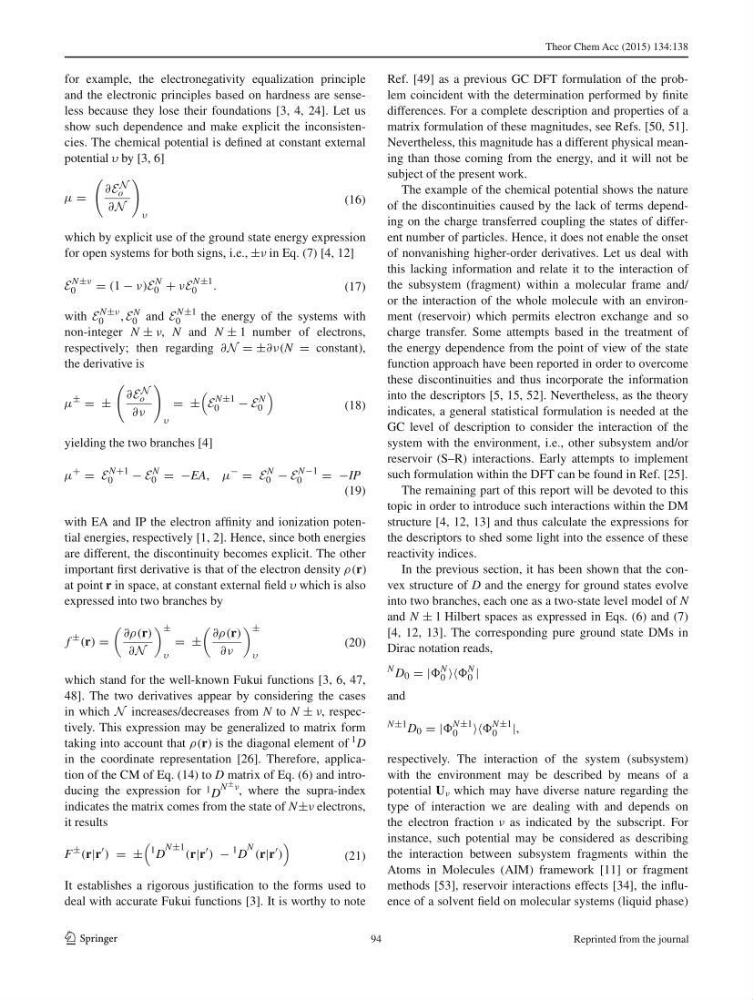
Theor Chem Acc (2015) 134:138
1 3
for example, the electronegativity equalization principle
and the electronic principles based on hardness are senseless because they lose their foundations [ 3 , 4 , 24 ]. Let us
show such dependence and make explicit the inconsistencies. The chemical potential is defi ned at constant external
potential υ by [ 3 , 6 ]
which by explicit use of the ground state energy expression
for open systems for both signs, i.e., ±ν in Eq. ( 7 ) [ 4 , 12 ]
with E
N±ν
0
, E
N
0 and E
N±1
0
the energy of the systems with
non-integer N ± ν , N and N ± 1 number of electrons,
respectively; then regarding ∂N = ±∂ν(N = constant),
the derivative is
yielding the two branches [ 4 ]
with EA and IP the electron affi nity and ionization potential energies, respectively [ 1 , 2 ]. Hence, since both energies
are different, the discontinuity becomes explicit. The other
important fi rst derivative is that of the electron density ρ(r)
at point r in space, at constant external fi eld υ which is also
expressed into two branches by
which stand for the well-known Fukui functions [ 3 , 6 , 47 ,
48 ]. The two derivatives appear by considering the cases
in which N increases/decreases from N to N ± ν , respectively. This expression may be generalized to matrix form
taking into account that ρ(r) is the diagonal element of 1 D
in the coordinate representation [ 26 ]. Therefore, application of the CM of Eq. ( 14 ) to D matrix of Eq. ( 6 ) and introducing the expression for 1 D
N ± ν , where the supra-index
indicates the matrix comes from the state of N±ν electrons,
it results
It establishes a rigorous justifi cation to the forms used to
deal with accurate Fukui functions [ 3 ]. It is worthy to note
(16)
μ =
∂E N
o
∂N
υ
(17)
E
N±ν
0
= (1 − ν)E
N
0 + νE
N±1
0
.
(18)
μ
±
= ±
∂E N
o
∂ν
υ
= ±
E
N±1
0
− E
N
0
(19)
μ
+
= E
N+1
0
− E
N
0 = −EA, μ
−
= E
N
0 − E
N−1
0
= −IP
(20)
f
±
(r) =
∂ρ(r)
∂N
±
υ
= ±
∂ρ(r)
∂ν
±
υ
(21)
F
±
(r|r
) = ±
1 D
N±1 (r|r
) −
1 D
N (r|r
)
Ref. [ 49 ] as a previous GC DFT formulation of the problem coincident with the determination performed by fi nite
differences. For a complete description and properties of a
matrix formulation of these magnitudes, see Refs. [ 50 , 51 ].
Nevertheless, this magnitude has a different physical meaning than those coming from the energy, and it will not be
subject of the present work.
The example of the chemical potential shows the nature
of the discontinuities caused by the lack of terms depending on the charge transferred coupling the states of different number of particles. Hence, it does not enable the onset
of nonvanishing higher-order derivatives. Let us deal with
this lacking information and relate it to the interaction of
the subsystem (fragment) within a molecular frame and/
or the interaction of the whole molecule with an environment (reservoir) which permits electron exchange and so
charge transfer. Some attempts based in the treatment of
the energy dependence from the point of view of the state
function approach have been reported in order to overcome
these discontinuities and thus incorporate the information
into the descriptors [ 5 , 15 , 52 ]. Nevertheless, as the theory
indicates, a general statistical formulation is needed at the
GC level of description to consider the interaction of the
system with the environment, i.e., other subsystem and/or
reservoir (S–R) interactions. Early attempts to implement
such formulation within the DFT can be found in Ref. [ 25 ].
The remaining part of this report will be devoted to this
topic in order to introduce such interactions within the DM
structure [ 4 , 12 , 13 ] and thus calculate the expressions for
the descriptors to shed some light into the essence of these
reactivity indices.
In the previous section, it has been shown that the convex structure of D and the energy for ground states evolve
into two branches, each one as a two-state level model of N
and N ± 1 Hilbert spaces as expressed in Eqs. ( 6 ) and ( 7 )
[ 4 , 12 , 13 ]. The corresponding pure ground state DMs in
Dirac notation reads,
and
respectively. The interaction of the system (subsystem)
with the environment may be described by means of a
potential U ν which may have diverse nature regarding the
type of interaction we are dealing with and depends on
the electron fraction ν as indicated by the subscript. For
instance, such potential may be considered as describing
the interaction between subsystem fragments within the
Atoms in Molecules (AIM) framework [ 11 ] or fragment
methods [ 53 ], reservoir interactions effects [ 34 ], the infl uence of a solvent fi eld on molecular systems (liquid phase)
N D 0 = |
N
0
N
0 |
N±1 D 0 = |
N±1
0
N±1
0
|,
94
Reprinted from the journal
1 3
for example, the electronegativity equalization principle
and the electronic principles based on hardness are senseless because they lose their foundations [ 3 , 4 , 24 ]. Let us
show such dependence and make explicit the inconsistencies. The chemical potential is defi ned at constant external
potential υ by [ 3 , 6 ]
which by explicit use of the ground state energy expression
for open systems for both signs, i.e., ±ν in Eq. ( 7 ) [ 4 , 12 ]
with E
N±ν
0
, E
N
0 and E
N±1
0
the energy of the systems with
non-integer N ± ν , N and N ± 1 number of electrons,
respectively; then regarding ∂N = ±∂ν(N = constant),
the derivative is
yielding the two branches [ 4 ]
with EA and IP the electron affi nity and ionization potential energies, respectively [ 1 , 2 ]. Hence, since both energies
are different, the discontinuity becomes explicit. The other
important fi rst derivative is that of the electron density ρ(r)
at point r in space, at constant external fi eld υ which is also
expressed into two branches by
which stand for the well-known Fukui functions [ 3 , 6 , 47 ,
48 ]. The two derivatives appear by considering the cases
in which N increases/decreases from N to N ± ν , respectively. This expression may be generalized to matrix form
taking into account that ρ(r) is the diagonal element of 1 D
in the coordinate representation [ 26 ]. Therefore, application of the CM of Eq. ( 14 ) to D matrix of Eq. ( 6 ) and introducing the expression for 1 D
N ± ν , where the supra-index
indicates the matrix comes from the state of N±ν electrons,
it results
It establishes a rigorous justifi cation to the forms used to
deal with accurate Fukui functions [ 3 ]. It is worthy to note
(16)
μ =
∂E N
o
∂N
υ
(17)
E
N±ν
0
= (1 − ν)E
N
0 + νE
N±1
0
.
(18)
μ
±
= ±
∂E N
o
∂ν
υ
= ±
E
N±1
0
− E
N
0
(19)
μ
+
= E
N+1
0
− E
N
0 = −EA, μ
−
= E
N
0 − E
N−1
0
= −IP
(20)
f
±
(r) =
∂ρ(r)
∂N
±
υ
= ±
∂ρ(r)
∂ν
±
υ
(21)
F
±
(r|r
) = ±
1 D
N±1 (r|r
) −
1 D
N (r|r
)
Ref. [ 49 ] as a previous GC DFT formulation of the problem coincident with the determination performed by fi nite
differences. For a complete description and properties of a
matrix formulation of these magnitudes, see Refs. [ 50 , 51 ].
Nevertheless, this magnitude has a different physical meaning than those coming from the energy, and it will not be
subject of the present work.
The example of the chemical potential shows the nature
of the discontinuities caused by the lack of terms depending on the charge transferred coupling the states of different number of particles. Hence, it does not enable the onset
of nonvanishing higher-order derivatives. Let us deal with
this lacking information and relate it to the interaction of
the subsystem (fragment) within a molecular frame and/
or the interaction of the whole molecule with an environment (reservoir) which permits electron exchange and so
charge transfer. Some attempts based in the treatment of
the energy dependence from the point of view of the state
function approach have been reported in order to overcome
these discontinuities and thus incorporate the information
into the descriptors [ 5 , 15 , 52 ]. Nevertheless, as the theory
indicates, a general statistical formulation is needed at the
GC level of description to consider the interaction of the
system with the environment, i.e., other subsystem and/or
reservoir (S–R) interactions. Early attempts to implement
such formulation within the DFT can be found in Ref. [ 25 ].
The remaining part of this report will be devoted to this
topic in order to introduce such interactions within the DM
structure [ 4 , 12 , 13 ] and thus calculate the expressions for
the descriptors to shed some light into the essence of these
reactivity indices.
In the previous section, it has been shown that the convex structure of D and the energy for ground states evolve
into two branches, each one as a two-state level model of N
and N ± 1 Hilbert spaces as expressed in Eqs. ( 6 ) and ( 7 )
[ 4 , 12 , 13 ]. The corresponding pure ground state DMs in
Dirac notation reads,
and
respectively. The interaction of the system (subsystem)
with the environment may be described by means of a
potential U ν which may have diverse nature regarding the
type of interaction we are dealing with and depends on
the electron fraction ν as indicated by the subscript. For
instance, such potential may be considered as describing
the interaction between subsystem fragments within the
Atoms in Molecules (AIM) framework [ 11 ] or fragment
methods [ 53 ], reservoir interactions effects [ 34 ], the infl uence of a solvent fi eld on molecular systems (liquid phase)
N D 0 = |
N
0
N
0 |
N±1 D 0 = |
N±1
0
N±1
0
|,
94
Reprinted from the journal