

Theor Chem Acc (2015) 134:138
1 3
Introducing the notation, M = E
M−1
0
− E M
0 as the energy
difference convenient interval, i.e., the fi rst ionization
potential of the system, and the assumption that for M > 1 ,
the M > > M+1 > 0 inequality holds [ 4 – 6 , 24 ], then
it results that the sequence
E M
0
M∈N
verifi es the above
inequality for arbitrary N, M ∈ N numbers, such that for
M = N, N + 1 , it follows
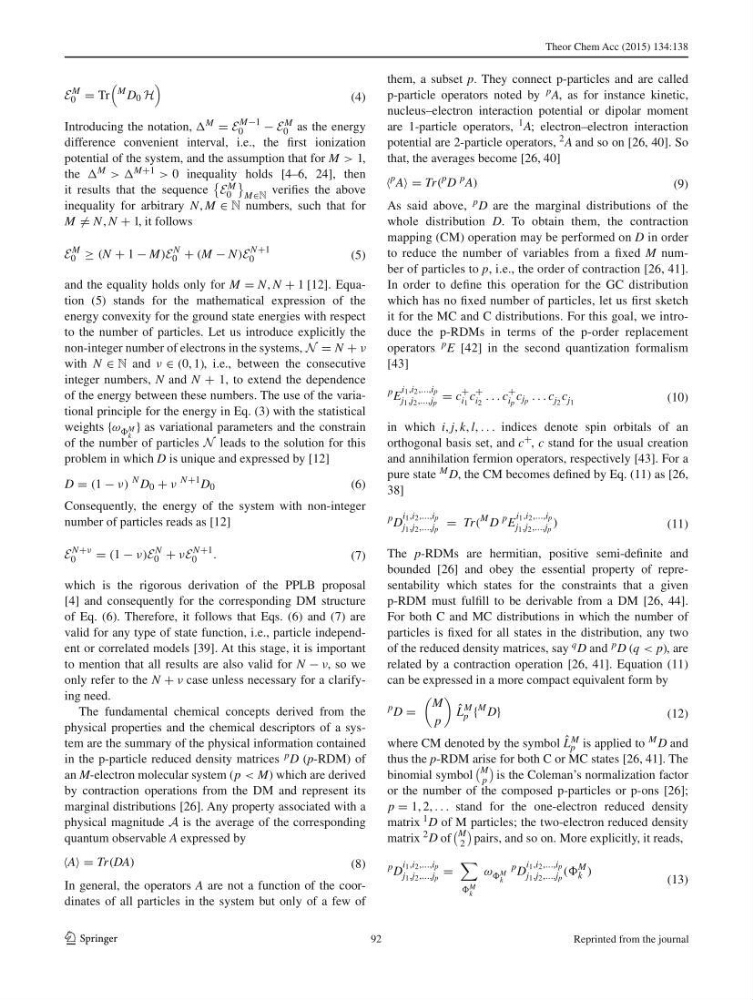
and the equality holds only for M = N, N + 1 [ 12 ]. Equation ( 5 ) stands for the mathematical expression of the
energy convexity for the ground state energies with respect
to the number of particles. Let us introduce explicitly the
non-integer number of electrons in the systems, N = N + ν
with N ∈ N and ν ∈ (0, 1) , i.e., between the consecutive
integer numbers, N and N + 1, to extend the dependence
of the energy between these numbers. The use of the variational principle for the energy in Eq. ( 3 ) with the statistical
weights {ω M
k
} as variational parameters and the constrain
of the number of particles N leads to the solution for this
problem in which D is unique and expressed by [ 12 ]
Consequently, the energy of the system with non-integer
number of particles reads as [ 12 ]
which is the rigorous derivation of the PPLB proposal
[ 4 ] and consequently for the corresponding DM structure
of Eq. ( 6 ). Therefore, it follows that Eqs. ( 6 ) and ( 7 ) are
valid for any type of state function, i.e., particle independent or correlated models [ 39 ]. At this stage, it is important
to mention that all results are also valid for N − ν , so we
only refer to the N + ν case unless necessary for a clarifying need.
The fundamental chemical concepts derived from the
physical properties and the chemical descriptors of a system are the summary of the physical information contained
in the p-particle reduced density matrices p D ( p -RDM) of
an M -electron molecular system ( p < M ) which are derived
by contraction operations from the DM and represent its
marginal distributions [ 26 ]. Any property associated with a
physical magnitude A is the average of the corresponding
quantum observable A expressed by
In general, the operators A are not a function of the coordinates of all particles in the system but only of a few of
(4)
E
M
0 = Tr
M D 0 H
(5)
E
M
0 ≥ (N + 1 − M)E
N
0 + (M − N)E
N+1
0
(6)
D = (1 − ν)
N D 0 + ν
N+1 D 0
(7)
E
N+ν
0
= (1 − ν)E
N
0 + νE
N+1
0
.
(8)
A = Tr(DA)
them, a subset p . They connect p-particles and are called
p-particle operators noted by p A , as for instance kinetic,
nucleus–electron interaction potential or dipolar moment
are 1-particle operators, 1 A ; electron–electron interaction
potential are 2-particle operators, 2 A and so on [ 26 , 40 ]. So
that, the averages become [ 26 , 40 ]
As said above, p D are the marginal distributions of the
whole distribution D . To obtain them, the contraction
mapping (CM) operation may be performed on D in order
to reduce the number of variables from a fi xed M number of particles to p , i.e., the order of contraction [ 26 , 41 ].
In order to defi ne this operation for the GC distribution
which has no fi xed number of particles, let us fi rst sketch
it for the MC and C distributions. For this goal, we introduce the p-RDMs in terms of the p-order replacement
operators p E [ 42 ] in the second quantization formalism
[ 43 ]
in which i, j, k, l, . . . indices denote spin orbitals of an
orthogonal basis set, and c + , c stand for the usual creation
and annihilation fermion operators, respectively [ 43 ]. For a
pure state M D , the CM becomes defi ned by Eq. ( 11 ) as [ 26 ,
38 ]
The p -RDMs are hermitian, positive semi-defi nite and
bounded [ 26 ] and obey the essential property of representability which states for the constraints that a given
p-RDM must fulfi ll to be derivable from a DM [ 26 , 44 ].
For both C and MC distributions in which the number of
particles is fi xed for all states in the distribution, any two
of the reduced density matrices, say q D and p D (q < p) , are
related by a contraction operation [ 26 , 41 ]. Equation ( 11 )
can be expressed in a more compact equivalent form by
where CM denoted by the symbol ˆ
L M
p is applied to M D and
thus the p -RDM arise for both C or MC states [ 26 , 41 ]. The
binomial symbol
M
p
is the Coleman’s normalization factor
or the number of the composed p-particles or p-ons [ 26 ];
p = 1, 2, . . . stand for the one-electron reduced density
matrix 1 D of M particles; the two-electron reduced density
matrix 2 D of
M
2
pairs, and so on. More explicitly, it reads,
(9)
p A = Tr(
p D
p A)
(10)
p E
i 1 ,i 2 ,...,i p
j 1 ,j 2 ,...,j p
= c
+
i 1
c
+
i 2
. . . c
+
i p
c j p . . . c j 2 c j 1
(11)
p D
i 1 ,i 2 ,...,i p
j 1 ,j 2 ,...,j p
= Tr(
M D
p E
i 1 ,i 2 ,...,i p
j 1 ,j 2 ,...,j p
)
(12)
p D =
M
p
ˆ
L
M
p {
M D}
(13)
p D
i 1 ,i 2 ,...,i p
j 1 ,j 2 ,...,j p
=
M
k
ω M
k
p D
i 1 ,i 2 ,...,i p
j 1 ,j 2 ,...,j p
((
M
k )
92
Reprinted from the journal
1 3
Introducing the notation, M = E
M−1
0
− E M
0 as the energy
difference convenient interval, i.e., the fi rst ionization
potential of the system, and the assumption that for M > 1 ,
the M > > M+1 > 0 inequality holds [ 4 – 6 , 24 ], then
it results that the sequence
E M
0
M∈N
verifi es the above
inequality for arbitrary N, M ∈ N numbers, such that for
M = N, N + 1 , it follows
and the equality holds only for M = N, N + 1 [ 12 ]. Equation ( 5 ) stands for the mathematical expression of the
energy convexity for the ground state energies with respect
to the number of particles. Let us introduce explicitly the
non-integer number of electrons in the systems, N = N + ν
with N ∈ N and ν ∈ (0, 1) , i.e., between the consecutive
integer numbers, N and N + 1, to extend the dependence
of the energy between these numbers. The use of the variational principle for the energy in Eq. ( 3 ) with the statistical
weights {ω M
k
} as variational parameters and the constrain
of the number of particles N leads to the solution for this
problem in which D is unique and expressed by [ 12 ]
Consequently, the energy of the system with non-integer
number of particles reads as [ 12 ]
which is the rigorous derivation of the PPLB proposal
[ 4 ] and consequently for the corresponding DM structure
of Eq. ( 6 ). Therefore, it follows that Eqs. ( 6 ) and ( 7 ) are
valid for any type of state function, i.e., particle independent or correlated models [ 39 ]. At this stage, it is important
to mention that all results are also valid for N − ν , so we
only refer to the N + ν case unless necessary for a clarifying need.
The fundamental chemical concepts derived from the
physical properties and the chemical descriptors of a system are the summary of the physical information contained
in the p-particle reduced density matrices p D ( p -RDM) of
an M -electron molecular system ( p < M ) which are derived
by contraction operations from the DM and represent its
marginal distributions [ 26 ]. Any property associated with a
physical magnitude A is the average of the corresponding
quantum observable A expressed by
In general, the operators A are not a function of the coordinates of all particles in the system but only of a few of
(4)
E
M
0 = Tr
M D 0 H
(5)
E
M
0 ≥ (N + 1 − M)E
N
0 + (M − N)E
N+1
0
(6)
D = (1 − ν)
N D 0 + ν
N+1 D 0
(7)
E
N+ν
0
= (1 − ν)E
N
0 + νE
N+1
0
.
(8)
A = Tr(DA)
them, a subset p . They connect p-particles and are called
p-particle operators noted by p A , as for instance kinetic,
nucleus–electron interaction potential or dipolar moment
are 1-particle operators, 1 A ; electron–electron interaction
potential are 2-particle operators, 2 A and so on [ 26 , 40 ]. So
that, the averages become [ 26 , 40 ]
As said above, p D are the marginal distributions of the
whole distribution D . To obtain them, the contraction
mapping (CM) operation may be performed on D in order
to reduce the number of variables from a fi xed M number of particles to p , i.e., the order of contraction [ 26 , 41 ].
In order to defi ne this operation for the GC distribution
which has no fi xed number of particles, let us fi rst sketch
it for the MC and C distributions. For this goal, we introduce the p-RDMs in terms of the p-order replacement
operators p E [ 42 ] in the second quantization formalism
[ 43 ]
in which i, j, k, l, . . . indices denote spin orbitals of an
orthogonal basis set, and c + , c stand for the usual creation
and annihilation fermion operators, respectively [ 43 ]. For a
pure state M D , the CM becomes defi ned by Eq. ( 11 ) as [ 26 ,
38 ]
The p -RDMs are hermitian, positive semi-defi nite and
bounded [ 26 ] and obey the essential property of representability which states for the constraints that a given
p-RDM must fulfi ll to be derivable from a DM [ 26 , 44 ].
For both C and MC distributions in which the number of
particles is fi xed for all states in the distribution, any two
of the reduced density matrices, say q D and p D (q < p) , are
related by a contraction operation [ 26 , 41 ]. Equation ( 11 )
can be expressed in a more compact equivalent form by
where CM denoted by the symbol ˆ
L M
p is applied to M D and
thus the p -RDM arise for both C or MC states [ 26 , 41 ]. The
binomial symbol
M
p
is the Coleman’s normalization factor
or the number of the composed p-particles or p-ons [ 26 ];
p = 1, 2, . . . stand for the one-electron reduced density
matrix 1 D of M particles; the two-electron reduced density
matrix 2 D of
M
2
pairs, and so on. More explicitly, it reads,
(9)
p A = Tr(
p D
p A)
(10)
p E
i 1 ,i 2 ,...,i p
j 1 ,j 2 ,...,j p
= c
+
i 1
c
+
i 2
. . . c
+
i p
c j p . . . c j 2 c j 1
(11)
p D
i 1 ,i 2 ,...,i p
j 1 ,j 2 ,...,j p
= Tr(
M D
p E
i 1 ,i 2 ,...,i p
j 1 ,j 2 ,...,j p
)
(12)
p D =
M
p
ˆ
L
M
p {
M D}
(13)
p D
i 1 ,i 2 ,...,i p
j 1 ,j 2 ,...,j p
=
M
k
ω M
k
p D
i 1 ,i 2 ,...,i p
j 1 ,j 2 ,...,j p
((
M
k )
92
Reprinted from the journal