

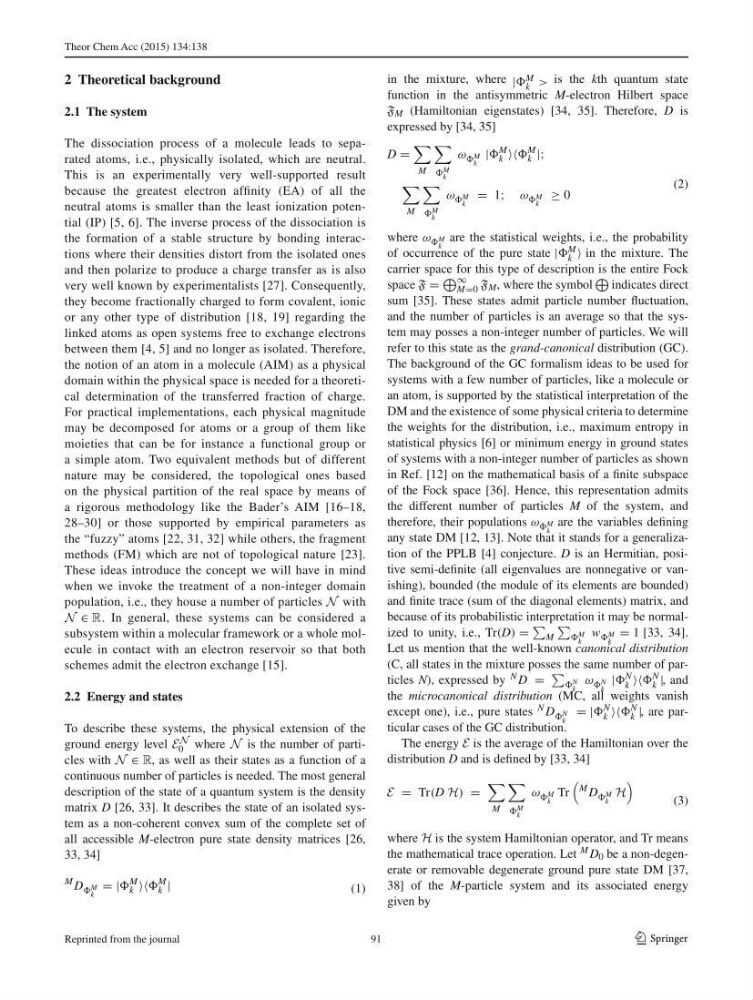
Theor Chem Acc (2015) 134:138
1 3
2 Theoretical background
2.1 The system
The dissociation process of a molecule leads to separated atoms, i.e., physically isolated, which are neutral.
This is an experimentally very well-supported result
because the greatest electron affi nity (EA) of all the
neutral atoms is smaller than the least ionization potential (IP) [ 5 , 6 ]. The inverse process of the dissociation is
the formation of a stable structure by bonding interactions where their densities distort from the isolated ones
and then polarize to produce a charge transfer as is also
very well known by experimentalists [ 27 ]. Consequently,
they become fractionally charged to form covalent, ionic
or any other type of distribution [ 18 , 19 ] regarding the
linked atoms as open systems free to exchange electrons
between them [ 4 , 5 ] and no longer as isolated. Therefore,
the notion of an atom in a molecule (AIM) as a physical
domain within the physical space is needed for a theoretical determination of the transferred fraction of charge.
For practical implementations, each physical magnitude
may be decomposed for atoms or a group of them like
moieties that can be for instance a functional group or
a simple atom. Two equivalent methods but of different
nature may be considered, the topological ones based
on the physical partition of the real space by means of
a rigorous methodology like the Bader’s AIM [ 16 – 18 ,
28 – 30 ] or those supported by empirical parameters as
the “fuzzy” atoms [ 22 , 31 , 32 ] while others, the fragment
methods (FM) which are not of topological nature [ 23 ].
These ideas introduce the concept we will have in mind
when we invoke the treatment of a non-integer domain
population, i.e., they house a number of particles N with
N ∈ R . In general, these systems can be considered a
subsystem within a molecular framework or a whole molecule in contact with an electron reservoir so that both
schemes admit the electron exchange [ 15 ].
2.2 Energy and states
To describe these systems, the physical extension of the
ground energy level E N
0 where N is the number of particles with N ∈ R , as well as their states as a function of a
continuous number of particles is needed. The most general
description of the state of a quantum system is the density
matrix D [ 26 , 33 ]. It describes the state of an isolated system as a non-coherent convex sum of the complete set of
all accessible M -electron pure state density matrices [ 26 ,
33 , 34 ]
(1)
M D M
k
= |
M
k
M
k |
in the mixture, where | M
k > is the k th quantum state
function in the antisymmetric M -electron Hilbert space
F M (Hamiltonian eigenstates) [ 34 , 35 ]. Therefore, D is
expressed by [ 34 , 35 ]
where ω M
k
are the statistical weights, i.e., the probability
of occurrence of the pure state | M
k in the mixture. The
carrier space for this type of description is the entire Fock
space F =
∞
M=0 F M , where the symbol
indicates direct
sum [ 35 ]. These states admit particle number fl uctuation,
and the number of particles is an average so that the system may posses a non-integer number of particles. We will
refer to this state as the grand-canonical distribution (GC).
The background of the GC formalism ideas to be used for
systems with a few number of particles, like a molecule or
an atom, is supported by the statistical interpretation of the
DM and the existence of some physical criteria to determine
the weights for the distribution, i.e., maximum entropy in
statistical physics [ 6 ] or minimum energy in ground states
of systems with a non-integer number of particles as shown
in Ref. [ 12 ] on the mathematical basis of a fi nite subspace
of the Fock space [ 36 ]. Hence, this representation admits
the different number of particles M of the system, and
therefore, their populations ω M
k
are the variables defi ning
any state DM [ 12 , 13 ]. Note that it stands for a generalization of the PPLB [ 4 ] conjecture. D is an Hermitian, positive semi-defi nite (all eigenvalues are nonnegative or vanishing), bounded (the module of its elements are bounded)
and fi nite trace (sum of the diagonal elements) matrix, and
because of its probabilistic interpretation it may be normalized to unity, i.e., Tr(D) =
M
M
k
w M
k
= 1 [ 33 , 34 ].
Let us mention that the well-known canonical distribution
(C, all states in the mixture posses the same number of particles N ), expressed by N D =
N
k
ω N
k
|
N
k
N
k | , and
the microcanonical distribution (MC, all weights vanish
except one), i.e., pure states N D N
k
= |
N
k
N
k | , are particular cases of the GC distribution.
The energy E is the average of the Hamiltonian over the
distribution D and is defi ned by [ 33 , 34 ]
where H is the system Hamiltonian operator, and Tr means
the mathematical trace operation. Let M D 0 be a non-degenerate or removable degenerate ground pure state DM [ 37 ,
38 ] of the M -particle system and its associated energy
given by
(2)
D =
M
M
k
ω M
k
|
M
k
M
k |;
M
M
k
ω M
k
= 1; ω M
k
≥ 0
(3)
E = Tr(D H) =
M
M
k
ω M
k
Tr
M D M
k
H
91
Reprinted from the journal
1 3
2 Theoretical background
2.1 The system
The dissociation process of a molecule leads to separated atoms, i.e., physically isolated, which are neutral.
This is an experimentally very well-supported result
because the greatest electron affi nity (EA) of all the
neutral atoms is smaller than the least ionization potential (IP) [ 5 , 6 ]. The inverse process of the dissociation is
the formation of a stable structure by bonding interactions where their densities distort from the isolated ones
and then polarize to produce a charge transfer as is also
very well known by experimentalists [ 27 ]. Consequently,
they become fractionally charged to form covalent, ionic
or any other type of distribution [ 18 , 19 ] regarding the
linked atoms as open systems free to exchange electrons
between them [ 4 , 5 ] and no longer as isolated. Therefore,
the notion of an atom in a molecule (AIM) as a physical
domain within the physical space is needed for a theoretical determination of the transferred fraction of charge.
For practical implementations, each physical magnitude
may be decomposed for atoms or a group of them like
moieties that can be for instance a functional group or
a simple atom. Two equivalent methods but of different
nature may be considered, the topological ones based
on the physical partition of the real space by means of
a rigorous methodology like the Bader’s AIM [ 16 – 18 ,
28 – 30 ] or those supported by empirical parameters as
the “fuzzy” atoms [ 22 , 31 , 32 ] while others, the fragment
methods (FM) which are not of topological nature [ 23 ].
These ideas introduce the concept we will have in mind
when we invoke the treatment of a non-integer domain
population, i.e., they house a number of particles N with
N ∈ R . In general, these systems can be considered a
subsystem within a molecular framework or a whole molecule in contact with an electron reservoir so that both
schemes admit the electron exchange [ 15 ].
2.2 Energy and states
To describe these systems, the physical extension of the
ground energy level E N
0 where N is the number of particles with N ∈ R , as well as their states as a function of a
continuous number of particles is needed. The most general
description of the state of a quantum system is the density
matrix D [ 26 , 33 ]. It describes the state of an isolated system as a non-coherent convex sum of the complete set of
all accessible M -electron pure state density matrices [ 26 ,
33 , 34 ]
(1)
M D M
k
= |
M
k
M
k |
in the mixture, where | M
k > is the k th quantum state
function in the antisymmetric M -electron Hilbert space
F M (Hamiltonian eigenstates) [ 34 , 35 ]. Therefore, D is
expressed by [ 34 , 35 ]
where ω M
k
are the statistical weights, i.e., the probability
of occurrence of the pure state | M
k in the mixture. The
carrier space for this type of description is the entire Fock
space F =
∞
M=0 F M , where the symbol
indicates direct
sum [ 35 ]. These states admit particle number fl uctuation,
and the number of particles is an average so that the system may posses a non-integer number of particles. We will
refer to this state as the grand-canonical distribution (GC).
The background of the GC formalism ideas to be used for
systems with a few number of particles, like a molecule or
an atom, is supported by the statistical interpretation of the
DM and the existence of some physical criteria to determine
the weights for the distribution, i.e., maximum entropy in
statistical physics [ 6 ] or minimum energy in ground states
of systems with a non-integer number of particles as shown
in Ref. [ 12 ] on the mathematical basis of a fi nite subspace
of the Fock space [ 36 ]. Hence, this representation admits
the different number of particles M of the system, and
therefore, their populations ω M
k
are the variables defi ning
any state DM [ 12 , 13 ]. Note that it stands for a generalization of the PPLB [ 4 ] conjecture. D is an Hermitian, positive semi-defi nite (all eigenvalues are nonnegative or vanishing), bounded (the module of its elements are bounded)
and fi nite trace (sum of the diagonal elements) matrix, and
because of its probabilistic interpretation it may be normalized to unity, i.e., Tr(D) =
M
M
k
w M
k
= 1 [ 33 , 34 ].
Let us mention that the well-known canonical distribution
(C, all states in the mixture posses the same number of particles N ), expressed by N D =
N
k
ω N
k
|
N
k
N
k | , and
the microcanonical distribution (MC, all weights vanish
except one), i.e., pure states N D N
k
= |
N
k
N
k | , are particular cases of the GC distribution.
The energy E is the average of the Hamiltonian over the
distribution D and is defi ned by [ 33 , 34 ]
where H is the system Hamiltonian operator, and Tr means
the mathematical trace operation. Let M D 0 be a non-degenerate or removable degenerate ground pure state DM [ 37 ,
38 ] of the M -particle system and its associated energy
given by
(2)
D =
M
M
k
ω M
k
|
M
k
M
k |;
M
M
k
ω M
k
= 1; ω M
k
≥ 0
(3)
E = Tr(D H) =
M
M
k
ω M
k
Tr
M D M
k
H
91
Reprinted from the journal