

Theor Chem Acc (2015) 134:147
1 3
optimized using density functional theory at the UM052X/6-31G(d,p) level, for charges going from +2 to −2,
except for 2b , which was optimized at the (R)M05-2X/631G(d,p) level. The M05-2X functional is a hybrid functional with 52 % of Hartree–Fock exchange [ 43 ], which
was previously found to give accurate results for conjugated systems with pancake bonds [ 44 ]. We found that the
restricted and unrestricted levels give geometries in close
agreements with each other. We obtained zero spin densities in all cases when there was a good overlap across
the helical pitch. For this reason, calculations at the unrestricted level provided no new information. The structures
present a C 2 symmetry, except for 1b
2+
. All calculations
were performed using the Gaussian 09 package [ 45 ]. We
used the graphics program ChemCraft [ 46 ].
To characterize such structures, we have used three different approaches which are listed below. The Cartesian
coordinates (x, y, z) of the i th atom of a helix are given by
the parametric Eq. ( 2 ),
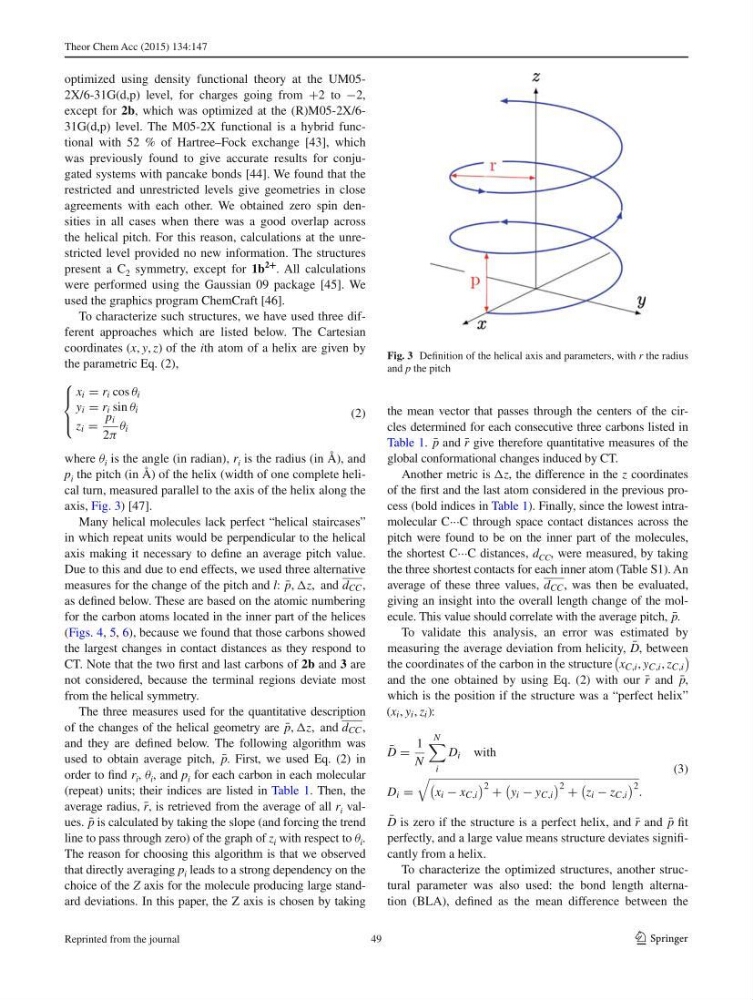
where θ i is the angle (in radian), r i is the radius (in Å), and
p i the pitch (in Å) of the helix (width of one complete helical turn, measured parallel to the axis of the helix along the
axis, Fig. 3 ) [ 47 ].
Many helical molecules lack perfect “helical staircases”
in which repeat units would be perpendicular to the helical
axis making it necessary to defi ne an average pitch value.
Due to this and due to end effects, we used three alternative
measures for the change of the pitch and l : ¯
p, z, and d CC ,
as defi ned below. These are based on the atomic numbering
for the carbon atoms located in the inner part of the helices
(Figs. 4 , 5 , 6 ), because we found that those carbons showed
the largest changes in contact distances as they respond to
CT. Note that the two fi rst and last carbons of 2b and 3 are
not considered, because the terminal regions deviate most
from the helical symmetry.
The three measures used for the quantitative description
of the changes of the helical geometry are ¯
p, z, and d CC ,
and they are defi ned below. The following algorithm was
used to obtain average pitch, ¯
p . First, we used Eq. ( 2 ) in
order to fi nd r i , θ i , and p i for each carbon in each molecular
(repeat) units; their indices are listed in Table 1 . Then, the
average radius, ¯
r , is retrieved from the average of all r i values. ¯
p is calculated by taking the slope (and forcing the trend
line to pass through zero) of the graph of z i with respect to θ i .
The reason for choosing this algorithm is that we observed
that directly averaging p i leads to a strong dependency on the
choice of the Z axis for the molecule producing large standard deviations. In this paper, the Z axis is chosen by taking
(2)
⎧
⎪ ⎨
⎪ ⎩
x i = r i cos θ i
y i = r i sin θ i
z i =
p i
2π
θ i
the mean vector that passes through the centers of the circles determined for each consecutive three carbons listed in
Table 1 . ¯
p and ¯
r give therefore quantitative measures of the
global conformational changes induced by CT.
Another metric is z , the difference in the z coordinates
of the fi rst and the last atom considered in the previous process (bold indices in Table 1 ). Finally, since the lowest intramolecular C···C through space contact distances across the
pitch were found to be on the inner part of the molecules,
the shortest C···C distances, d CC , were measured, by taking
the three shortest contacts for each inner atom (Table S1). An
average of these three values, d CC , was then be evaluated,
giving an insight into the overall length change of the molecule. This value should correlate with the average pitch, ¯
p .
To validate this analysis, an error was estimated by
measuring the average deviation from helicity, ¯
D , between
the coordinates of the carbon in the structure
x C,i , y C,i , z C,i
and the one obtained by using Eq. ( 2 ) with our ¯
r and ¯
p ,
which is the position if the structure was a “perfect helix”
(x i , y i , z i ) :
¯
D is zero if the structure is a perfect helix, and ¯
r and ¯
p fi t
perfectly, and a large value means structure deviates signifi -
cantly from a helix.
To characterize the optimized structures, another structural parameter was also used: the bond length alternation (BLA), defi ned as the mean difference between the
(3)
¯
D =
1
N
N
i
D i with
D i =
x i − x C,i
2 +
y i − y C,i
2 +
z i − z C,i
2 .
Fig. 3 Defi nition of the helical axis and parameters, with r the radius
and p the pitch
49
Reprinted from the journal
1 3
optimized using density functional theory at the UM052X/6-31G(d,p) level, for charges going from +2 to −2,
except for 2b , which was optimized at the (R)M05-2X/631G(d,p) level. The M05-2X functional is a hybrid functional with 52 % of Hartree–Fock exchange [ 43 ], which
was previously found to give accurate results for conjugated systems with pancake bonds [ 44 ]. We found that the
restricted and unrestricted levels give geometries in close
agreements with each other. We obtained zero spin densities in all cases when there was a good overlap across
the helical pitch. For this reason, calculations at the unrestricted level provided no new information. The structures
present a C 2 symmetry, except for 1b
2+
. All calculations
were performed using the Gaussian 09 package [ 45 ]. We
used the graphics program ChemCraft [ 46 ].
To characterize such structures, we have used three different approaches which are listed below. The Cartesian
coordinates (x, y, z) of the i th atom of a helix are given by
the parametric Eq. ( 2 ),
where θ i is the angle (in radian), r i is the radius (in Å), and
p i the pitch (in Å) of the helix (width of one complete helical turn, measured parallel to the axis of the helix along the
axis, Fig. 3 ) [ 47 ].
Many helical molecules lack perfect “helical staircases”
in which repeat units would be perpendicular to the helical
axis making it necessary to defi ne an average pitch value.
Due to this and due to end effects, we used three alternative
measures for the change of the pitch and l : ¯
p, z, and d CC ,
as defi ned below. These are based on the atomic numbering
for the carbon atoms located in the inner part of the helices
(Figs. 4 , 5 , 6 ), because we found that those carbons showed
the largest changes in contact distances as they respond to
CT. Note that the two fi rst and last carbons of 2b and 3 are
not considered, because the terminal regions deviate most
from the helical symmetry.
The three measures used for the quantitative description
of the changes of the helical geometry are ¯
p, z, and d CC ,
and they are defi ned below. The following algorithm was
used to obtain average pitch, ¯
p . First, we used Eq. ( 2 ) in
order to fi nd r i , θ i , and p i for each carbon in each molecular
(repeat) units; their indices are listed in Table 1 . Then, the
average radius, ¯
r , is retrieved from the average of all r i values. ¯
p is calculated by taking the slope (and forcing the trend
line to pass through zero) of the graph of z i with respect to θ i .
The reason for choosing this algorithm is that we observed
that directly averaging p i leads to a strong dependency on the
choice of the Z axis for the molecule producing large standard deviations. In this paper, the Z axis is chosen by taking
(2)
⎧
⎪ ⎨
⎪ ⎩
x i = r i cos θ i
y i = r i sin θ i
z i =
p i
2π
θ i
the mean vector that passes through the centers of the circles determined for each consecutive three carbons listed in
Table 1 . ¯
p and ¯
r give therefore quantitative measures of the
global conformational changes induced by CT.
Another metric is z , the difference in the z coordinates
of the fi rst and the last atom considered in the previous process (bold indices in Table 1 ). Finally, since the lowest intramolecular C···C through space contact distances across the
pitch were found to be on the inner part of the molecules,
the shortest C···C distances, d CC , were measured, by taking
the three shortest contacts for each inner atom (Table S1). An
average of these three values, d CC , was then be evaluated,
giving an insight into the overall length change of the molecule. This value should correlate with the average pitch, ¯
p .
To validate this analysis, an error was estimated by
measuring the average deviation from helicity, ¯
D , between
the coordinates of the carbon in the structure
x C,i , y C,i , z C,i
and the one obtained by using Eq. ( 2 ) with our ¯
r and ¯
p ,
which is the position if the structure was a “perfect helix”
(x i , y i , z i ) :
¯
D is zero if the structure is a perfect helix, and ¯
r and ¯
p fi t
perfectly, and a large value means structure deviates signifi -
cantly from a helix.
To characterize the optimized structures, another structural parameter was also used: the bond length alternation (BLA), defi ned as the mean difference between the
(3)
¯
D =
1
N
N
i
D i with
D i =
x i − x C,i
2 +
y i − y C,i
2 +
z i − z C,i
2 .
Fig. 3 Defi nition of the helical axis and parameters, with r the radius
and p the pitch
49
Reprinted from the journal