

Theor Chem Acc (2015) 134:147
1 3
electron pairing [ 35 ]. Those observations are coherent
with the molecular orbital description of the phenomenon,
where two singly occupied molecular orbitals (SOMOs)
overlap to form a bonding inter-molecular orbital between
the two molecules, like the electron pair in a covalent bond
(Fig. 1 ), in a trough space fashion across the vdW separation. However, those bonds are much weaker than conventional bonds and are longer than covalent ones (for example, the CC covalent distance is 1.54 Å, while pancake
bonds are around 3.1 Å). They also often retain a diradicaloid character [ 35 ].
Combining these two concepts, it may be interesting to
look into highly π-conjugated molecules for intramolecular orbital interactions with signifi cant overlap across the
vdW separation triggered by a redox charge transfer (CT)
process. The candidates must present possibilities of π–π
stacking, and therefore, aromatic helical molecules are
very appealing. In the past, helical structures were already
envisaged for molecular actuation, for example helicene
[ 36 ] and o -phenylene [ 37 – 39 ]. The helical architecture is
attractive because the helical molecule holds the π-electron
network in place and is ready made for through space
bonding and antibonding interactions that is then exploited
for redox actuation. The critical question is whether for
any given helix, there is suffi cient frontier orbital overlap
matching across the pitch. Given the subtle dependency
of this overlap as a function of the molecular architecture,
only computations at the appropriate level can help select
systems for this goal.
In this paper, we will present computational results for
helicene-like molecules testing the idea whether such an
architecture could be exploited for molecular redox actuation
using the π–π overlap across the space of the helical pitch.
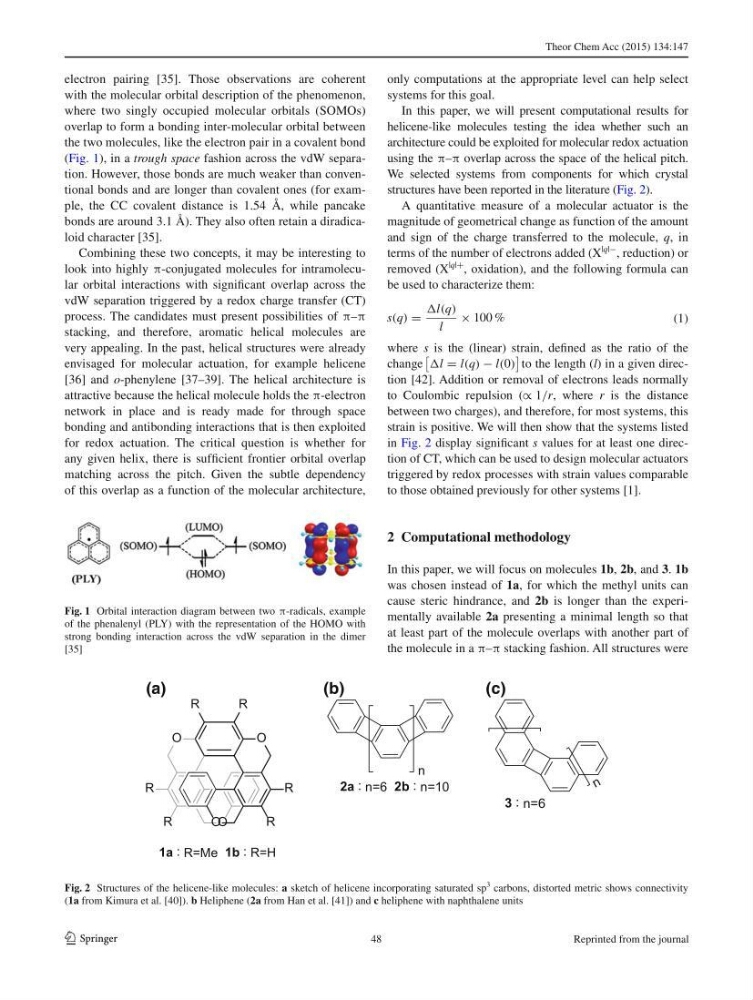
We selected systems from components for which crystal
structures have been reported in the literature (Fig. 2 ).
A quantitative measure of a molecular actuator is the
magnitude of geometrical change as function of the amount
and sign of the charge transferred to the molecule, q , in
terms of the number of electrons added (X
| q |− , reduction) or
removed (X
| q |+
, oxidation), and the following formula can
be used to characterize them:
where s is the (linear) strain, defi ned as the ratio of the
change
l = l(q) − l(0)
to the length ( l ) in a given direction [ 42 ]. Addition or removal of electrons leads normally
to Coulombic repulsion ( ∝ 1/r , where r is the distance
between two charges), and therefore, for most systems, this
strain is positive. We will then show that the systems listed
in Fig. 2 display signifi cant s values for at least one direction of CT, which can be used to design molecular actuators
triggered by redox processes with strain values comparable
to those obtained previously for other systems [ 1 ].
2 Computational methodology
In this paper, we will focus on molecules 1b , 2b , and 3 . 1b
was chosen instead of 1a , for which the methyl units can
cause steric hindrance, and 2b is longer than the experimentally available 2a presenting a minimal length so that
at least part of the molecule overlaps with another part of
the molecule in a π–π stacking fashion. All structures were
(1)
s(q) =
l(q)
l
× 100 %
Fig. 1 Orbital interaction diagram between two π-radicals, example
of the phenalenyl (PLY) with the representation of the HOMO with
strong bonding interaction across the vdW separation in the dimer
[ 35 ]
O
O
O
O
R
R
R
R
R
R
1a : R=Me 1b : R=H
n
2a : n=6 2b : n=10
n
3 : n=6
(a)
(b)
(c)
Fig. 2 Structures of the helicene-like molecules: a sketch of helicene incorporating saturated sp
3 carbons, distorted metric shows connectivity
( 1a from Kimura et al. [ 40 ]). b Heliphene ( 2a from Han et al. [ 41 ]) and c heliphene with naphthalene units
48
Reprinted from the journal
1 3
electron pairing [ 35 ]. Those observations are coherent
with the molecular orbital description of the phenomenon,
where two singly occupied molecular orbitals (SOMOs)
overlap to form a bonding inter-molecular orbital between
the two molecules, like the electron pair in a covalent bond
(Fig. 1 ), in a trough space fashion across the vdW separation. However, those bonds are much weaker than conventional bonds and are longer than covalent ones (for example, the CC covalent distance is 1.54 Å, while pancake
bonds are around 3.1 Å). They also often retain a diradicaloid character [ 35 ].
Combining these two concepts, it may be interesting to
look into highly π-conjugated molecules for intramolecular orbital interactions with signifi cant overlap across the
vdW separation triggered by a redox charge transfer (CT)
process. The candidates must present possibilities of π–π
stacking, and therefore, aromatic helical molecules are
very appealing. In the past, helical structures were already
envisaged for molecular actuation, for example helicene
[ 36 ] and o -phenylene [ 37 – 39 ]. The helical architecture is
attractive because the helical molecule holds the π-electron
network in place and is ready made for through space
bonding and antibonding interactions that is then exploited
for redox actuation. The critical question is whether for
any given helix, there is suffi cient frontier orbital overlap
matching across the pitch. Given the subtle dependency
of this overlap as a function of the molecular architecture,
only computations at the appropriate level can help select
systems for this goal.
In this paper, we will present computational results for
helicene-like molecules testing the idea whether such an
architecture could be exploited for molecular redox actuation
using the π–π overlap across the space of the helical pitch.
We selected systems from components for which crystal
structures have been reported in the literature (Fig. 2 ).
A quantitative measure of a molecular actuator is the
magnitude of geometrical change as function of the amount
and sign of the charge transferred to the molecule, q , in
terms of the number of electrons added (X
| q |− , reduction) or
removed (X
| q |+
, oxidation), and the following formula can
be used to characterize them:
where s is the (linear) strain, defi ned as the ratio of the
change
l = l(q) − l(0)
to the length ( l ) in a given direction [ 42 ]. Addition or removal of electrons leads normally
to Coulombic repulsion ( ∝ 1/r , where r is the distance
between two charges), and therefore, for most systems, this
strain is positive. We will then show that the systems listed
in Fig. 2 display signifi cant s values for at least one direction of CT, which can be used to design molecular actuators
triggered by redox processes with strain values comparable
to those obtained previously for other systems [ 1 ].
2 Computational methodology
In this paper, we will focus on molecules 1b , 2b , and 3 . 1b
was chosen instead of 1a , for which the methyl units can
cause steric hindrance, and 2b is longer than the experimentally available 2a presenting a minimal length so that
at least part of the molecule overlaps with another part of
the molecule in a π–π stacking fashion. All structures were
(1)
s(q) =
l(q)
l
× 100 %
Fig. 1 Orbital interaction diagram between two π-radicals, example
of the phenalenyl (PLY) with the representation of the HOMO with
strong bonding interaction across the vdW separation in the dimer
[ 35 ]
O
O
O
O
R
R
R
R
R
R
1a : R=Me 1b : R=H
n
2a : n=6 2b : n=10
n
3 : n=6
(a)
(b)
(c)
Fig. 2 Structures of the helicene-like molecules: a sketch of helicene incorporating saturated sp
3 carbons, distorted metric shows connectivity
( 1a from Kimura et al. [ 40 ]). b Heliphene ( 2a from Han et al. [ 41 ]) and c heliphene with naphthalene units
48
Reprinted from the journal