

Theor Chem Acc (2015) 134:86
1 3
“physical” terms [ 1 ], obviously causing complications in
the practical applications. This non-Hermiticity originated
from the asymmetric treatment of “bra”-s and “ket”-s
constituting the different one- and two-electron integrals,
as different functions in the integrands were analyzed by
assuming that every operator acts “to right.”
The intramolecular CHA formalism received no direct
numerical applications. However, the application of the same
philosophy to the BSSE problem of intermolecular interactions has been found rather useful [ 1 , 3 , 4 ]. An energy decomposition formalism has also been developed [ 1 ], in which the
different energy components were defi ned as the expectation
values of the corresponding ‘‘physical” terms of the Hamiltonian; the analysis of one of them (that of the diatomic electrostatic interactions in a point-charge approximation) had led to
the defi nition of the bond order index [ 5 – 8 ], which has been
widely applied in studying different chemical problems.
Later a somewhat different energy decomposition
scheme—called “chemical energy component analysis”
(CECA)—has been introduced [ 9 , 10 ]. It differed from the
scheme in [ 1 ] in two aspects. First all two-center integrals
were conserved, including those that in [ 1 ] were considered
as fi nite basis correction terms with respect to the intraatomic Hamiltonians, and were omitted from the “physical
terms.” Second, the projective integral approximations were
symmetrized with respect the “bra”-s and “ket”-s. Although
for the energy decomposition this symmetrization probably would have a true signifi cance only if one admitted the
use of complex basis functions, it is the conceptual starting
point for our present analysis, because it permits to build
up a Hermitian version of the “chemical” Hamiltonian.
In the CECA scheme, the energy of a molecule calculated at the SCF level is expressed approximately but to a
good accuracy as a sum of atomic and diatomic contributions, the computation of which requires the use of oneand two-center integrals only [ 9 ]. It seems important that
the error of this approximation apparently has the character
of a “white noise” and does not refl ect any actual intramolecular effects of physical or chemical signifi cance.
For the CECA scheme, several (more or less successful) improvements and refi nements have been developed
(see e.g., [ 11 – 14 ]); we are not going to discuss them here
in any detail. All of them (including, of course, CECA
itself) are a posteriori means of analysis, that is, they can
be applied after a conventional ab initio SCF calculation
has been performed, in order to elucidate the results of the
latter. The aim of the present paper is to use the same integral approximation scheme in order to develop an approximate ab initio scheme of a priori calculations, in which one
needs not to calculate any three- and four-center integrals.
In this respect, the scheme could be put in parallel with
the semiempirical quantum chemical methods. However,
the projective integral approximations are improving with
increasing basis sets; thus, one may expect that the proposed scheme will exhibit convergence to the conventional
Hartree–Fock limit. (The proposed scheme may be useful
also as a “layer” in schemes like ONIOM [ 15 ].)
2 Integral approximation
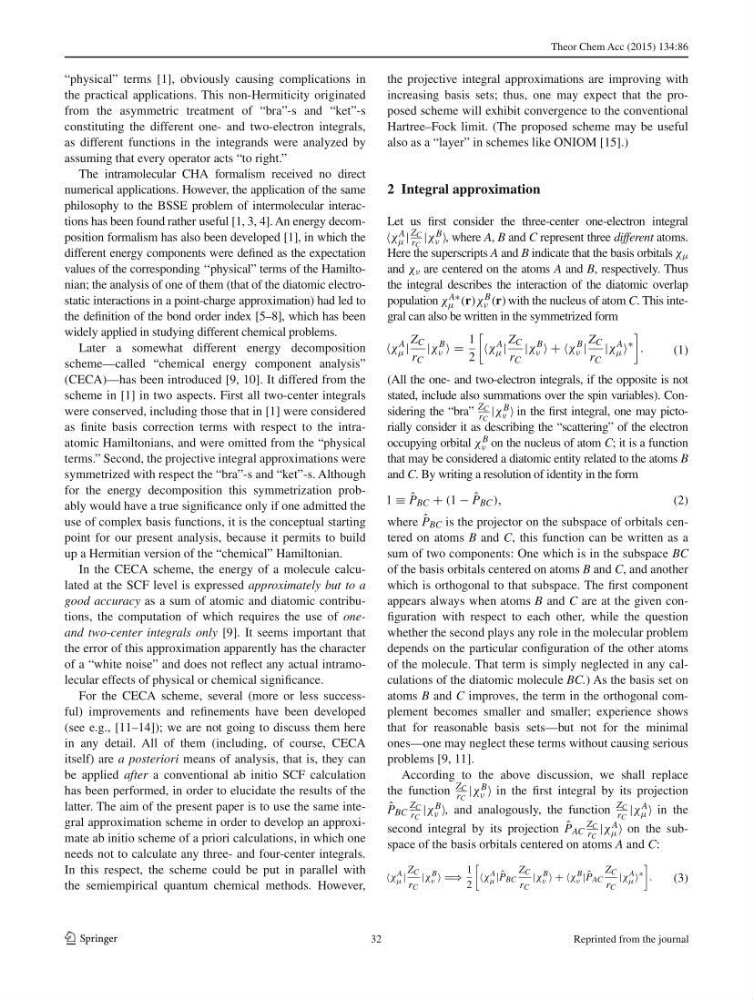
Let us fi rst consider the three-center one-electron integral
χ A
μ |
Z C
r C
|χ B
ν , where A , B and C represent three different atoms.
Here the superscripts A and B indicate that the basis orbitals χ μ
and χ ν are centered on the atoms A and B , respectively. Thus
the integral describes the interaction of the diatomic overlap
population χ A∗
μ (r)χ B
ν (r) with the nucleus of atom C . This integral can also be written in the symmetrized form
(All the one- and two-electron integrals, if the opposite is not
stated, include also summations over the spin variables). Considering the “bra”
Z C
r C
|χ B
ν in the fi rst integral, one may pictorially consider it as describing the “scattering” of the electron
occupying orbital χ B
ν on the nucleus of atom C ; it is a function
that may be considered a diatomic entity related to the atoms B
and C . By writing a resolution of identity in the form
where ˆ
P BC is the projector on the subspace of orbitals centered on atoms B and C , this function can be written as a
sum of two components: One which is in the subspace BC
of the basis orbitals centered on atoms B and C , and another
which is orthogonal to that subspace. The fi rst component
appears always when atoms B and C are at the given confi guration with respect to each other, while the question
whether the second plays any role in the molecular problem
depends on the particular confi guration of the other atoms
of the molecule. That term is simply neglected in any calculations of the diatomic molecule BC. ) As the basis set on
atoms B and C improves, the term in the orthogonal complement becomes smaller and smaller; experience shows
that for reasonable basis sets—but not for the minimal
ones—one may neglect these terms without causing serious
problems [ 9 , 11 ].
According to the above discussion, we shall replace
the function
Z C
r C
|χ B
ν in the fi rst integral by its projection
ˆ
P BC
Z C
r C
|χ B
ν , and analogously, the function
Z C
r C
|χ A
μ in the
second integral by its projection ˆ
P AC
Z C
r C
|χ A
μ on the subspace of the basis orbitals centered on atoms A and C :
(1)
χ
A
μ |
Z C
r C
|χ
B
ν =
1
2
χ
A
μ |
Z C
r C
|χ
B
ν + +χ
B
ν |
Z C
r C
|χ
A
μ
∗
.
(2)
1 ≡ ˆ
P BC + (1 − ˆ
P BC ),
(3)
χ
A
μ |
Z C
r C
|χ
B
ν =⇒
1
2
χ
A
μ | ˆ
P BC
Z C
r C
|χ
B
ν + +χ
B
ν | ˆ
P AC
Z C
r C
|χ
A
μ
∗
.
32
Reprinted from the journal
1 3
“physical” terms [ 1 ], obviously causing complications in
the practical applications. This non-Hermiticity originated
from the asymmetric treatment of “bra”-s and “ket”-s
constituting the different one- and two-electron integrals,
as different functions in the integrands were analyzed by
assuming that every operator acts “to right.”
The intramolecular CHA formalism received no direct
numerical applications. However, the application of the same
philosophy to the BSSE problem of intermolecular interactions has been found rather useful [ 1 , 3 , 4 ]. An energy decomposition formalism has also been developed [ 1 ], in which the
different energy components were defi ned as the expectation
values of the corresponding ‘‘physical” terms of the Hamiltonian; the analysis of one of them (that of the diatomic electrostatic interactions in a point-charge approximation) had led to
the defi nition of the bond order index [ 5 – 8 ], which has been
widely applied in studying different chemical problems.
Later a somewhat different energy decomposition
scheme—called “chemical energy component analysis”
(CECA)—has been introduced [ 9 , 10 ]. It differed from the
scheme in [ 1 ] in two aspects. First all two-center integrals
were conserved, including those that in [ 1 ] were considered
as fi nite basis correction terms with respect to the intraatomic Hamiltonians, and were omitted from the “physical
terms.” Second, the projective integral approximations were
symmetrized with respect the “bra”-s and “ket”-s. Although
for the energy decomposition this symmetrization probably would have a true signifi cance only if one admitted the
use of complex basis functions, it is the conceptual starting
point for our present analysis, because it permits to build
up a Hermitian version of the “chemical” Hamiltonian.
In the CECA scheme, the energy of a molecule calculated at the SCF level is expressed approximately but to a
good accuracy as a sum of atomic and diatomic contributions, the computation of which requires the use of oneand two-center integrals only [ 9 ]. It seems important that
the error of this approximation apparently has the character
of a “white noise” and does not refl ect any actual intramolecular effects of physical or chemical signifi cance.
For the CECA scheme, several (more or less successful) improvements and refi nements have been developed
(see e.g., [ 11 – 14 ]); we are not going to discuss them here
in any detail. All of them (including, of course, CECA
itself) are a posteriori means of analysis, that is, they can
be applied after a conventional ab initio SCF calculation
has been performed, in order to elucidate the results of the
latter. The aim of the present paper is to use the same integral approximation scheme in order to develop an approximate ab initio scheme of a priori calculations, in which one
needs not to calculate any three- and four-center integrals.
In this respect, the scheme could be put in parallel with
the semiempirical quantum chemical methods. However,
the projective integral approximations are improving with
increasing basis sets; thus, one may expect that the proposed scheme will exhibit convergence to the conventional
Hartree–Fock limit. (The proposed scheme may be useful
also as a “layer” in schemes like ONIOM [ 15 ].)
2 Integral approximation
Let us fi rst consider the three-center one-electron integral
χ A
μ |
Z C
r C
|χ B
ν , where A , B and C represent three different atoms.
Here the superscripts A and B indicate that the basis orbitals χ μ
and χ ν are centered on the atoms A and B , respectively. Thus
the integral describes the interaction of the diatomic overlap
population χ A∗
μ (r)χ B
ν (r) with the nucleus of atom C . This integral can also be written in the symmetrized form
(All the one- and two-electron integrals, if the opposite is not
stated, include also summations over the spin variables). Considering the “bra”
Z C
r C
|χ B
ν in the fi rst integral, one may pictorially consider it as describing the “scattering” of the electron
occupying orbital χ B
ν on the nucleus of atom C ; it is a function
that may be considered a diatomic entity related to the atoms B
and C . By writing a resolution of identity in the form
where ˆ
P BC is the projector on the subspace of orbitals centered on atoms B and C , this function can be written as a
sum of two components: One which is in the subspace BC
of the basis orbitals centered on atoms B and C , and another
which is orthogonal to that subspace. The fi rst component
appears always when atoms B and C are at the given confi guration with respect to each other, while the question
whether the second plays any role in the molecular problem
depends on the particular confi guration of the other atoms
of the molecule. That term is simply neglected in any calculations of the diatomic molecule BC. ) As the basis set on
atoms B and C improves, the term in the orthogonal complement becomes smaller and smaller; experience shows
that for reasonable basis sets—but not for the minimal
ones—one may neglect these terms without causing serious
problems [ 9 , 11 ].
According to the above discussion, we shall replace
the function
Z C
r C
|χ B
ν in the fi rst integral by its projection
ˆ
P BC
Z C
r C
|χ B
ν , and analogously, the function
Z C
r C
|χ A
μ in the
second integral by its projection ˆ
P AC
Z C
r C
|χ A
μ on the subspace of the basis orbitals centered on atoms A and C :
(1)
χ
A
μ |
Z C
r C
|χ
B
ν =
1
2
χ
A
μ |
Z C
r C
|χ
B
ν + +χ
B
ν |
Z C
r C
|χ
A
μ
∗
.
(2)
1 ≡ ˆ
P BC + (1 − ˆ
P BC ),
(3)
χ
A
μ |
Z C
r C
|χ
B
ν =⇒
1
2
χ
A
μ | ˆ
P BC
Z C
r C
|χ
B
ν + +χ
B
ν | ˆ
P AC
Z C
r C
|χ
A
μ
∗
.
32
Reprinted from the journal