

Theor Chem Acc (2015) 134:107
1 3
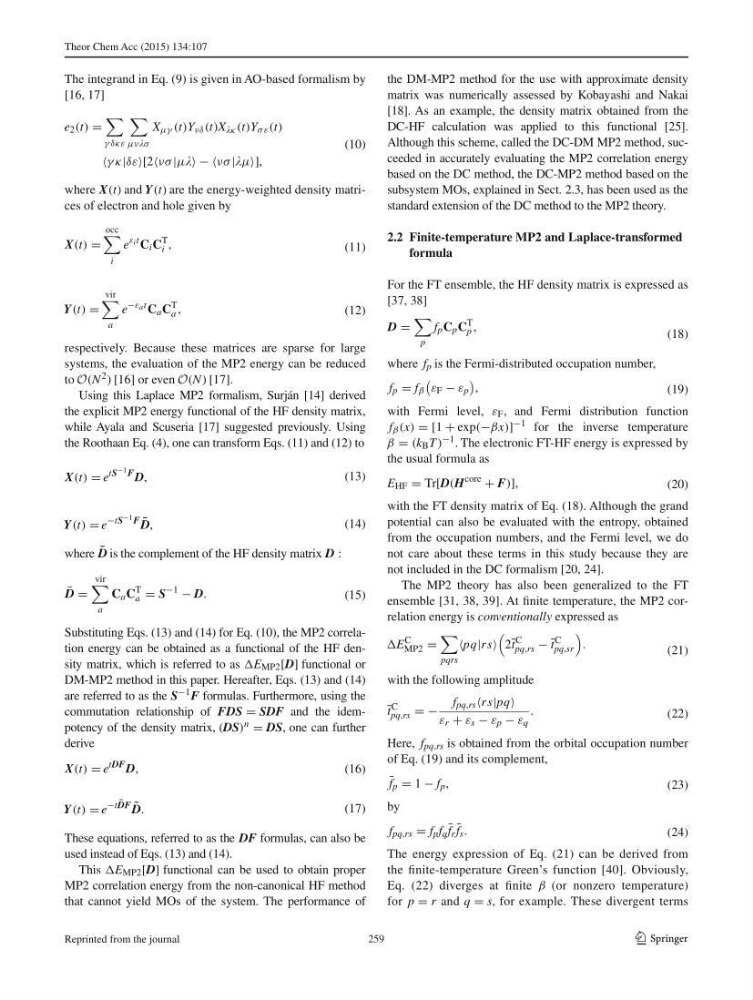
The integrand in Eq. ( 9 ) is given in AO-based formalism by
[ 16 , 17 ]
where X(t) and Y(t) are the energy-weighted density matrices of electron and hole given by
respectively. Because these matrices are sparse for large
systems, the evaluation of the MP2 energy can be reduced
to O(N 2 ) [ 16 ] or even O(N) [ 17 ].
Using this Laplace MP2 formalism, Surján [ 14 ] derived
the explicit MP2 energy functional of the HF density matrix,
while Ayala and Scuseria [ 17 ] suggested previously. Using
the Roothaan Eq. ( 4 ), one can transform Eqs. ( 11 ) and ( 12 ) to
where ¯
D is the complement of the HF density matrix D :
Substituting Eqs. ( 13 ) and ( 14 ) for Eq. ( 10 ), the MP2 correlation energy can be obtained as a functional of the HF density matrix, which is referred to as E MP2 [D] functional or
DM-MP2 method in this paper. Hereafter, Eqs. ( 13 ) and ( 14 )
are referred to as the S −1 F formulas. Furthermore, using the
commutation relationship of FDS = SDF and the idempotency of the density matrix, (DS) n = DS, one can further
derive
These equations, referred to as the DF formulas, can also be
used instead of Eqs. ( 13 ) and ( 14 ).
This E MP2 [D] functional can be used to obtain proper
MP2 correlation energy from the non-canonical HF method
that cannot yield MOs of the system. The performance of
(10)
e 2 (t) =
γ δκε
μνσ
X μγ (t)Y νδ (t)X κ (t)Y σ ε (t)
γ κ|δε[2νσ |μ − −νσ |μ],
(11)
X(t) =
occ
i
e
ε i t C i C
T
i ,
(12)
Y(t) =
vir
a
e
−ε a t C a C
T
a ,
(13)
X(t) = e
tS −1 F D,
(14)
Y(t) = e
−tS −1 F ¯
D,
(15)
¯
D =
vir
a
C a C
T
a = S
−1
− D.
(16)
X(t) = e
tDF D,
(17)
Y(t) = e
−t ¯
DF ¯
D.
the DM-MP2 method for the use with approximate density
matrix was numerically assessed by Kobayashi and Nakai
[ 18 ]. As an example, the density matrix obtained from the
DC-HF calculation was applied to this functional [ 25 ].
Although this scheme, called the DC-DM MP2 method, succeeded in accurately evaluating the MP2 correlation energy
based on the DC method, the DC-MP2 method based on the
subsystem MOs, explained in Sect. 2.3 , has been used as the
standard extension of the DC method to the MP2 theory.
2.2 Finite-temperature MP2 and Laplace-transformed
formula
For the FT ensemble, the HF density matrix is expressed as
[ 37 , 38 ]
where f p is the Fermi-distributed occupation number,
with Fermi level, ε F , and Fermi distribution function
f β (x) = [1 + exp(−βx)] −1 for the inverse temperature
β = (k B T ) −1 . The electronic FT-HF energy is expressed by
the usual formula as
with the FT density matrix of Eq. ( 18 ). Although the grand
potential can also be evaluated with the entropy, obtained
from the occupation numbers, and the Fermi level, we do
not care about these terms in this study because they are
not included in the DC formalism [ 20 , 24 ].
The MP2 theory has also been generalized to the FT
ensemble [ 31 , 38 , 39 ]. At fi nite temperature, the MP2 correlation energy is conventionally expressed as
with the following amplitude
Here, f pq,rs is obtained from the orbital occupation number
of Eq. ( 19 ) and its complement,
by
The energy expression of Eq. ( 21 ) can be derived from
the fi nite-temperature Green’s function [ 40 ]. Obviously,
Eq. ( 22 ) diverges at fi nite β (or nonzero temperature)
for p = r and q = s, for example. These divergent terms
(18)
D =
p
f p C p C
T
p ,
(19)
f p = f β
ε F − ε p
,
(20)
E HF = Tr[D(H
core
+ F)],
(21)
E
C
MP2 =
pqrs
pq|rs
2˜ t
C
pq,rs − ˜ t
C
pq,sr
.
(22)
˜ t
C
pq,rs = −
f pq,rs rs|pq
ε r + ε s − ε p − ε q
.
(23)
¯
f p = 1 − f p ,
(24)
f pq,rs = f p f q ¯
f r ¯
f s .
259
Reprinted from the journal
1 3
The integrand in Eq. ( 9 ) is given in AO-based formalism by
[ 16 , 17 ]
where X(t) and Y(t) are the energy-weighted density matrices of electron and hole given by
respectively. Because these matrices are sparse for large
systems, the evaluation of the MP2 energy can be reduced
to O(N 2 ) [ 16 ] or even O(N) [ 17 ].
Using this Laplace MP2 formalism, Surján [ 14 ] derived
the explicit MP2 energy functional of the HF density matrix,
while Ayala and Scuseria [ 17 ] suggested previously. Using
the Roothaan Eq. ( 4 ), one can transform Eqs. ( 11 ) and ( 12 ) to
where ¯
D is the complement of the HF density matrix D :
Substituting Eqs. ( 13 ) and ( 14 ) for Eq. ( 10 ), the MP2 correlation energy can be obtained as a functional of the HF density matrix, which is referred to as E MP2 [D] functional or
DM-MP2 method in this paper. Hereafter, Eqs. ( 13 ) and ( 14 )
are referred to as the S −1 F formulas. Furthermore, using the
commutation relationship of FDS = SDF and the idempotency of the density matrix, (DS) n = DS, one can further
derive
These equations, referred to as the DF formulas, can also be
used instead of Eqs. ( 13 ) and ( 14 ).
This E MP2 [D] functional can be used to obtain proper
MP2 correlation energy from the non-canonical HF method
that cannot yield MOs of the system. The performance of
(10)
e 2 (t) =
γ δκε
μνσ
X μγ (t)Y νδ (t)X κ (t)Y σ ε (t)
γ κ|δε[2νσ |μ − −νσ |μ],
(11)
X(t) =
occ
i
e
ε i t C i C
T
i ,
(12)
Y(t) =
vir
a
e
−ε a t C a C
T
a ,
(13)
X(t) = e
tS −1 F D,
(14)
Y(t) = e
−tS −1 F ¯
D,
(15)
¯
D =
vir
a
C a C
T
a = S
−1
− D.
(16)
X(t) = e
tDF D,
(17)
Y(t) = e
−t ¯
DF ¯
D.
the DM-MP2 method for the use with approximate density
matrix was numerically assessed by Kobayashi and Nakai
[ 18 ]. As an example, the density matrix obtained from the
DC-HF calculation was applied to this functional [ 25 ].
Although this scheme, called the DC-DM MP2 method, succeeded in accurately evaluating the MP2 correlation energy
based on the DC method, the DC-MP2 method based on the
subsystem MOs, explained in Sect. 2.3 , has been used as the
standard extension of the DC method to the MP2 theory.
2.2 Finite-temperature MP2 and Laplace-transformed
formula
For the FT ensemble, the HF density matrix is expressed as
[ 37 , 38 ]
where f p is the Fermi-distributed occupation number,
with Fermi level, ε F , and Fermi distribution function
f β (x) = [1 + exp(−βx)] −1 for the inverse temperature
β = (k B T ) −1 . The electronic FT-HF energy is expressed by
the usual formula as
with the FT density matrix of Eq. ( 18 ). Although the grand
potential can also be evaluated with the entropy, obtained
from the occupation numbers, and the Fermi level, we do
not care about these terms in this study because they are
not included in the DC formalism [ 20 , 24 ].
The MP2 theory has also been generalized to the FT
ensemble [ 31 , 38 , 39 ]. At fi nite temperature, the MP2 correlation energy is conventionally expressed as
with the following amplitude
Here, f pq,rs is obtained from the orbital occupation number
of Eq. ( 19 ) and its complement,
by
The energy expression of Eq. ( 21 ) can be derived from
the fi nite-temperature Green’s function [ 40 ]. Obviously,
Eq. ( 22 ) diverges at fi nite β (or nonzero temperature)
for p = r and q = s, for example. These divergent terms
(18)
D =
p
f p C p C
T
p ,
(19)
f p = f β
ε F − ε p
,
(20)
E HF = Tr[D(H
core
+ F)],
(21)
E
C
MP2 =
pqrs
pq|rs
2˜ t
C
pq,rs − ˜ t
C
pq,sr
.
(22)
˜ t
C
pq,rs = −
f pq,rs rs|pq
ε r + ε s − ε p − ε q
.
(23)
¯
f p = 1 − f p ,
(24)
f pq,rs = f p f q ¯
f r ¯
f s .
259
Reprinted from the journal