

Theor Chem Acc (2015) 134:107
1 3
formalism [ 15 – 17 ]. One of the authors (MK) followed
this DM-MP2 or E MP2 [D] functional [ 18 ]. Its extension
to higher-order MP energies was also mentioned by Surján
and Szabados [ 19 ].
Another simple but straightforward way of reducing the
computational time of quantum chemical calculations is
the fragmentation of the system under consideration. Kobayashi, Nakai, and coworkers have developed one of them,
called the divide-and-conquer (DC) method [ 20 – 22 ], which
was fi rst proposed by Yang [ 23 , 24 ] in the framework of the
mean-fi eld theories. The characteristic feature of the DC
method, which allows the method to be applied to delocalized systems, is the use of the overlapped fragmentation
that is managed by introducing the buffer region with the
assistance of the fi nite-temperature (FT) HF formalism.
They also proposed two types of the extension of the DC
method to the post-HF correlation theories, including MP2.
The fi rst one, called the DC–DM MP2 method, applies the
approximate HF density matrix obtained from the DC-HF
calculation to the E MP2 [D] functional [ 25 ]. In the other
method, called the DC-MP2 method, the correlation energy
corresponding to each subsystem is evaluated using the
subsystem molecular orbitals (MOs) [ 26 ]. The latter one
has also been applied to the cluster expansion theories
[ 27 – 29 ]. Although it was practically found that the DC–
DM MP2 energy often shows better agreement with the
canonical MP2 energy than the DC-MP2 one, the DC-MP2
method is usually adopted because of its smaller computational cost. In the DC–DM MP2 method, the FT effect
is considered to be included through the use of FT DC-HF
density matrix. But in the DC-MP2 method, the subsystem
MOs are clearly separated into occupied and virtual ones.
By the way, the MP2 theory was also extended to the
FT ensemble [ 30 , 31 ] based on the FT Green’s function
theory. Recently, Hirata and He [ 32 ] formulated a novel
representation, called the renormalized formula, which is
free from the so-called Kohn–Luttinger conundrum [ 33 ].
Kohn–Luttinger conundrum refers to the following inconsistency: taking the limit of T → 0 for the conventional
FT many-body perturbation formalism does not lead to
the zero-temperature correspondence for metallic system
because of the appearance of the anomalous diagram. In
addition, the renormalized FT-MP2 method consistently
connects the divergence rates of the zero-temperature MP2
energy for homogeneous electron gas system to the FT
formalism. Their method is based on the FT normal ordering and thermal Wick’s theorem [ 34 , 35 ]. In this paper, we
reveal the relation between two DM-MP2 and two FT-MP2
energy expressions. Then, we introduce the FT effect to the
DC-MP2 correlation energy. The theoretical aspects of this
paper are given in Sect. 2 . It is followed by the numerical
assessment in calculations of small benzene molecule and
fairly large polyene system, C 60 H 62 .
2 Theory
2.1 Laplace-transformed MP2 and E MP2 [D]
functionals
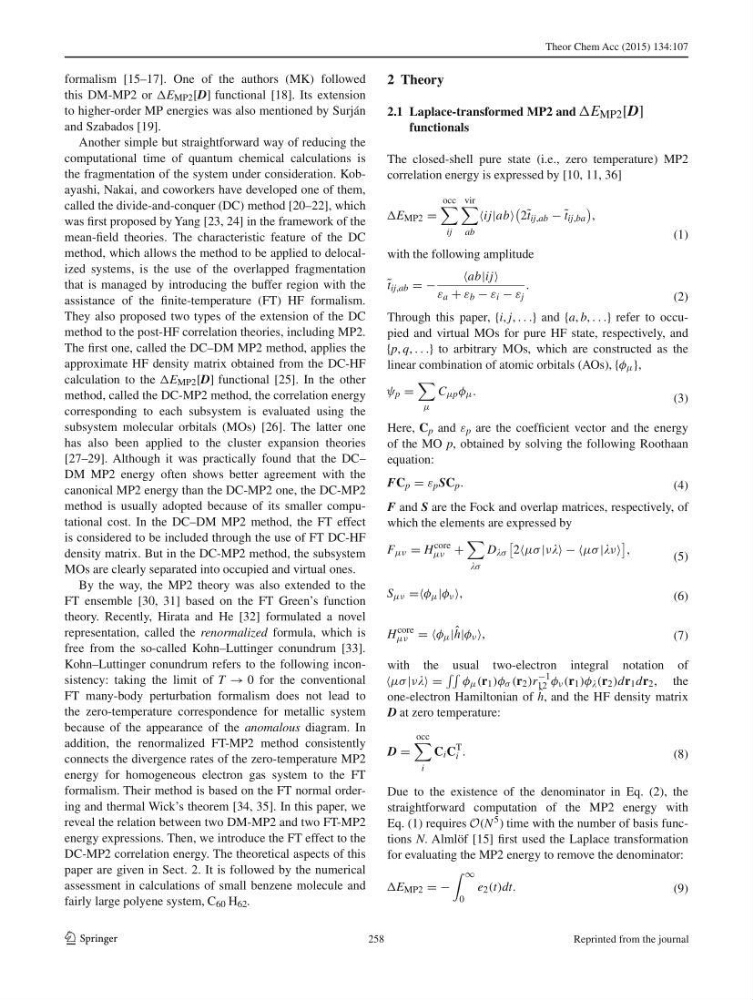
The closed-shell pure state (i.e., zero temperature) MP2
correlation energy is expressed by [ 10 , 11 , 36 ]
with the following amplitude
Through this paper, {i, j, . . .} and {a, b, . . .} refer to occupied and virtual MOs for pure HF state, respectively, and
{p, q, . . .} to arbitrary MOs, which are constructed as the
linear combination of atomic orbitals (AOs), {φ μ },
Here, C p and ε p are the coeffi cient vector and the energy
of the MO p , obtained by solving the following Roothaan
equation:
F and S are the Fock and overlap matrices, respectively, of
which the elements are expressed by
with the usual two-electron integral notation of
μσ |ν =
φ μ (r 1 )φ σ (r 2 )r
−1
12 φ ν (r 1 )φ (r 2 )dr 1 dr 2 , the
one-electron Hamiltonian of ˆ
h, and the HF density matrix
D at zero temperature:
Due to the existence of the denominator in Eq. ( 2 ), the
straightforward computation of the MP2 energy with
Eq. ( 1 ) requires O(N 5 ) time with the number of basis functions N . Almlöf [ 15 ] fi rst used the Laplace transformation
for evaluating the MP2 energy to remove the denominator:
(1)
E MP2 =
occ
ij
vir
ab
ij|ab
2˜ t ij,ab − ˜ t ij,ba
,
(2)
˜ t ij,ab = −
ab|ij
ε a + ε b − ε i − ε j
.
(3)
ψ p =
μ
C μp φ μ .
(4)
FC p = ε p SC p .
(5)
F μν = H
core
μν +
σ
D σ
2μσ |ν − −μσ |ν
,
(6)
S μν ==φ μ |φ ν ,
(7)
H
core
μν = =φ μ | ˆ
h|φ ν ,
(8)
D =
occ
i
C i C
T
i .
(9)
E MP2 = −
∞
0
e 2 (t)dt.
258
Reprinted from the journal
1 3
formalism [ 15 – 17 ]. One of the authors (MK) followed
this DM-MP2 or E MP2 [D] functional [ 18 ]. Its extension
to higher-order MP energies was also mentioned by Surján
and Szabados [ 19 ].
Another simple but straightforward way of reducing the
computational time of quantum chemical calculations is
the fragmentation of the system under consideration. Kobayashi, Nakai, and coworkers have developed one of them,
called the divide-and-conquer (DC) method [ 20 – 22 ], which
was fi rst proposed by Yang [ 23 , 24 ] in the framework of the
mean-fi eld theories. The characteristic feature of the DC
method, which allows the method to be applied to delocalized systems, is the use of the overlapped fragmentation
that is managed by introducing the buffer region with the
assistance of the fi nite-temperature (FT) HF formalism.
They also proposed two types of the extension of the DC
method to the post-HF correlation theories, including MP2.
The fi rst one, called the DC–DM MP2 method, applies the
approximate HF density matrix obtained from the DC-HF
calculation to the E MP2 [D] functional [ 25 ]. In the other
method, called the DC-MP2 method, the correlation energy
corresponding to each subsystem is evaluated using the
subsystem molecular orbitals (MOs) [ 26 ]. The latter one
has also been applied to the cluster expansion theories
[ 27 – 29 ]. Although it was practically found that the DC–
DM MP2 energy often shows better agreement with the
canonical MP2 energy than the DC-MP2 one, the DC-MP2
method is usually adopted because of its smaller computational cost. In the DC–DM MP2 method, the FT effect
is considered to be included through the use of FT DC-HF
density matrix. But in the DC-MP2 method, the subsystem
MOs are clearly separated into occupied and virtual ones.
By the way, the MP2 theory was also extended to the
FT ensemble [ 30 , 31 ] based on the FT Green’s function
theory. Recently, Hirata and He [ 32 ] formulated a novel
representation, called the renormalized formula, which is
free from the so-called Kohn–Luttinger conundrum [ 33 ].
Kohn–Luttinger conundrum refers to the following inconsistency: taking the limit of T → 0 for the conventional
FT many-body perturbation formalism does not lead to
the zero-temperature correspondence for metallic system
because of the appearance of the anomalous diagram. In
addition, the renormalized FT-MP2 method consistently
connects the divergence rates of the zero-temperature MP2
energy for homogeneous electron gas system to the FT
formalism. Their method is based on the FT normal ordering and thermal Wick’s theorem [ 34 , 35 ]. In this paper, we
reveal the relation between two DM-MP2 and two FT-MP2
energy expressions. Then, we introduce the FT effect to the
DC-MP2 correlation energy. The theoretical aspects of this
paper are given in Sect. 2 . It is followed by the numerical
assessment in calculations of small benzene molecule and
fairly large polyene system, C 60 H 62 .
2 Theory
2.1 Laplace-transformed MP2 and E MP2 [D]
functionals
The closed-shell pure state (i.e., zero temperature) MP2
correlation energy is expressed by [ 10 , 11 , 36 ]
with the following amplitude
Through this paper, {i, j, . . .} and {a, b, . . .} refer to occupied and virtual MOs for pure HF state, respectively, and
{p, q, . . .} to arbitrary MOs, which are constructed as the
linear combination of atomic orbitals (AOs), {φ μ },
Here, C p and ε p are the coeffi cient vector and the energy
of the MO p , obtained by solving the following Roothaan
equation:
F and S are the Fock and overlap matrices, respectively, of
which the elements are expressed by
with the usual two-electron integral notation of
μσ |ν =
φ μ (r 1 )φ σ (r 2 )r
−1
12 φ ν (r 1 )φ (r 2 )dr 1 dr 2 , the
one-electron Hamiltonian of ˆ
h, and the HF density matrix
D at zero temperature:
Due to the existence of the denominator in Eq. ( 2 ), the
straightforward computation of the MP2 energy with
Eq. ( 1 ) requires O(N 5 ) time with the number of basis functions N . Almlöf [ 15 ] fi rst used the Laplace transformation
for evaluating the MP2 energy to remove the denominator:
(1)
E MP2 =
occ
ij
vir
ab
ij|ab
2˜ t ij,ab − ˜ t ij,ba
,
(2)
˜ t ij,ab = −
ab|ij
ε a + ε b − ε i − ε j
.
(3)
ψ p =
μ
C μp φ μ .
(4)
FC p = ε p SC p .
(5)
F μν = H
core
μν +
σ
D σ
2μσ |ν − −μσ |ν
,
(6)
S μν ==φ μ |φ ν ,
(7)
H
core
μν = =φ μ | ˆ
h|φ ν ,
(8)
D =
occ
i
C i C
T
i .
(9)
E MP2 = −
∞
0
e 2 (t)dt.
258
Reprinted from the journal