

Theor Chem Acc (2015) 134:143
1 3
Be atom is fi xed at the x = 0, y = 0, z = 0 point, while
the positions of hydrogens are x = 0, y = ± (2.54 a.u. −
0.46*z) [ 35 ]. This process can be qualitatively described by
a two-by-two CAS problem which contains two determinants D A = 1a 2
1 2a 2
1 1b 2
2 and D B = 1a 2
1 2a 2
1 3a 2
1 , which give
contribution to the ground state MCSCF wave function.
The two determinants change role at the 2.875–2.9 a.u.
interval, i.e., for z < 2.9 a.u. D A is the leading determinant,
while for the larger z values determinant D B has the larger
coeffi cient. To demonstrate the Fermi-vacuum dependence
of the QMBPT2 method these calculations were performed
for both possible PDs. The results of the BeH 2 calculations
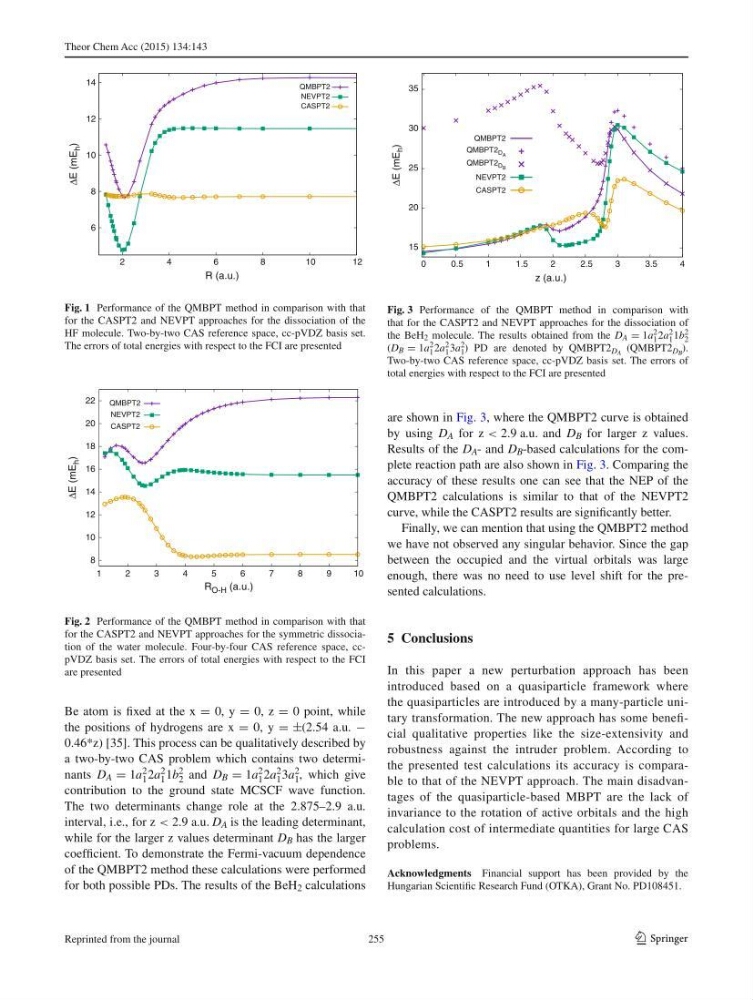
are shown in Fig. 3 , where the QMBPT2 curve is obtained
by using D A for z < 2.9 a.u. and D B for larger z values.
Results of the D A - and D B -based calculations for the complete reaction path are also shown in Fig. 3 . Comparing the
accuracy of these results one can see that the NEP of the
QMBPT2 calculations is similar to that of the NEVPT2
curve, while the CASPT2 results are signifi cantly better.
Finally, we can mention that using the QMBPT2 method
we have not observed any singular behavior. Since the gap
between the occupied and the virtual orbitals was large
enough, there was no need to use level shift for the presented calculations.
5 Conclusions
In this paper a new perturbation approach has been
introduced based on a quasiparticle framework where
the quasiparticles are introduced by a many-particle unitary transformation. The new approach has some benefi -
cial qualitative properties like the size-extensivity and
robustness against the intruder problem. According to
the presented test calculations its accuracy is comparable to that of the NEVPT approach. The main disadvantages of the quasiparticle-based MBPT are the lack of
invariance to the rotation of active orbitals and the high
calculation cost of intermediate quantities for large CAS
problems.
Acknowledgments Financial support has been provided by the
Hungarian Scientifi c Research Fund (OTKA), Grant No. PD108451.
6
8
10
12
14
2
4
6
8
10
12
ΔE (mE
h )
R (a.u.)
QMBPT2
NEVPT2
CASPT2
Fig. 1 Performance of the QMBPT method in comparison with that
for the CASPT2 and NEVPT approaches for the dissociation of the
HF molecule. Two-by-two CAS reference space, cc-pVDZ basis set.
The errors of total energies with respect to the FCI are presented
8
10
12
14
16
18
20
22
1
2
3
4
5
6
7
8
9
10
ΔE (mE
h )
R O-H (a.u.)
QMBPT2
NEVPT2
CASPT2
Fig. 2 Performance of the QMBPT method in comparison with that
for the CASPT2 and NEVPT approaches for the symmetric dissociation of the water molecule. Four-by-four CAS reference space, ccpVDZ basis set. The errors of total energies with respect to the FCI
are presented
15
20
25
30
35
0
0.5
1
1.5
2
2.5
3
3.5
4
ΔE (mE
h )
z (a.u.)
QMBPT2
QMBPT2 D A
QMBPT2 D B
NEVPT2
CASPT2
Fig. 3 Performance of the QMBPT method in comparison with
that for the CASPT2 and NEVPT approaches for the dissociation of
the BeH 2 molecule. The results obtained from the D A = 1a 2
1 2a 2
1 1b 2
2
( D B = 1a 2
1 2a 2
1 3a 2
1 ) PD are denoted by QMBPT2 D A ( QMBPT2 D B ).
Two-by-two CAS reference space, cc-pVDZ basis set. The errors of
total energies with respect to the FCI are presented
255
Reprinted from the journal
1 3
Be atom is fi xed at the x = 0, y = 0, z = 0 point, while
the positions of hydrogens are x = 0, y = ± (2.54 a.u. −
0.46*z) [ 35 ]. This process can be qualitatively described by
a two-by-two CAS problem which contains two determinants D A = 1a 2
1 2a 2
1 1b 2
2 and D B = 1a 2
1 2a 2
1 3a 2
1 , which give
contribution to the ground state MCSCF wave function.
The two determinants change role at the 2.875–2.9 a.u.
interval, i.e., for z < 2.9 a.u. D A is the leading determinant,
while for the larger z values determinant D B has the larger
coeffi cient. To demonstrate the Fermi-vacuum dependence
of the QMBPT2 method these calculations were performed
for both possible PDs. The results of the BeH 2 calculations
are shown in Fig. 3 , where the QMBPT2 curve is obtained
by using D A for z < 2.9 a.u. and D B for larger z values.
Results of the D A - and D B -based calculations for the complete reaction path are also shown in Fig. 3 . Comparing the
accuracy of these results one can see that the NEP of the
QMBPT2 calculations is similar to that of the NEVPT2
curve, while the CASPT2 results are signifi cantly better.
Finally, we can mention that using the QMBPT2 method
we have not observed any singular behavior. Since the gap
between the occupied and the virtual orbitals was large
enough, there was no need to use level shift for the presented calculations.
5 Conclusions
In this paper a new perturbation approach has been
introduced based on a quasiparticle framework where
the quasiparticles are introduced by a many-particle unitary transformation. The new approach has some benefi -
cial qualitative properties like the size-extensivity and
robustness against the intruder problem. According to
the presented test calculations its accuracy is comparable to that of the NEVPT approach. The main disadvantages of the quasiparticle-based MBPT are the lack of
invariance to the rotation of active orbitals and the high
calculation cost of intermediate quantities for large CAS
problems.
Acknowledgments Financial support has been provided by the
Hungarian Scientifi c Research Fund (OTKA), Grant No. PD108451.
6
8
10
12
14
2
4
6
8
10
12
ΔE (mE
h )
R (a.u.)
QMBPT2
NEVPT2
CASPT2
Fig. 1 Performance of the QMBPT method in comparison with that
for the CASPT2 and NEVPT approaches for the dissociation of the
HF molecule. Two-by-two CAS reference space, cc-pVDZ basis set.
The errors of total energies with respect to the FCI are presented
8
10
12
14
16
18
20
22
1
2
3
4
5
6
7
8
9
10
ΔE (mE
h )
R O-H (a.u.)
QMBPT2
NEVPT2
CASPT2
Fig. 2 Performance of the QMBPT method in comparison with that
for the CASPT2 and NEVPT approaches for the symmetric dissociation of the water molecule. Four-by-four CAS reference space, ccpVDZ basis set. The errors of total energies with respect to the FCI
are presented
15
20
25
30
35
0
0.5
1
1.5
2
2.5
3
3.5
4
ΔE (mE
h )
z (a.u.)
QMBPT2
QMBPT2 D A
QMBPT2 D B
NEVPT2
CASPT2
Fig. 3 Performance of the QMBPT method in comparison with
that for the CASPT2 and NEVPT approaches for the dissociation of
the BeH 2 molecule. The results obtained from the D A = 1a 2
1 2a 2
1 1b 2
2
( D B = 1a 2
1 2a 2
1 3a 2
1 ) PD are denoted by QMBPT2 D A ( QMBPT2 D B ).
Two-by-two CAS reference space, cc-pVDZ basis set. The errors of
total energies with respect to the FCI are presented
255
Reprinted from the journal