

Theor Chem Acc (2015) 134:143
1 3
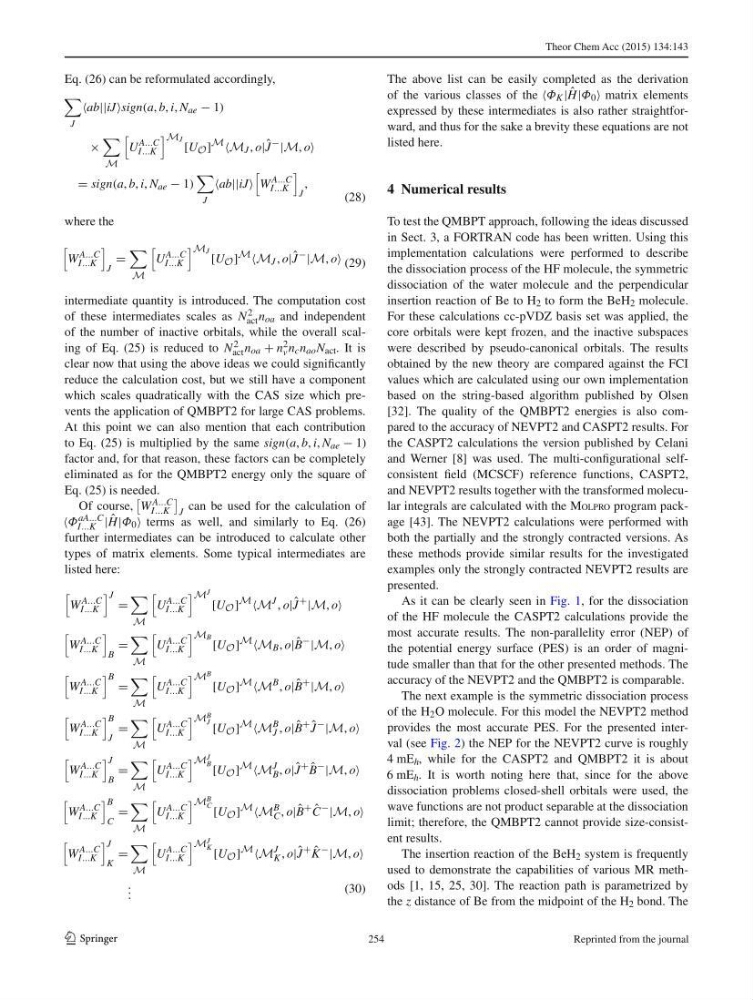
Eq. ( 26 ) can be reformulated accordingly,
where the
intermediate quantity is introduced. The computation cost
of these intermediates scales as N 2
act n oa and independent
of the number of inactive orbitals, while the overall scaling of Eq. ( 25 ) is reduced to N 2
act n oa + n 2
v n c n ao N act . It is
clear now that using the above ideas we could signifi cantly
reduce the calculation cost, but we still have a component
which scales quadratically with the CAS size which prevents the application of QMBPT2 for large CAS problems.
At this point we can also mention that each contribution
to Eq. ( 25 ) is multiplied by the same sign(a, b, i, N ae − 1)
factor and, for that reason, these factors can be completely
eliminated as for the QMBPT2 energy only the square of
Eq. ( 25 ) is needed.
Of course,
W
A...C
I...K
J
can be used for the calculation of
Φ
aA...C
I...K | ˆ
H|Φ 0 terms as well, and similarly to Eq. ( 26 )
further intermediates can be introduced to calculate other
types of matrix elements. Some typical intermediates are
listed here:
(28)
J
ab||iJsign(a, b, i, N ae − 1)
×
M
U
A...C
I...K
M J
[U O ]
M
M J , o| ˆ
J
−
|M, o
= sign(a, b, i, N ae − 1)
J
ab||iJ
W
A...C
I...K
J
,
(29)
W
A...C
I...K
J
=
M
U
A...C
I...K
M J
[U O ]
M
M J , o| ˆ
J
−
|M, o
(30)
W
A...C
I...K
J =
M
U
A...C
I...K
M J
[U O ]
M
M
J , o| ˆ
J
+
|M, o
W
A...C
I...K
B
=
M
U
A...C
I...K
M B
[U O ]
M
M B , o| ˆ
B
−
|M, o
W
A...C
I...K
B =
M
U
A...C
I...K
M B
[U O ]
M
M
B , o| ˆ
B
+
|M, o
W
A...C
I...K
B
J
=
M
U
A...C
I...K
M B
J [U O ]
M
M
B
J , o| ˆ
B
+ ˆ
J
−
|M, o
W
A...C
I...K
J
B
=
M
U
A...C
I...K
M J
B [U O ]
M
M
J
B , o| ˆ
J
+ ˆ
B
−
|M, o
W
A...C
I...K
B
C
=
M
U
A...C
I...K
M B
C [U O ]
M
M
B
C , o| ˆ
B
+ ˆ
C
−
|M, o
W
A...C
I...K
J
K
=
M
U
A...C
I...K
M J
K [U O ]
M
M
J
K , o| ˆ
J
+ ˆ
K
−
|M, o
. .
.
The above list can be easily completed as the derivation
of the various classes of the Φ K | ˆ
H|Φ 0 matrix elements
expressed by these intermediates is also rather straightforward, and thus for the sake a brevity these equations are not
listed here.
4 Numerical results
To test the QMBPT approach, following the ideas discussed
in Sect. 3 , a FORTRAN code has been written. Using this
implementation calculations were performed to describe
the dissociation process of the HF molecule, the symmetric
dissociation of the water molecule and the perpendicular
insertion reaction of Be to H 2 to form the BeH 2 molecule.
For these calculations cc-pVDZ basis set was applied, the
core orbitals were kept frozen, and the inactive subspaces
were described by pseudo-canonical orbitals. The results
obtained by the new theory are compared against the FCI
values which are calculated using our own implementation
based on the string-based algorithm published by Olsen
[ 32 ]. The quality of the QMBPT2 energies is also compared to the accuracy of NEVPT2 and CASPT2 results. For
the CASPT2 calculations the version published by Celani
and Werner [ 8 ] was used. The multi-confi gurational selfconsistent fi eld (MCSCF) reference functions, CASPT2,
and NEVPT2 results together with the transformed molecular integrals are calculated with the MOLPRO program package [ 43 ]. The NEVPT2 calculations were performed with
both the partially and the strongly contracted versions. As
these methods provide similar results for the investigated
examples only the strongly contracted NEVPT2 results are
presented.
As it can be clearly seen in Fig. 1 , for the dissociation
of the HF molecule the CASPT2 calculations provide the
most accurate results. The non-parallelity error (NEP) of
the potential energy surface (PES) is an order of magnitude smaller than that for the other presented methods. The
accuracy of the NEVPT2 and the QMBPT2 is comparable.
The next example is the symmetric dissociation process
of the H 2 O molecule. For this model the NEVPT2 method
provides the most accurate PES. For the presented interval (see Fig. 2 ) the NEP for the NEVPT2 curve is roughly
4 mE h , while for the CASPT2 and QMBPT2 it is about
6 mE h . It is worth noting here that, since for the above
dissociation problems closed-shell orbitals were used, the
wave functions are not product separable at the dissociation
limit; therefore, the QMBPT2 cannot provide size-consistent results.
The insertion reaction of the BeH 2 system is frequently
used to demonstrate the capabilities of various MR methods [ 1 , 15 , 25 , 30 ]. The reaction path is parametrized by
the z distance of Be from the midpoint of the H 2 bond. The
254
Reprinted from the journal
1 3
Eq. ( 26 ) can be reformulated accordingly,
where the
intermediate quantity is introduced. The computation cost
of these intermediates scales as N 2
act n oa and independent
of the number of inactive orbitals, while the overall scaling of Eq. ( 25 ) is reduced to N 2
act n oa + n 2
v n c n ao N act . It is
clear now that using the above ideas we could signifi cantly
reduce the calculation cost, but we still have a component
which scales quadratically with the CAS size which prevents the application of QMBPT2 for large CAS problems.
At this point we can also mention that each contribution
to Eq. ( 25 ) is multiplied by the same sign(a, b, i, N ae − 1)
factor and, for that reason, these factors can be completely
eliminated as for the QMBPT2 energy only the square of
Eq. ( 25 ) is needed.
Of course,
W
A...C
I...K
J
can be used for the calculation of
Φ
aA...C
I...K | ˆ
H|Φ 0 terms as well, and similarly to Eq. ( 26 )
further intermediates can be introduced to calculate other
types of matrix elements. Some typical intermediates are
listed here:
(28)
J
ab||iJsign(a, b, i, N ae − 1)
×
M
U
A...C
I...K
M J
[U O ]
M
M J , o| ˆ
J
−
|M, o
= sign(a, b, i, N ae − 1)
J
ab||iJ
W
A...C
I...K
J
,
(29)
W
A...C
I...K
J
=
M
U
A...C
I...K
M J
[U O ]
M
M J , o| ˆ
J
−
|M, o
(30)
W
A...C
I...K
J =
M
U
A...C
I...K
M J
[U O ]
M
M
J , o| ˆ
J
+
|M, o
W
A...C
I...K
B
=
M
U
A...C
I...K
M B
[U O ]
M
M B , o| ˆ
B
−
|M, o
W
A...C
I...K
B =
M
U
A...C
I...K
M B
[U O ]
M
M
B , o| ˆ
B
+
|M, o
W
A...C
I...K
B
J
=
M
U
A...C
I...K
M B
J [U O ]
M
M
B
J , o| ˆ
B
+ ˆ
J
−
|M, o
W
A...C
I...K
J
B
=
M
U
A...C
I...K
M J
B [U O ]
M
M
J
B , o| ˆ
J
+ ˆ
B
−
|M, o
W
A...C
I...K
B
C
=
M
U
A...C
I...K
M B
C [U O ]
M
M
B
C , o| ˆ
B
+ ˆ
C
−
|M, o
W
A...C
I...K
J
K
=
M
U
A...C
I...K
M J
K [U O ]
M
M
J
K , o| ˆ
J
+ ˆ
K
−
|M, o
. .
.
The above list can be easily completed as the derivation
of the various classes of the Φ K | ˆ
H|Φ 0 matrix elements
expressed by these intermediates is also rather straightforward, and thus for the sake a brevity these equations are not
listed here.
4 Numerical results
To test the QMBPT approach, following the ideas discussed
in Sect. 3 , a FORTRAN code has been written. Using this
implementation calculations were performed to describe
the dissociation process of the HF molecule, the symmetric
dissociation of the water molecule and the perpendicular
insertion reaction of Be to H 2 to form the BeH 2 molecule.
For these calculations cc-pVDZ basis set was applied, the
core orbitals were kept frozen, and the inactive subspaces
were described by pseudo-canonical orbitals. The results
obtained by the new theory are compared against the FCI
values which are calculated using our own implementation
based on the string-based algorithm published by Olsen
[ 32 ]. The quality of the QMBPT2 energies is also compared to the accuracy of NEVPT2 and CASPT2 results. For
the CASPT2 calculations the version published by Celani
and Werner [ 8 ] was used. The multi-confi gurational selfconsistent fi eld (MCSCF) reference functions, CASPT2,
and NEVPT2 results together with the transformed molecular integrals are calculated with the MOLPRO program package [ 43 ]. The NEVPT2 calculations were performed with
both the partially and the strongly contracted versions. As
these methods provide similar results for the investigated
examples only the strongly contracted NEVPT2 results are
presented.
As it can be clearly seen in Fig. 1 , for the dissociation
of the HF molecule the CASPT2 calculations provide the
most accurate results. The non-parallelity error (NEP) of
the potential energy surface (PES) is an order of magnitude smaller than that for the other presented methods. The
accuracy of the NEVPT2 and the QMBPT2 is comparable.
The next example is the symmetric dissociation process
of the H 2 O molecule. For this model the NEVPT2 method
provides the most accurate PES. For the presented interval (see Fig. 2 ) the NEP for the NEVPT2 curve is roughly
4 mE h , while for the CASPT2 and QMBPT2 it is about
6 mE h . It is worth noting here that, since for the above
dissociation problems closed-shell orbitals were used, the
wave functions are not product separable at the dissociation
limit; therefore, the QMBPT2 cannot provide size-consistent results.
The insertion reaction of the BeH 2 system is frequently
used to demonstrate the capabilities of various MR methods [ 1 , 15 , 25 , 30 ]. The reaction path is parametrized by
the z distance of Be from the midpoint of the H 2 bond. The
254
Reprinted from the journal