

Theor Chem Acc (2015) 134:74
1 3
[ 43 ] molecules and monitored the change of total energy
increasing the number of basis functions and optimizing
their parameters. Based on Table 1 , we fi nd that polarization functions decrease the energy of water and ammonia,
respectively, by 38.7 and 32.5 m E h , while for methane,
this number is 21.1 m E h . As expected, the more electrons
build up an atom or the more a bond is polarized, the better
description is achieved by the use of BFs. In these cases,
s -type BFs seem to be insuffi cient for the replacement of
polarization functions, but using p -type ones, the energy is
considerably lower than with basis sets including polarization functions. We note that the p -type BFs are always
located closer to the nitrogen and oxygen atoms improving
also the description of atoms, while the s -type functions are
farther from the heavy atoms contributing primarily to the
description of bonds. Evaluating the results, we selected
the 6-31G–1 s 1 p BF basis set for both bond types for further calculations.
The next step is to study single bonds between heteroatoms and the carbon atom. We chose methylamine [ 45 ]
and methanol [ 46 ] and optimized the BFs for the N–C and
O–C bonds using the AO and BF basis sets optimized previously for the atoms and other bonds. As we have seen, for
accurate energies, the N–H and O–H bonds require p -type
BFs, which improve the quality of the description of both
the atoms and the bonds. Since it is likely to be the case
for the N–C and O–C bonds, we also considered BF sets
including p functions for the latter bonds. This turned out to
be especially important for molecules which include N–C
and O–C bonds but no O–H and N–H bonds, such as ethers,
because for those systems, the p -type functions improving
the atoms would be missing. Performing the optimizations, we again observe that the p functions are closer to
the heavy atom of higher electronegativity. Considering the
results (see Table 1 ), we can conclude that the performance
of the BF basis sets is superior to that for the conventional
AO basis sets including polarization functions.
Double and triple bonds between heteroatoms and the
carbon atom (N=C, N≡C, O=C) were treated similar to
the carbon–carbon multiple bonds: A set of p functions
was placed on each π -bond. The model systems include
methanimine [ 47 ], hydrogen cyanide [ 44 ], and formaldehyde [ 48 ]; the results of the optimizations are presented
in Table 1 . As can be seen, if the heteroatom is nitrogen,
even one s -type function is suffi cient in addition to the p
functions used for the π -bonds to achieve the accuracy of
the reoptimized AO basis set. For oxygen, two s functions
are desirable since the energies obtained with the 1 s 1 p BF
set are only slightly better than those computed with the
r6-31G** basis, and, as we have seen for hydrocarbons,
if the BF basis sets optimized for the small molecules are
used for bigger systems, their performance with respect to
the original AO bases is relatively worse.
With the BF basis sets optimized for the bonds including
heteroatoms, we performed benchmark calculations for a
test set of 12 molecules including alcohol, ketone, carbonic
acid, carbonate, ester, ether, primary and secondary amine,
imine, amide, and nitrile. As reference, the cc-pVTZ basis
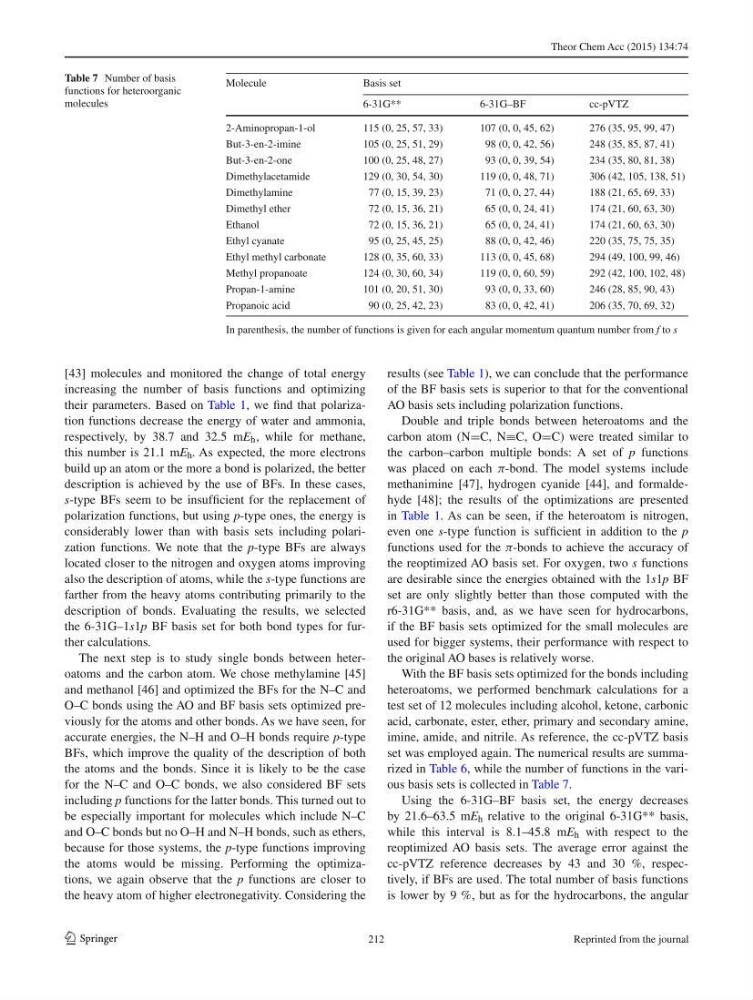
set was employed again. The numerical results are summarized in Table 6 , while the number of functions in the various basis sets is collected in Table 7 .
Using the 6-31G–BF basis set, the energy decreases
by 21.6–63.5 m E h relative to the original 6-31G** basis,
while this interval is 8.1–45.8 m E h with respect to the
reoptimized AO basis sets. The average error against the
cc-pVTZ reference decreases by 43 and 30 %, respectively, if BFs are used. The total number of basis functions
is lower by 9 %, but as for the hydrocarbons, the angular
Table 7 Number of basis
functions for heteroorganic
molecules
In parenthesis, the number of functions is given for each angular momentum quantum number from f to s
Molecule
Basis set
6-31G**
6-31G–BF
cc-pVTZ
2-Aminopropan-1-ol
115 (0, 25, 57, 33)
107 (0, 0, 45, 62)
276 (35, 95, 99, 47)
But-3-en-2-imine
105 (0, 25, 51, 29)
98 (0, 0, 42, 56)
248 (35, 85, 87, 41)
But-3-en-2-one
100 (0, 25, 48, 27)
93 (0, 0, 39, 54)
234 (35, 80, 81, 38)
Dimethylacetamide
129 (0, 30, 54, 30)
119 (0, 0, 48, 71)
306 (42, 105, 138, 51)
Dimethylamine
77 (0, 15, 39, 23)
71 (0, 0, 27, 44)
188 (21, 65, 69, 33)
Dimethyl ether
72 (0, 15, 36, 21)
65 (0, 0, 24, 41)
174 (21, 60, 63, 30)
Ethanol
72 (0, 15, 36, 21)
65 (0, 0, 24, 41)
174 (21, 60, 63, 30)
Ethyl cyanate
95 (0, 25, 45, 25)
88 (0, 0, 42, 46)
220 (35, 75, 75, 35)
Ethyl methyl carbonate
128 (0, 35, 60, 33)
113 (0, 0, 45, 68)
294 (49, 100, 99, 46)
Methyl propanoate
124 (0, 30, 60, 34)
119 (0, 0, 60, 59)
292 (42, 100, 102, 48)
Propan-1-amine
101 (0, 20, 51, 30)
93 (0, 0, 33, 60)
246 (28, 85, 90, 43)
Propanoic acid
90 (0, 25, 42, 23)
83 (0, 0, 42, 41)
206 (35, 70, 69, 32)
212
Reprinted from the journal
1 3
[ 43 ] molecules and monitored the change of total energy
increasing the number of basis functions and optimizing
their parameters. Based on Table 1 , we fi nd that polarization functions decrease the energy of water and ammonia,
respectively, by 38.7 and 32.5 m E h , while for methane,
this number is 21.1 m E h . As expected, the more electrons
build up an atom or the more a bond is polarized, the better
description is achieved by the use of BFs. In these cases,
s -type BFs seem to be insuffi cient for the replacement of
polarization functions, but using p -type ones, the energy is
considerably lower than with basis sets including polarization functions. We note that the p -type BFs are always
located closer to the nitrogen and oxygen atoms improving
also the description of atoms, while the s -type functions are
farther from the heavy atoms contributing primarily to the
description of bonds. Evaluating the results, we selected
the 6-31G–1 s 1 p BF basis set for both bond types for further calculations.
The next step is to study single bonds between heteroatoms and the carbon atom. We chose methylamine [ 45 ]
and methanol [ 46 ] and optimized the BFs for the N–C and
O–C bonds using the AO and BF basis sets optimized previously for the atoms and other bonds. As we have seen, for
accurate energies, the N–H and O–H bonds require p -type
BFs, which improve the quality of the description of both
the atoms and the bonds. Since it is likely to be the case
for the N–C and O–C bonds, we also considered BF sets
including p functions for the latter bonds. This turned out to
be especially important for molecules which include N–C
and O–C bonds but no O–H and N–H bonds, such as ethers,
because for those systems, the p -type functions improving
the atoms would be missing. Performing the optimizations, we again observe that the p functions are closer to
the heavy atom of higher electronegativity. Considering the
results (see Table 1 ), we can conclude that the performance
of the BF basis sets is superior to that for the conventional
AO basis sets including polarization functions.
Double and triple bonds between heteroatoms and the
carbon atom (N=C, N≡C, O=C) were treated similar to
the carbon–carbon multiple bonds: A set of p functions
was placed on each π -bond. The model systems include
methanimine [ 47 ], hydrogen cyanide [ 44 ], and formaldehyde [ 48 ]; the results of the optimizations are presented
in Table 1 . As can be seen, if the heteroatom is nitrogen,
even one s -type function is suffi cient in addition to the p
functions used for the π -bonds to achieve the accuracy of
the reoptimized AO basis set. For oxygen, two s functions
are desirable since the energies obtained with the 1 s 1 p BF
set are only slightly better than those computed with the
r6-31G** basis, and, as we have seen for hydrocarbons,
if the BF basis sets optimized for the small molecules are
used for bigger systems, their performance with respect to
the original AO bases is relatively worse.
With the BF basis sets optimized for the bonds including
heteroatoms, we performed benchmark calculations for a
test set of 12 molecules including alcohol, ketone, carbonic
acid, carbonate, ester, ether, primary and secondary amine,
imine, amide, and nitrile. As reference, the cc-pVTZ basis
set was employed again. The numerical results are summarized in Table 6 , while the number of functions in the various basis sets is collected in Table 7 .
Using the 6-31G–BF basis set, the energy decreases
by 21.6–63.5 m E h relative to the original 6-31G** basis,
while this interval is 8.1–45.8 m E h with respect to the
reoptimized AO basis sets. The average error against the
cc-pVTZ reference decreases by 43 and 30 %, respectively, if BFs are used. The total number of basis functions
is lower by 9 %, but as for the hydrocarbons, the angular
Table 7 Number of basis
functions for heteroorganic
molecules
In parenthesis, the number of functions is given for each angular momentum quantum number from f to s
Molecule
Basis set
6-31G**
6-31G–BF
cc-pVTZ
2-Aminopropan-1-ol
115 (0, 25, 57, 33)
107 (0, 0, 45, 62)
276 (35, 95, 99, 47)
But-3-en-2-imine
105 (0, 25, 51, 29)
98 (0, 0, 42, 56)
248 (35, 85, 87, 41)
But-3-en-2-one
100 (0, 25, 48, 27)
93 (0, 0, 39, 54)
234 (35, 80, 81, 38)
Dimethylacetamide
129 (0, 30, 54, 30)
119 (0, 0, 48, 71)
306 (42, 105, 138, 51)
Dimethylamine
77 (0, 15, 39, 23)
71 (0, 0, 27, 44)
188 (21, 65, 69, 33)
Dimethyl ether
72 (0, 15, 36, 21)
65 (0, 0, 24, 41)
174 (21, 60, 63, 30)
Ethanol
72 (0, 15, 36, 21)
65 (0, 0, 24, 41)
174 (21, 60, 63, 30)
Ethyl cyanate
95 (0, 25, 45, 25)
88 (0, 0, 42, 46)
220 (35, 75, 75, 35)
Ethyl methyl carbonate
128 (0, 35, 60, 33)
113 (0, 0, 45, 68)
294 (49, 100, 99, 46)
Methyl propanoate
124 (0, 30, 60, 34)
119 (0, 0, 60, 59)
292 (42, 100, 102, 48)
Propan-1-amine
101 (0, 20, 51, 30)
93 (0, 0, 33, 60)
246 (28, 85, 90, 43)
Propanoic acid
90 (0, 25, 42, 23)
83 (0, 0, 42, 41)
206 (35, 70, 69, 32)
212
Reprinted from the journal