

Theor Chem Acc (2015) 134:74
1 3
It can be observed that for methane, the energy obtained
with the r6-31G** basis set can be recovered by two s -type
BFs placed on the C–H bonds, while the number of basis
functions is only 25 instead of 34. In the next step, using
the C–H BFs and the C and H AO basis sets optimized
for methane, the positions and exponents of BFs placed
on the C–C bond were determined for the ethane molecule [ 43 ]. For consistency, for the optimization of the C–C
BFs, we always chose the basis set optimized for methane
that includes the same number of BFs on the C–H bonds.
Inspecting the corresponding block in Table 1 , we can conclude that two s -type BFs are also suffi cient for ethane to
reach the accuracy of the r6-31G** basis set, while the
number of basis functions is lower by 14, though the energy
difference at the HF level with respect to the r6-31G**
results is somewhat smaller than for methane.
In order to select the fi nal basis set augmented with
BFs for the description of saturated hydrocarbons, further
test calculations were carried out for linear, branched, and
cyclic hydrocarbons at the DFT level using the B3LYP
(Becke’s three-parameter hybrid functional including the
correlation functional of Lee, Yang, and Parr) functional
[ 49 , 50 ]. For each species, the most stable conformer was
considered. The geometries of the test molecules were
optimized with the M06-2X hybrid functional of Truhlar et al. [ 51 ] with the cc-pVDZ basis set [ 52 ] using the
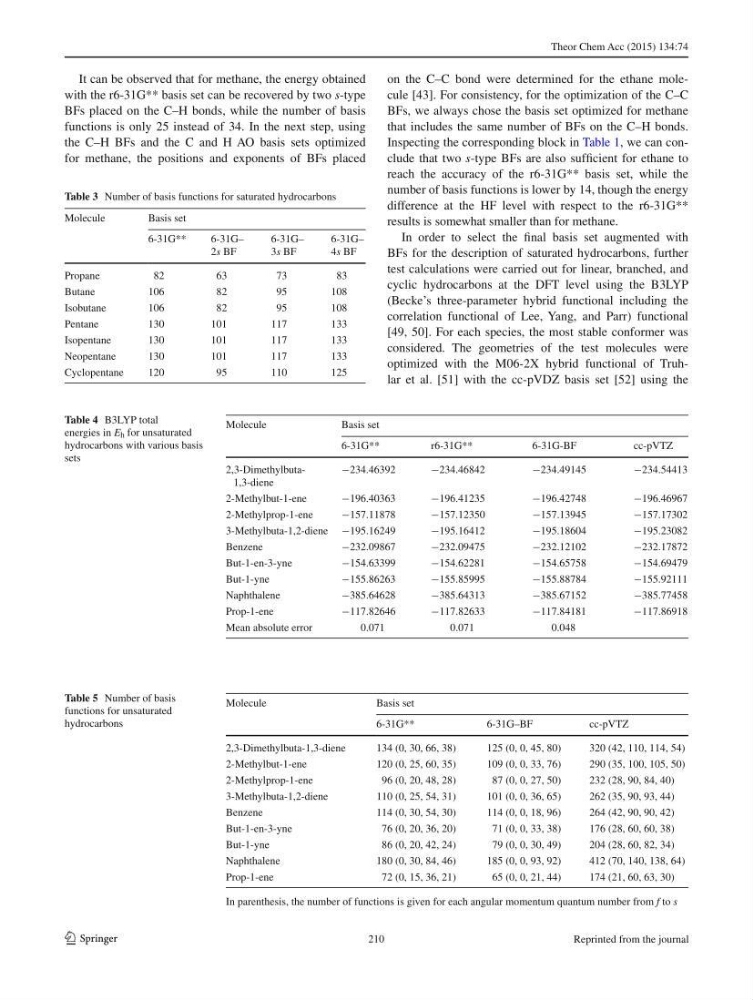
Table 3 Number of basis functions for saturated hydrocarbons
Molecule
Basis set
6-31G**
6-31G–
2 s BF
6-31G–
3 s BF
6-31G–
4 s BF
Propane
82
63
73
83
Butane
106
82
95
108
Isobutane
106
82
95
108
Pentane
130
101
117
133
Isopentane
130
101
117
133
Neopentane
130
101
117
133
Cyclopentane
120
95
110
125
Table 4 B3LYP total
energies in E h for unsaturated
hydrocarbons with various basis
sets
Molecule
Basis set
6-31G**
r6-31G**
6-31G-BF
cc-pVTZ
2,3-Dimethylbuta1,3-diene
−234.46392
−234.46842
−234.49145
−234.54413
2-Methylbut-1-ene
−196.40363
−196.41235
−196.42748
−196.46967
2-Methylprop-1-ene
−157.11878
−157.12350
−157.13945
−157.17302
3-Methylbuta-1,2-diene −195.16249
−195.16412
−195.18604
−195.23082
Benzene
−232.09867
−232.09475
−232.12102
−232.17872
But-1-en-3-yne
−154.63399
−154.62281
−154.65758
−154.69479
But-1-yne
−155.86263
−155.85995
−155.88784
−155.92111
Naphthalene
−385.64628
−385.64313
−385.67152
−385.77458
Prop-1-ene
−117.82646
−117.82633
−117.84181
−117.86918
Mean absolute error
0.071
0.071
0.048
Table 5 Number of basis
functions for unsaturated
hydrocarbons
In parenthesis, the number of functions is given for each angular momentum quantum number from f to s
Molecule
Basis set
6-31G**
6-31G–BF
cc-pVTZ
2,3-Dimethylbuta-1,3-diene
134 (0, 30, 66, 38)
125 (0, 0, 45, 80)
320 (42, 110, 114, 54)
2-Methylbut-1-ene
120 (0, 25, 60, 35)
109 (0, 0, 33, 76)
290 (35, 100, 105, 50)
2-Methylprop-1-ene
96 (0, 20, 48, 28)
87 (0, 0, 27, 50)
232 (28, 90, 84, 40)
3-Methylbuta-1,2-diene
110 (0, 25, 54, 31)
101 (0, 0, 36, 65)
262 (35, 90, 93, 44)
Benzene
114 (0, 30, 54, 30)
114 (0, 0, 18, 96)
264 (42, 90, 90, 42)
But-1-en-3-yne
76 (0, 20, 36, 20)
71 (0, 0, 33, 38)
176 (28, 60, 60, 38)
But-1-yne
86 (0, 20, 42, 24)
79 (0, 0, 30, 49)
204 (28, 60, 82, 34)
Naphthalene
180 (0, 30, 84, 46)
185 (0, 0, 93, 92)
412 (70, 140, 138, 64)
Prop-1-ene
72 (0, 15, 36, 21)
65 (0, 0, 21, 44)
174 (21, 60, 63, 30)
210
Reprinted from the journal
1 3
It can be observed that for methane, the energy obtained
with the r6-31G** basis set can be recovered by two s -type
BFs placed on the C–H bonds, while the number of basis
functions is only 25 instead of 34. In the next step, using
the C–H BFs and the C and H AO basis sets optimized
for methane, the positions and exponents of BFs placed
on the C–C bond were determined for the ethane molecule [ 43 ]. For consistency, for the optimization of the C–C
BFs, we always chose the basis set optimized for methane
that includes the same number of BFs on the C–H bonds.
Inspecting the corresponding block in Table 1 , we can conclude that two s -type BFs are also suffi cient for ethane to
reach the accuracy of the r6-31G** basis set, while the
number of basis functions is lower by 14, though the energy
difference at the HF level with respect to the r6-31G**
results is somewhat smaller than for methane.
In order to select the fi nal basis set augmented with
BFs for the description of saturated hydrocarbons, further
test calculations were carried out for linear, branched, and
cyclic hydrocarbons at the DFT level using the B3LYP
(Becke’s three-parameter hybrid functional including the
correlation functional of Lee, Yang, and Parr) functional
[ 49 , 50 ]. For each species, the most stable conformer was
considered. The geometries of the test molecules were
optimized with the M06-2X hybrid functional of Truhlar et al. [ 51 ] with the cc-pVDZ basis set [ 52 ] using the
Table 3 Number of basis functions for saturated hydrocarbons
Molecule
Basis set
6-31G**
6-31G–
2 s BF
6-31G–
3 s BF
6-31G–
4 s BF
Propane
82
63
73
83
Butane
106
82
95
108
Isobutane
106
82
95
108
Pentane
130
101
117
133
Isopentane
130
101
117
133
Neopentane
130
101
117
133
Cyclopentane
120
95
110
125
Table 4 B3LYP total
energies in E h for unsaturated
hydrocarbons with various basis
sets
Molecule
Basis set
6-31G**
r6-31G**
6-31G-BF
cc-pVTZ
2,3-Dimethylbuta1,3-diene
−234.46392
−234.46842
−234.49145
−234.54413
2-Methylbut-1-ene
−196.40363
−196.41235
−196.42748
−196.46967
2-Methylprop-1-ene
−157.11878
−157.12350
−157.13945
−157.17302
3-Methylbuta-1,2-diene −195.16249
−195.16412
−195.18604
−195.23082
Benzene
−232.09867
−232.09475
−232.12102
−232.17872
But-1-en-3-yne
−154.63399
−154.62281
−154.65758
−154.69479
But-1-yne
−155.86263
−155.85995
−155.88784
−155.92111
Naphthalene
−385.64628
−385.64313
−385.67152
−385.77458
Prop-1-ene
−117.82646
−117.82633
−117.84181
−117.86918
Mean absolute error
0.071
0.071
0.048
Table 5 Number of basis
functions for unsaturated
hydrocarbons
In parenthesis, the number of functions is given for each angular momentum quantum number from f to s
Molecule
Basis set
6-31G**
6-31G–BF
cc-pVTZ
2,3-Dimethylbuta-1,3-diene
134 (0, 30, 66, 38)
125 (0, 0, 45, 80)
320 (42, 110, 114, 54)
2-Methylbut-1-ene
120 (0, 25, 60, 35)
109 (0, 0, 33, 76)
290 (35, 100, 105, 50)
2-Methylprop-1-ene
96 (0, 20, 48, 28)
87 (0, 0, 27, 50)
232 (28, 90, 84, 40)
3-Methylbuta-1,2-diene
110 (0, 25, 54, 31)
101 (0, 0, 36, 65)
262 (35, 90, 93, 44)
Benzene
114 (0, 30, 54, 30)
114 (0, 0, 18, 96)
264 (42, 90, 90, 42)
But-1-en-3-yne
76 (0, 20, 36, 20)
71 (0, 0, 33, 38)
176 (28, 60, 60, 38)
But-1-yne
86 (0, 20, 42, 24)
79 (0, 0, 30, 49)
204 (28, 60, 82, 34)
Naphthalene
180 (0, 30, 84, 46)
185 (0, 0, 93, 92)
412 (70, 140, 138, 64)
Prop-1-ene
72 (0, 15, 36, 21)
65 (0, 0, 21, 44)
174 (21, 60, 63, 30)
210
Reprinted from the journal